QUESTION IMAGE
Question
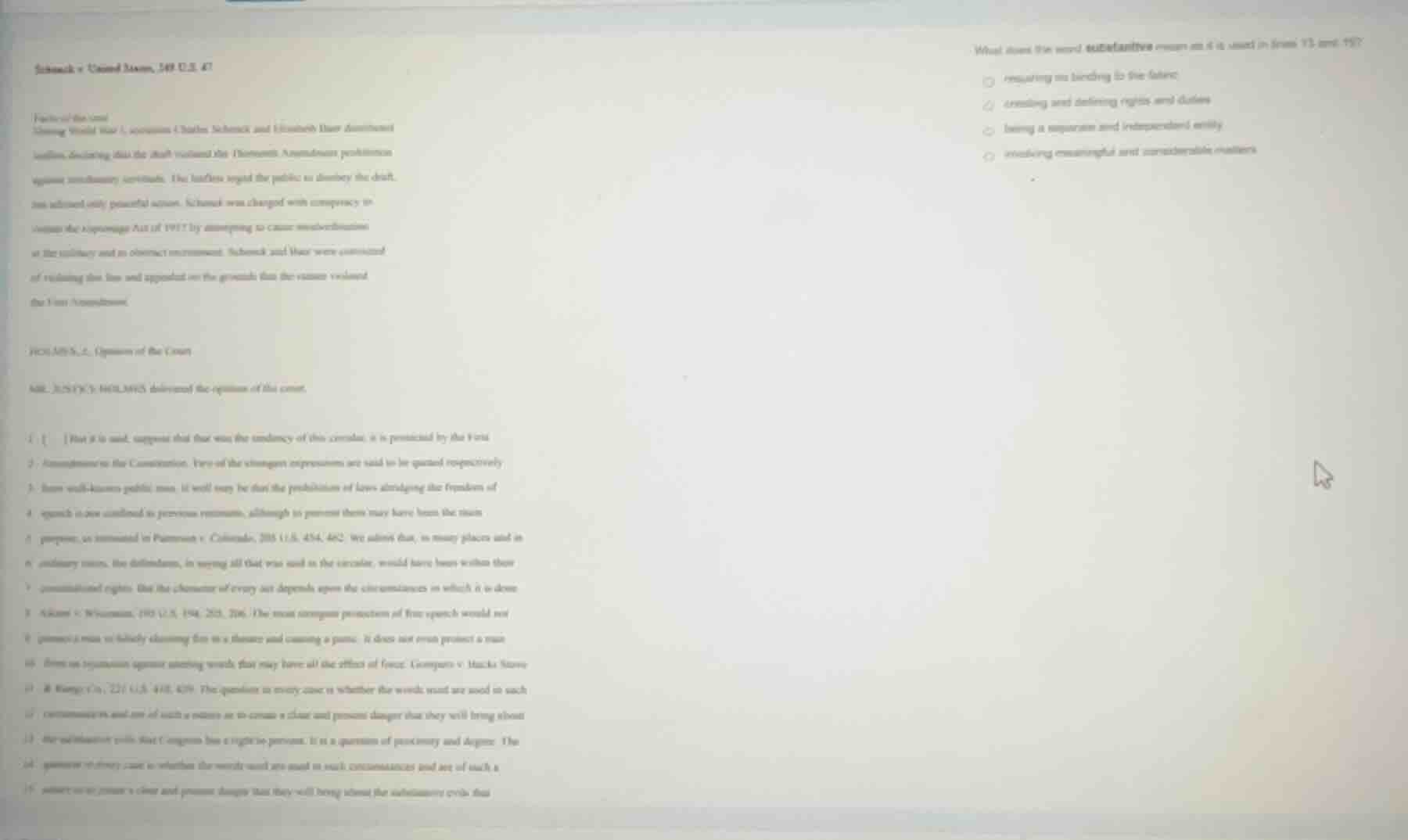
schenck v. united states, 249 u.s. 47 facts of the case during world war i, defendants schenck and baer distributed leaflets declaring that the draft violated the thirteenth amendment prohibition against involuntary servitude. the leaflets urged the public to disobey the draft, but advised only peaceful action. schenck was charged with conspiracy to violate the espionage act of 1917 by attempting to cause insubordination in the military and to obstruct recruitment. schenck and baer were convicted of violating this law and appealed on the grounds that the statute violated the first amendment. holmes, j., (opinion of the court) mr. justice holmes delivered the opinion of the court. 1 . . . not to say, suppose that that was the tendency of this circular, is it protected by the first 2 amendment to the constitution. few of the strongest expressions are said to be quoted respectively 3 from well - known public men. it will very be that the prohibition of laws abridging the freedom of 4 speech is not confined to previous remonstrance, although to prevent there may have been the main 5 purpose, as intimated in patterson v. colorado, 205 u.s. 454, 462; we admit that, in many places and in 6 ordinary times, the defendants, in saying all that was said in the circular, would have been within their 7 constitutional rights. but the character of every act depends upon the circumstances in which it is done. 8 abrams v. united states, 250 u.s. 616, 250, 266. the most stringent protection of free speech would not 9 protect a man in falsely shouting fire in a theatre and causing a panic. it does not even protect a man 10 from an injunction against uttering words that may have all the effect of force. gompers v. bucks stove 11 & range co., 221 u.s. 418, 439. the question in every case is whether the words used are used in such 12 circumstances and are of such a nature as to create a clear and present danger that they will bring about 13 the substantive evils that congress has a right to prevent. it is a question of proximity and degree. the 14 question in every case is whether the words used are used in such circumstances and are of such a 15 nature as to create a clear and present danger that they will bring about the substantive evils that what does the word substantive mean as it is used in lines 13 and 15? ☐ requiring no binding to the facts ☐ creating and defining rights and duties ☐ being a supreme and independent entity ☐ involving meaningful and considerable matters
The term "substantive" in this legal context (from Schenck v. United States, a First Amendment case) refers to significant, tangible harms or outcomes that Congress has the authority to prevent. The question's options align with this meaning of addressing meaningful, consequential matters rather than procedural or minor issues.

Snap & solve any problem in the app
Get step-by-step solutions on Sovi AI
Photo-based solutions with guided steps
Explore more problems and detailed explanations
- involving meaningful and considerable matters