QUESTION IMAGE
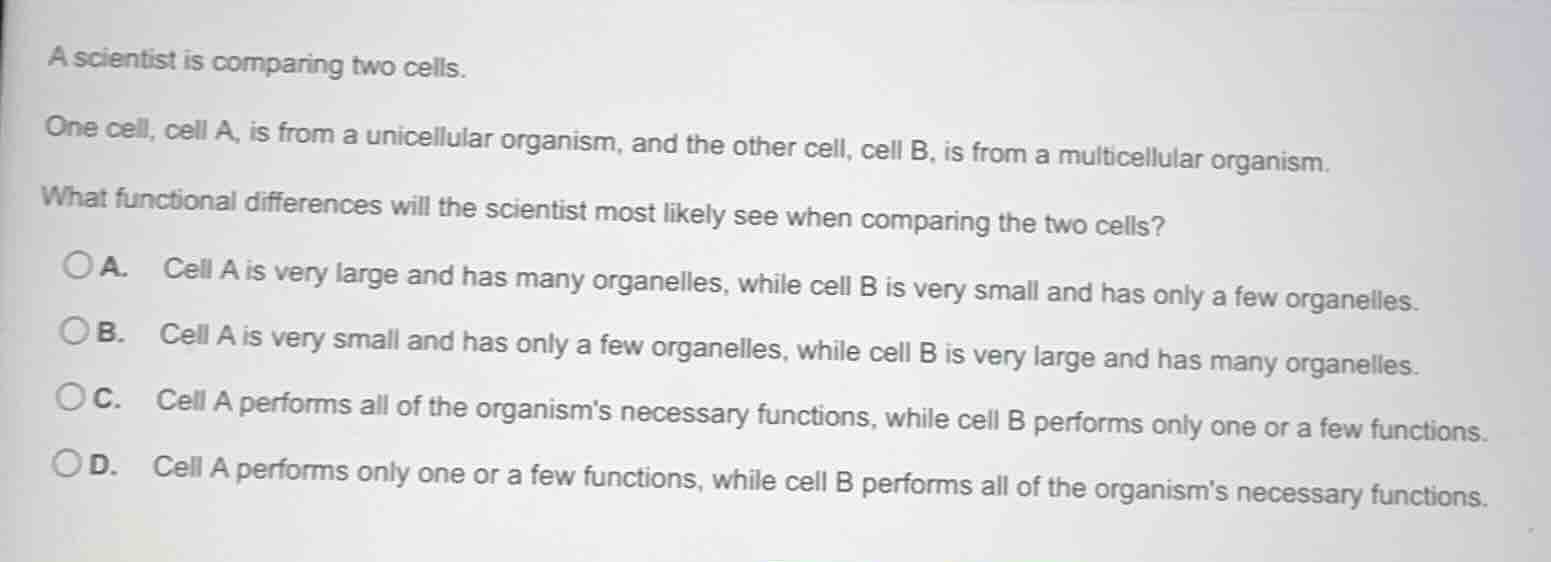
Question
a scientist is comparing two cells.
one cell, cell a, is from a unicellular organism, and the other cell, cell b, is from a multicellular organism.
what functional differences will the scientist most likely see when comparing the two cells?
a. cell a is very large and has many organelles, while cell b is very small and has only a few organelles.
b. cell a is very small and has only a few organelles, while cell b is very large and has many organelles.
c. cell a performs all of the organisms necessary functions, while cell b performs only one or a few functions.
d. cell a performs only one or a few functions, while cell b performs all of the organisms necessary functions.
To solve this, we analyze the functions of cells in unicellular and multicellular organisms:
- Unicellular organisms (like Cell A) have a single cell that must perform all life - sustaining functions (e.g., reproduction, obtaining nutrients, respiration) for the organism.
- Multicellular organisms (like Cell B) have cells that are specialized. Each cell typically performs only one or a few specific functions (e.g., muscle cells contract, nerve cells transmit signals), and different cells work together to support the organism.
- Option A and B are incorrect as the size and number of organelles are not the key functional differences between unicellular and multicellular cells in this context. Unicellular cells can be small or large, and multicellular cells also vary in size and organelle number depending on their specialization.
- Option D is incorrect as it reverses the functional roles. Unicellular cells perform all functions, and multicellular cells are specialized.

Snap & solve any problem in the app
Get step-by-step solutions on Sovi AI
Photo-based solutions with guided steps
Explore more problems and detailed explanations
C. Cell A performs all of the organism's necessary functions, while cell B performs only one or a few functions.