QUESTION IMAGE
Question
be a scientist
plant comparison
identify two plants you are familiar with. describe in a diagram how their external structures are alike and different. present your diagram to classmates.
external structures of a plant
the external structures of plants are probably the ones you are most familiar with—the leaf, stem, roots, and flowers. not unlike the internal structures, the external structures of a plant (like leaves, stems, and roots) have jobs or functions to help them survive, grow, and reproduce.
plants lose water through their leaves. the leaves have a cuticle, or a waxy outer covering. this cuticle helps limit the amount of water a plant loses. plants that live in a desert environment often have thick leaves with a smooth, waxy cuticle. the thick, waxy covering gives the plant extra protection against water loss. the thick leaves help the plant store water. the same process also works for plants. the waxy cuticle prevents unwanted water from entering the plant as well. while water is good for a plant, it is best taken in through the roots of the plant and not taken in through the leaves. the cuticle of a plant completely seals the plant leaf. it must only open its stomata to make sure that air can enter the plant.
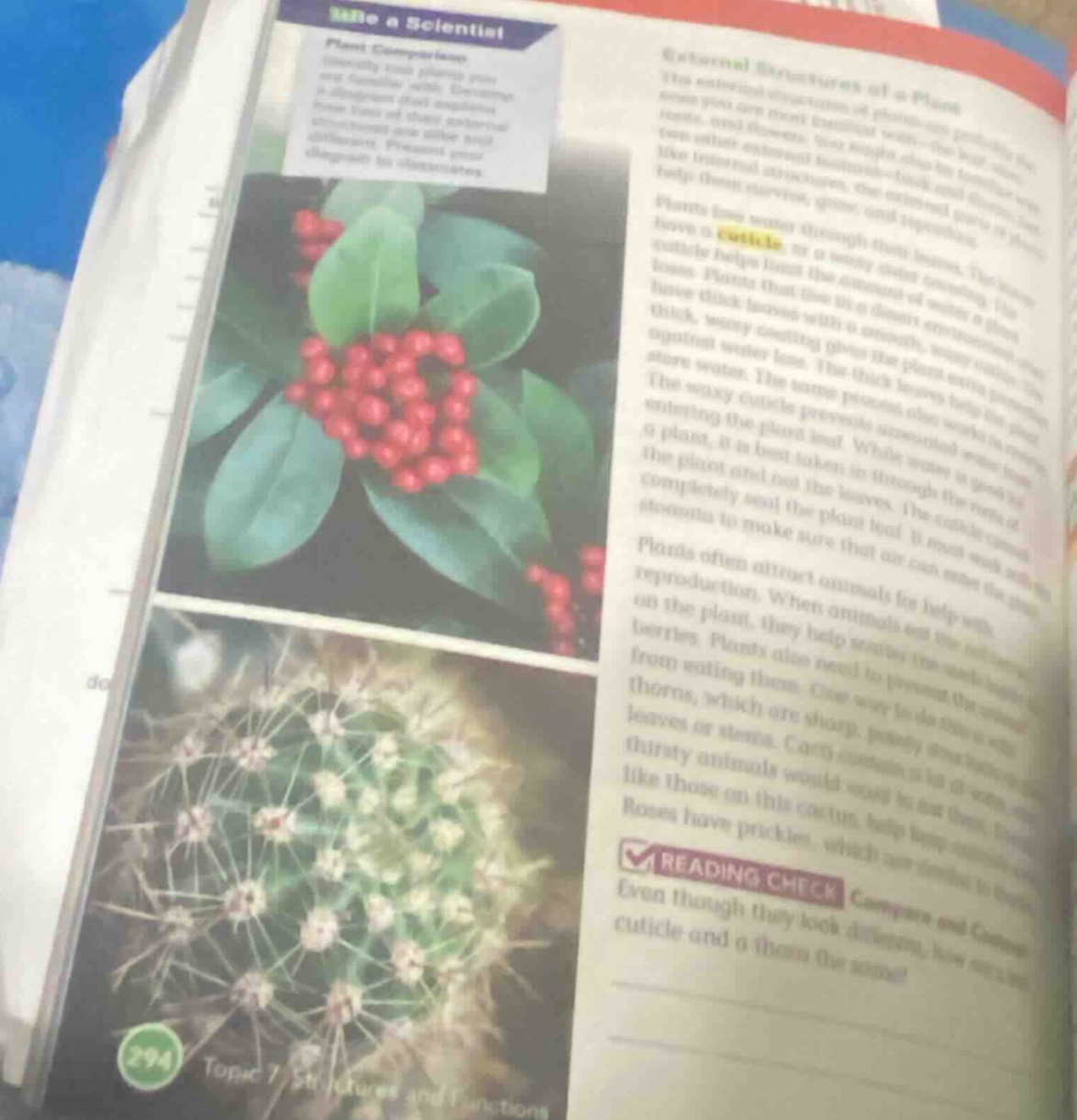
plants often attract animals for help with reproduction. when animals eat the fruit (like berries) on the plant, they help scatter the seeds. plants also need to prevent the animals from eating them. one way to do this is with thorns, which are sharp, pointy structures on leaves or stems. cacti contain a lot of water, so thirsty animals would want to eat them. thorns like those on this cactus help keep animals away. roses have prickles, which are similar to thorns.
reading check compare and contrast
even though they look different, how are a cuticle and a thorn the same?
To answer how a cuticle and a thorn are similar, we analyze their functions. A cuticle (waxy layer on leaves) and a thorn (sharp structure on plants) both serve protective purposes. The cuticle prevents water loss and unwanted substances from entering, while thorns deter animals from eating the plant. Both are adaptations that help the plant survive by protecting it (from water loss/damage or herbivores, respectively).

Snap & solve any problem in the app
Get step-by-step solutions on Sovi AI
Photo-based solutions with guided steps
Explore more problems and detailed explanations
A cuticle and a thorn are similar because both are structural adaptations of plants that serve a protective function. The cuticle (a waxy layer on leaves) protects the plant by reducing water loss and preventing unwanted substances from entering, while a thorn (a sharp structure on stems/leaves) protects the plant by deterring animals from eating it. Both help the plant survive in its environment.