QUESTION IMAGE
Question
3
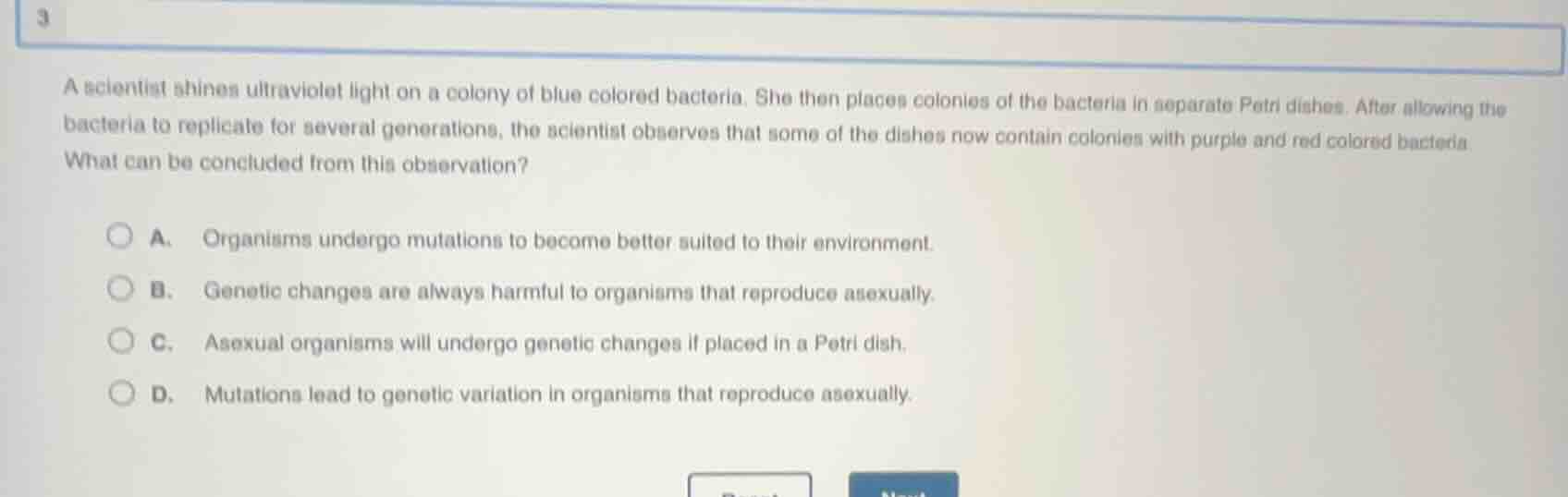
a scientist shines ultraviolet light on a colony of blue colored bacteria. she then places colonies of the bacteria in separate petri dishes. after allowing the bacteria to replicate for several generations, the scientist observes that some of the dishes now contain colonies with purple and red colored bacteria. what can be concluded from this observation?
a. organisms undergo mutations to become better suited to their environment.
b. genetic changes are always harmful to organisms that reproduce asexually.
c. asexual organisms will undergo genetic changes if placed in a petri dish.
d. mutations lead to genetic variation in organisms that reproduce asexually.
- Option A is incorrect: Mutations are random, not intentional to adapt to the environment.
- Option B is incorrect: The color changes here are neutral (not harmful) evidence that genetic changes aren't always harmful.
- Option C is incorrect: The Petri dish is just the growth medium; the UV light, not the dish, caused the genetic change.
- Option D is correct: Bacteria reproduce asexually, and the new colors come from UV-induced mutations, creating genetic variation.

Snap & solve any problem in the app
Get step-by-step solutions on Sovi AI
Photo-based solutions with guided steps
Explore more problems and detailed explanations
D. Mutations lead to genetic variation in organisms that reproduce asexually.