QUESTION IMAGE
Question
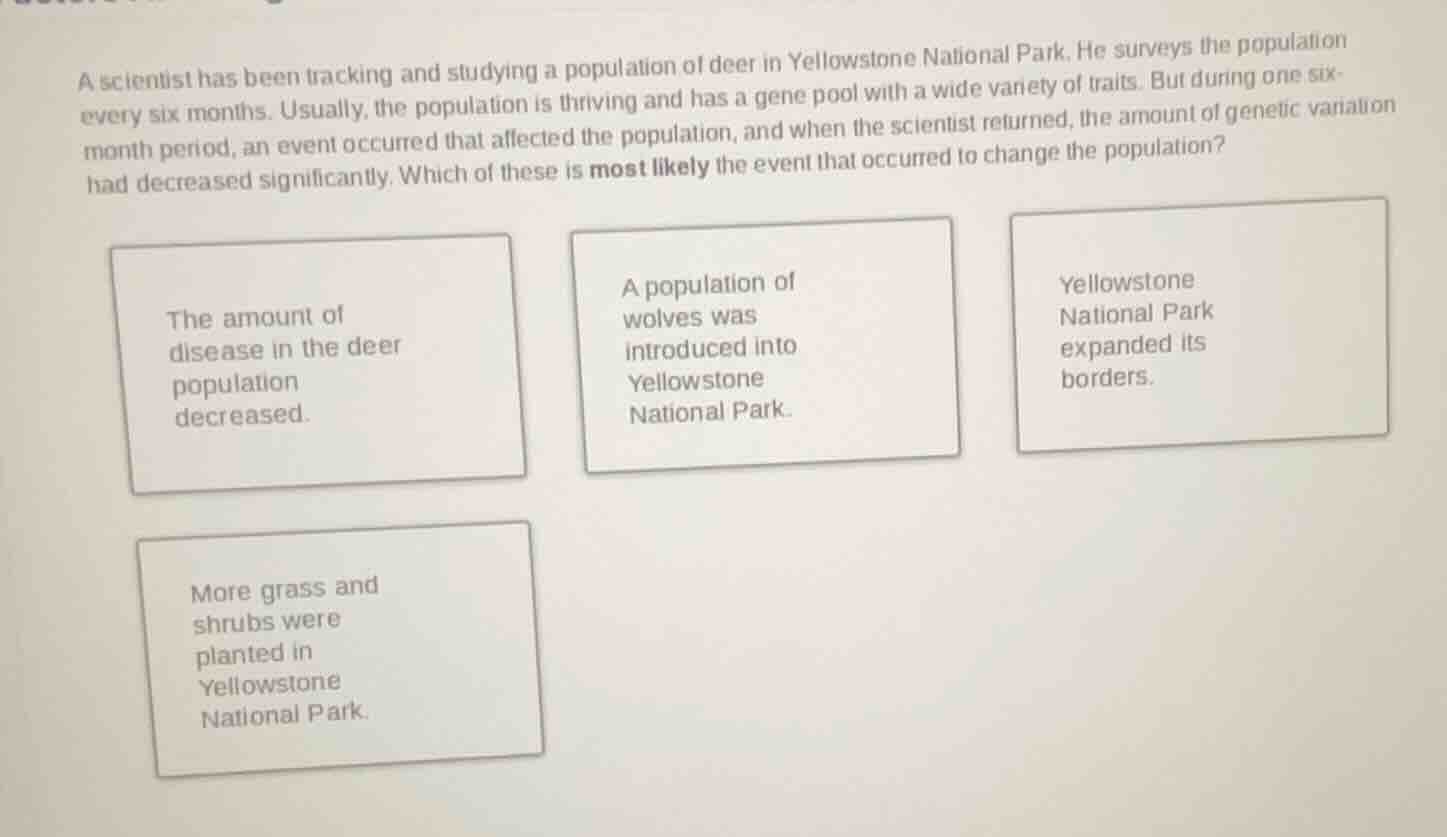
a scientist has been tracking and studying a population of deer in yellowstone national park. he surveys the population every six months. usually, the population is thriving and has a gene pool with a wide variety of traits. but during one six - month period, an event occurred that affected the population, and when the scientist returned, the amount of genetic variation had decreased significantly. which of these is most likely the event that occurred to change the population?
the amount of disease in the deer population decreased.
a population of wolves was introduced into yellowstone national park.
yellowstone national park expanded its borders.
more grass and shrubs were planted in yellowstone national park.
To determine the event that decreased genetic variation in the deer population, we analyze each option:
- "The amount of disease in the deer population decreased": A decrease in disease would likely allow the population to thrive, not reduce genetic variation.
- "A population of wolves was introduced into Yellowstone National Park": Wolves would act as a selective pressure, likely preying on certain deer (e.g., those with traits making them more vulnerable), reducing the gene pool's diversity.
- "Yellowstone National Park expanded its borders": Expanding borders would increase available habitat, likely allowing the deer population to grow or diversify, not reduce genetic variation.
- "More grass and shrubs were planted in Yellowstone National Park": Increased food would support population growth or diversification, not reduce genetic variation.
The introduction of wolves (a predator) is most likely to cause a significant reduction in genetic variation by selectively removing individuals with certain traits.

Snap & solve any problem in the app
Get step-by-step solutions on Sovi AI
Photo-based solutions with guided steps
Explore more problems and detailed explanations
B. A population of wolves was introduced into Yellowstone National Park.