QUESTION IMAGE
Question
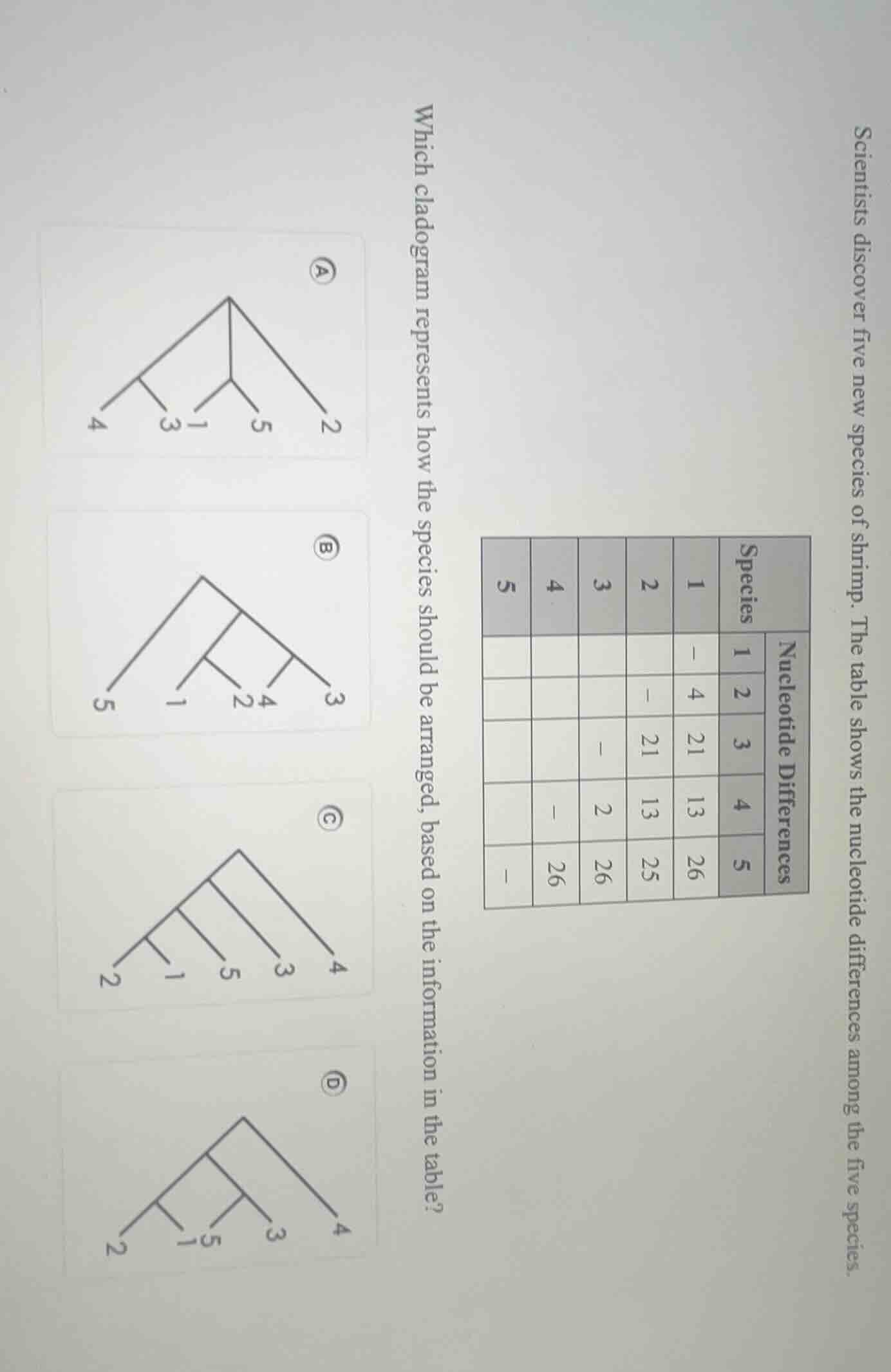
scientists discover five new species of shrimp. the table shows the nucleotide differences among the five species.
| species 1 | species 2 | species 3 | species 4 | species 5 | |
|---|---|---|---|---|---|
| species 2 | 4 | – | 21 | 13 | 25 |
| species 3 | 21 | 21 | – | 2 | 26 |
| species 4 | 13 | 13 | 2 | – | 26 |
| species 5 | 26 | 25 | 26 | 26 | – |
which cladogram represents how the species should be arranged, based on the information in the table?
(a) cladogram with branches: 2, 5, 1, 3, 4 (with 1 and 3 closer, 1/3 and 5, then 4, then 2)
(b) cladogram with branches: 3, 4, 2, 1, 5 (with 3, then 4/2, then 4/2/1, then 5)
(c) cladogram with branches: 4, 3, 5, 1, 2 (with 4, then 3, then 5, then 1, then 2)
(d) cladogram with branches: 4, 3, 5, 1, 2 (with 4, then 3/5, then 3/5/1, then 2)
Step1: Identify closest species pairs
Look for the smallest nucleotide difference values:
- Species 1 & 2: 4 differences
- Species 3 & 4: 2 differences
- Species 1 & 3: 21, 1 & 4:13, 5 has 26 differences with 1,3,4, 25 with 2
Step2: Group closely related species
Pair 1-2 (closest, 4 differences) and pair 3-4 (closest, 2 differences). Species 5 is the most distantly related (highest differences with all others).
Step3: Match to cladogram structure
Check which cladogram has 1+2 as a subgroup, 3+4 as a subgroup, and 5 as an outgroup relative to 1/2, with 4 as the most distant from the 1/2/5 cluster. This matches option D.

Snap & solve any problem in the app
Get step-by-step solutions on Sovi AI
Photo-based solutions with guided steps
Explore more problems and detailed explanations
D. The cladogram with species 4 as the outermost branch, followed by a subgroup of 3, then a subgroup of 5, then a subgroup of 1 and 2.