QUESTION IMAGE
Question
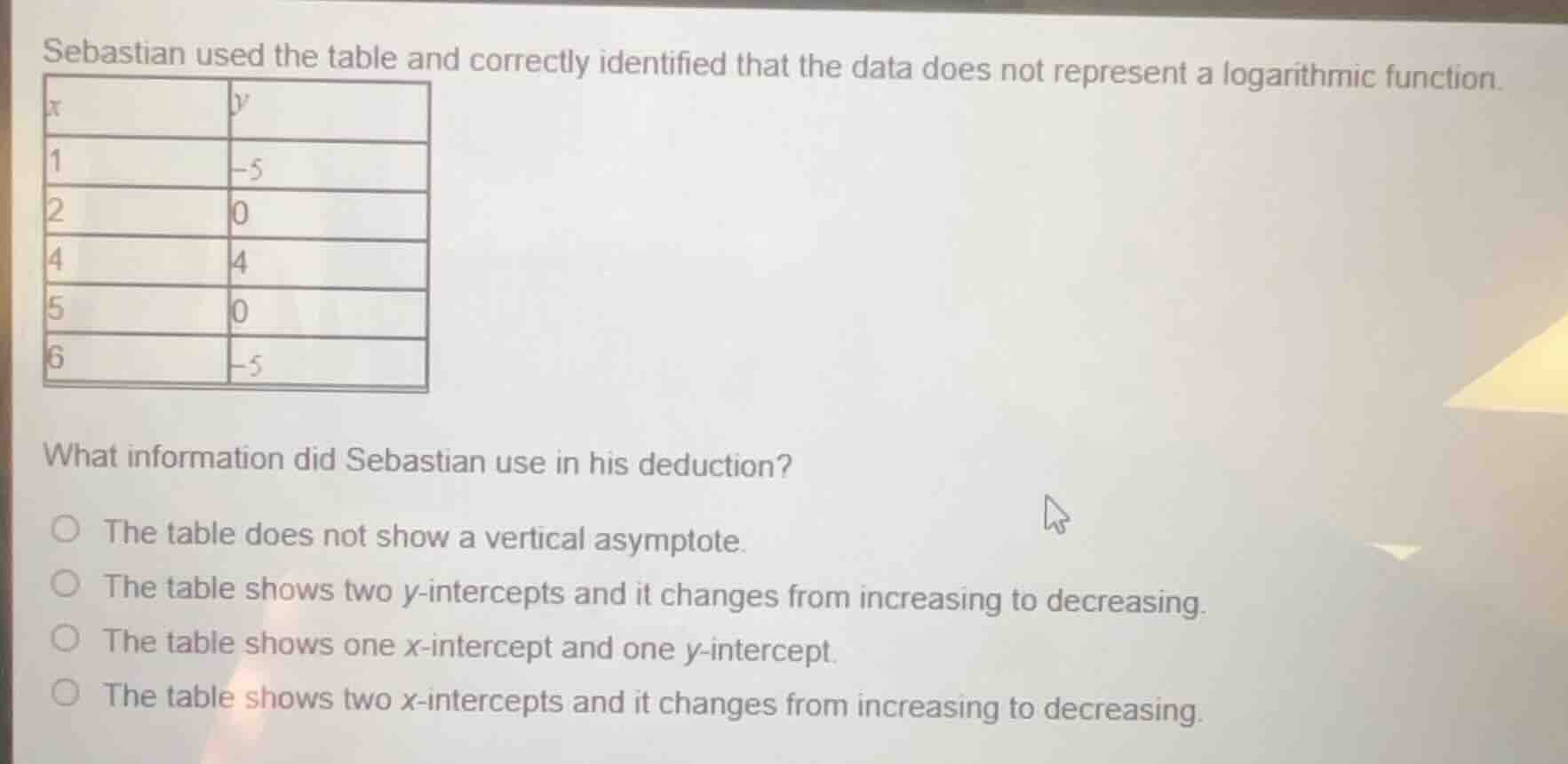
sebastian used the table and correctly identified that the data does not represent a logarithmic function.
| x | y |
|---|---|
| 2 | 0 |
| 4 | 4 |
| 5 | 0 |
| 6 | -5 |
what information did sebastian use in his deduction?
- the table does not show a vertical asymptote.
- the table shows two y-intercepts and it changes from increasing to decreasing.
- the table shows one x-intercept and one y-intercept.
- the table shows two x-intercepts and it changes from increasing to decreasing.
Brief Explanations
- Analyze logarithmic function properties: Logarithmic functions (e.g., \(y = \log_b(x)\)) have one \(x\)-intercept (when \(y = 0\), \(x = 1\) for basic logs), are either always increasing or always decreasing (depending on the base \(b\)), and have a vertical asymptote at \(x = 0\) (for \(y=\log_b(x)\)).
- Analyze the table:
- \(x\)-intercepts: Points where \(y = 0\) are \((2, 0)\) and \((5, 0)\) → two \(x\)-intercepts.
- Monotonicity: From \(x = 1\) to \(x = 4\), \(y\) increases (\(-5 \to 0 \to 4\)); from \(x = 4\) to \(x = 6\), \(y\) decreases (\(4 \to 0 \to -5\)) → changes from increasing to decreasing.
- Logarithmic functions are strictly monotonic (always increasing or always decreasing) and have only one \(x\)-intercept. Thus, the table’s two \(x\)-intercepts and non - monotonic (increasing then decreasing) behavior contradict logarithmic function properties.
- Eliminate other options:
- Vertical asymptote: Logarithmic functions have a vertical asymptote, but the table’s lack of showing it is not the key (the data’s behavior is more critical).
- \(y\)-intercept: Only one \(y\)-intercept (\(x = 1\), \(y=-5\) is not a \(y\)-intercept; \(y\)-intercept is at \(x = 0\), not in the table).
- One \(x\)-intercept: The table has two \(x\)-intercepts.

Snap & solve any problem in the app
Get step-by-step solutions on Sovi AI
Photo-based solutions with guided steps
Explore more problems and detailed explanations
D. The table shows two x - intercepts and it changes from increasing to decreasing.