QUESTION IMAGE
Question
second solution
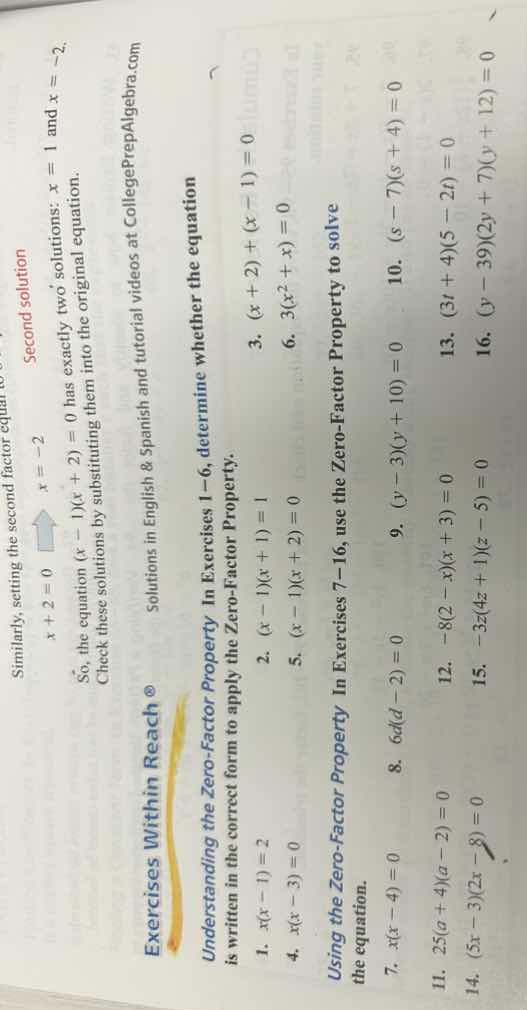
similarly, setting the second factor equal to
$x + 2 = 0 \quad \boldsymbol{\
ightarrow} \quad x = -2$
so, the equation $(x - 1)(x + 2) = 0$ has exactly two solutions: $x = 1$ and $x = -2$.
check these solutions by substituting them into the original equation.
solutions in english & spanish and tutorial videos at collegeprepalgebra.com
exercises within reach®
understanding the zero-factor property in exercises 1–6, determine whether the equation
is written in the correct form to apply the zero-factor property.
- $x(x-1)=2$
- $(x-1)(x+1)=1$
- $(x + 2)+(x - 1)=0$
- $x(x-3)=0$
- $(x-1)(x+2)=0$
- $3(x^{2}+x)=0$
using the zero-factor property in exercises 7–16, use the zero-factor property to solve
the equation.
- $x(x - 4)=0$
- $6d(d - 2)=0$
- $(y - 3)(y + 10)=0$
- $(s - 7)(s + 4)=0$
- $25(a + 4)(a - 2)=0$
- $-8(2 - x)(x + 3)=0$
- $(3t + 4)(5 - 2t)=0$
- $(5x - 3)(2x - 8)=0$
- $-3z(4z + 1)(z - 5)=0$
- $(y - 39)(2y + 7)(y + 12)=0$
Exercises 1-6: Verify Zero-Factor Property
The Zero-Factor Property states that if $ab=0$, then $a=0$ or $b=0$. We check if each equation is set to 0 with factored terms, or rearrange to match this form.
Step1: Analyze each equation
Check if equation matches $ab=0$ form.
---
- $x(x-1)=2$: Not set to 0 → does not apply
- $(x-1)(x+1)=1$: Not set to 0 → does not apply
- $(x+2)+(x-1)=0$: Sum, not product → does not apply
- $x(x-3)=0$: Product = 0 → applies
- $(x-1)(x+2)=0$: Product = 0 → applies
- $3(x^2+x)=0$: Product = 0 → applies
---
Exercises 7-16: Solve via Zero-Factor Property
For each equation $ab=0$, set each factor equal to 0 and solve for the variable.
Step1: Set each factor to 0
Solve for the unknown variable.
---
- $x(x-4)=0$
$x=0$ or $x-4=0$ → $x=0$ or $x=4$
- $6d(d-2)=0$
$6d=0$ or $d-2=0$ → $d=0$ or $d=2$
- $(y-3)(y+10)=0$
$y-3=0$ or $y+10=0$ → $y=3$ or $y=-10$
- $(s-7)(s+4)=0$
$s-7=0$ or $s+4=0$ → $s=7$ or $s=-4$
- $25(a+4)(a-2)=0$
$a+4=0$ or $a-2=0$ → $a=-4$ or $a=2$
- $-8(2-x)(x+3)=0$
$2-x=0$ or $x+3=0$ → $x=2$ or $x=-3$
- $(3t+4)(5-2t)=0$
$3t+4=0$ or $5-2t=0$ → $t=-\frac{4}{3}$ or $t=\frac{5}{2}$
- $(5x-3)(2x-8)=0$
$5x-3=0$ or $2x-8=0$ → $x=\frac{3}{5}$ or $x=4$
- $-3z(4z+1)(z-5)=0$
$-3z=0$ or $4z+1=0$ or $z-5=0$ → $z=0$, $z=-\frac{1}{4}$, or $z=5$
- $(y-39)(2y+7)(y+12)=0$
$y-39=0$ or $2y+7=0$ or $y+12=0$ → $y=39$, $y=-\frac{7}{2}$, or $y=-12$

Snap & solve any problem in the app
Get step-by-step solutions on Sovi AI
Photo-based solutions with guided steps
Explore more problems and detailed explanations
Exercises 1-6
- Does not apply
- Does not apply
- Does not apply
- Applies
- Applies
- Applies
Exercises 7-16
- $x=0$ or $x=4$
- $d=0$ or $d=2$
- $y=3$ or $y=-10$
- $s=7$ or $s=-4$
- $a=-4$ or $a=2$
- $x=2$ or $x=-3$
- $t=-\frac{4}{3}$ or $t=\frac{5}{2}$
- $x=\frac{3}{5}$ or $x=4$
- $z=0$, $z=-\frac{1}{4}$, or $z=5$
- $y=39$, $y=-\frac{7}{2}$, or $y=-12$