QUESTION IMAGE
Question
section 5- proportions in triangles
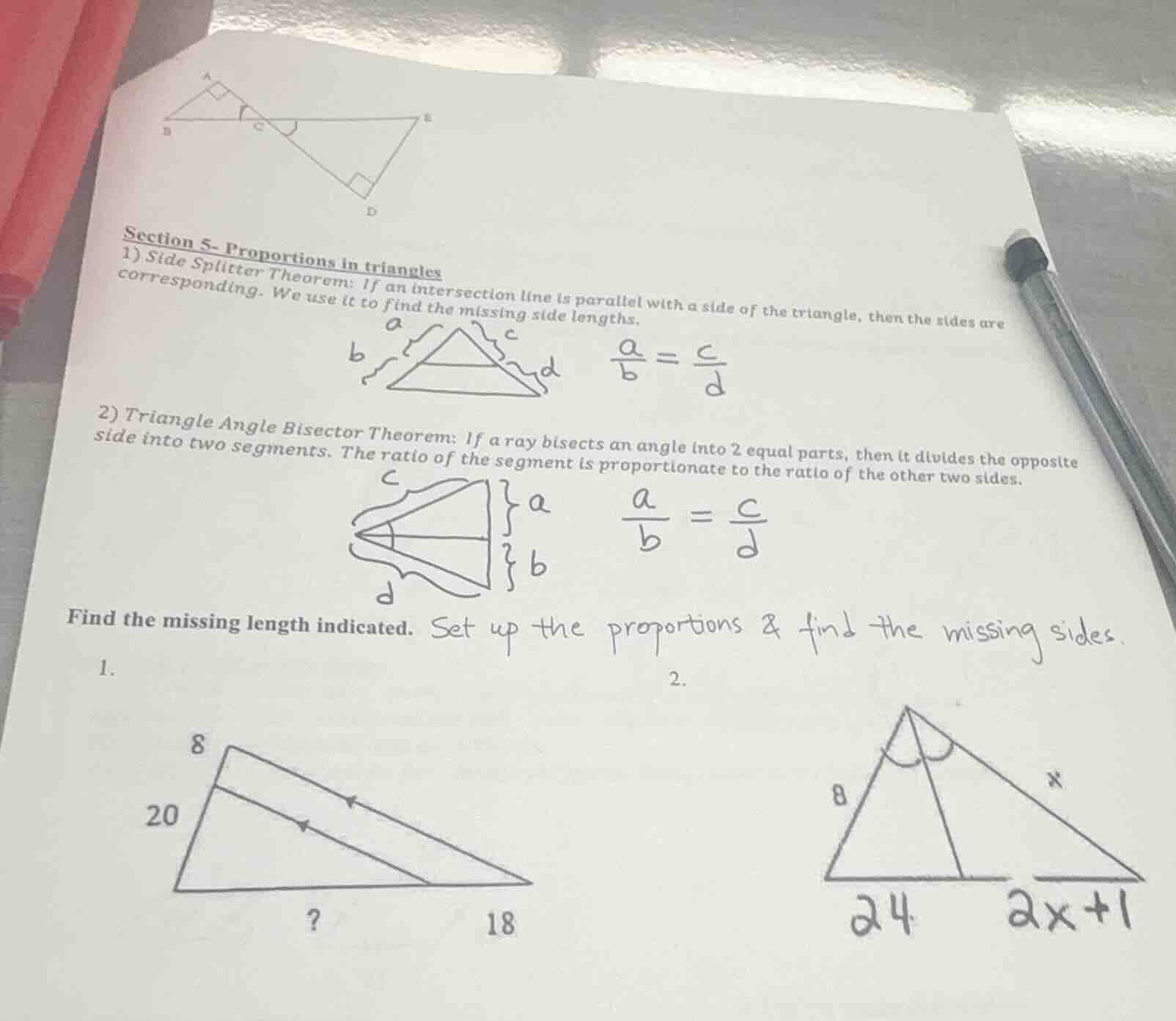
- side splitter theorem: if an intersection line is parallel with a side of the triangle, then the sides are corresponding. we use it to find the missing side lengths.
- triangle angle bisector theorem: if a ray bisects an angle into 2 equal parts, then it divides the opposite side into two segments. the ratio of the segment is proportionate to the ratio of the other two sides.
find the missing length indicated. set up the proportions & find the missing sides.
1.
2.
8
20
?
18
8
x
24
2x + 1
Problem 1:
Step1: Identify the theorem
We use the Side Splitter Theorem. Let the missing length be \( x \). The segments are \( 20 \), \( 8 \), \( x \), and \( 18 \). The ratio of the sides should be equal, so we set up the proportion \(\frac{20}{8}=\frac{x + 18}{18}\)? Wait, no, actually, the two segments of one side are \( 20 \) and \( 8 \) (total \( 28 \))? Wait, no, looking at the diagram, the two parts of the left side are \( 20 \) and \( 8 \), and the two parts of the base are \(? \) and \( 18 \). By Side Splitter Theorem, \(\frac{20}{8}=\frac{? + 18}{18}\)? No, correct proportion: if a line is parallel to the base, then \(\frac{20}{20 + 8}=\frac{?}{? + 18}\)? Wait, no, the Side Splitter Theorem states that if a line is parallel to a side of the triangle, then it divides the other two sides proportionally. So the two sides are split into \( 20 \) and \( 8 \) (one side) and \( y \) (missing) and \( 18 \) (the other side). So the proportion is \(\frac{20}{8}=\frac{y}{18}\)? Wait, no, let's re - examine. The two segments of the left side: the lower part is \( 20 \), the upper part is \( 8 \). The two segments of the base: the lower part is \( y \) (missing), the upper part is \( 18 \). So by Side Splitter Theorem, \(\frac{20}{8}=\frac{y}{18}\)? No, that's not right. Wait, the correct proportion is \(\frac{20}{20 + 8}=\frac{y}{y + 18}\)? No, I think I made a mistake. Let's start over. The Side Splitter Theorem: if a line is parallel to a side of the triangle, then \(\frac{\text{segment1}}{\text{segment2}}=\frac{\text{segment3}}{\text{segment4}}\), where segment1 and segment2 are on one side, segment3 and segment4 are on the other side. So here, the left side is split into \( 20 \) (lower) and \( 8 \) (upper). The base is split into \( x \) (lower, missing) and \( 18 \) (upper). So the proportion is \(\frac{20}{8}=\frac{x}{18}\)? No, that would be if the total length of the left side is \( 20 \) and the upper is \( 8 \), but actually, the two parts of the left side are \( 20 \) (the part below the parallel line) and \( 8 \) (the part above), and the two parts of the base are \( x \) (below) and \( 18 \) (above). So the correct proportion is \(\frac{20}{8}=\frac{x}{18}\)? Wait, no, the formula from the Side Splitter Theorem is \(\frac{a}{b}=\frac{c}{d}\) where \( a \) and \( b \) are the two segments of one side, \( c \) and \( d \) are the two segments of the other side. So if the left side has segments \( 20 \) and \( 8 \), and the base has segments \( x \) and \( 18 \), then \(\frac{20}{8}=\frac{x}{18}\). Wait, solving for \( x \): \( x=\frac{20\times18}{8}=\frac{360}{8} = 45\)? Wait, no, that can't be. Wait, maybe the total length of the left side is \( 20 + 8=28 \), and the total length of the base is \( x + 18 \). Then \(\frac{20}{28}=\frac{x}{x + 18}\). Cross - multiply: \( 20(x + 18)=28x\), \( 20x+360 = 28x\), \( 8x = 360\), \( x = 45 \). Ah, that makes sense. So the missing length (the lower part of the base) is \( 45 \), and the total base length is \( 45+18 = 63 \), but the question is about the missing length indicated (the \(? \) which is the lower part of the base).
Step2: Set up the proportion
Using the Side Splitter Theorem, if the line is parallel to the base, then \(\frac{20}{20 + 8}=\frac{?}{? + 18}\). Let \(? = x \). So \(\frac{20}{28}=\frac{x}{x + 18}\).
Step3: Cross - multiply and solve
Cross - multiply: \( 20(x + 18)=28x \)
Expand: \( 20x+360 = 28x \)
Subtract \( 20x \) from both sides: \( 360 = 8x \)
Divide both sides by \( 8 \): \( x=\frac{360}{8}=45 \)
Step1: Identify the theorem
We use the Triangle Angle Bisector Theorem. The theorem states that if a ray bisects an angle of a triangle, then it divides the opposite side into segments proportional to the adjacent sides. So we have \(\frac{8}{x}=\frac{24}{2x + 1}\)
Step2: Cross - multiply
Cross - multiply the proportion \(\frac{8}{x}=\frac{24}{2x + 1}\) to get \( 8(2x + 1)=24x \)
Step3: Expand and solve
Expand the left - hand side: \( 16x+8 = 24x \)
Subtract \( 16x \) from both sides: \( 8 = 8x \)
Divide both sides by \( 8 \): \( x = 1 \)

Snap & solve any problem in the app
Get step-by-step solutions on Sovi AI
Photo-based solutions with guided steps
Explore more problems and detailed explanations
The missing length is \( 45 \)