QUESTION IMAGE
Question
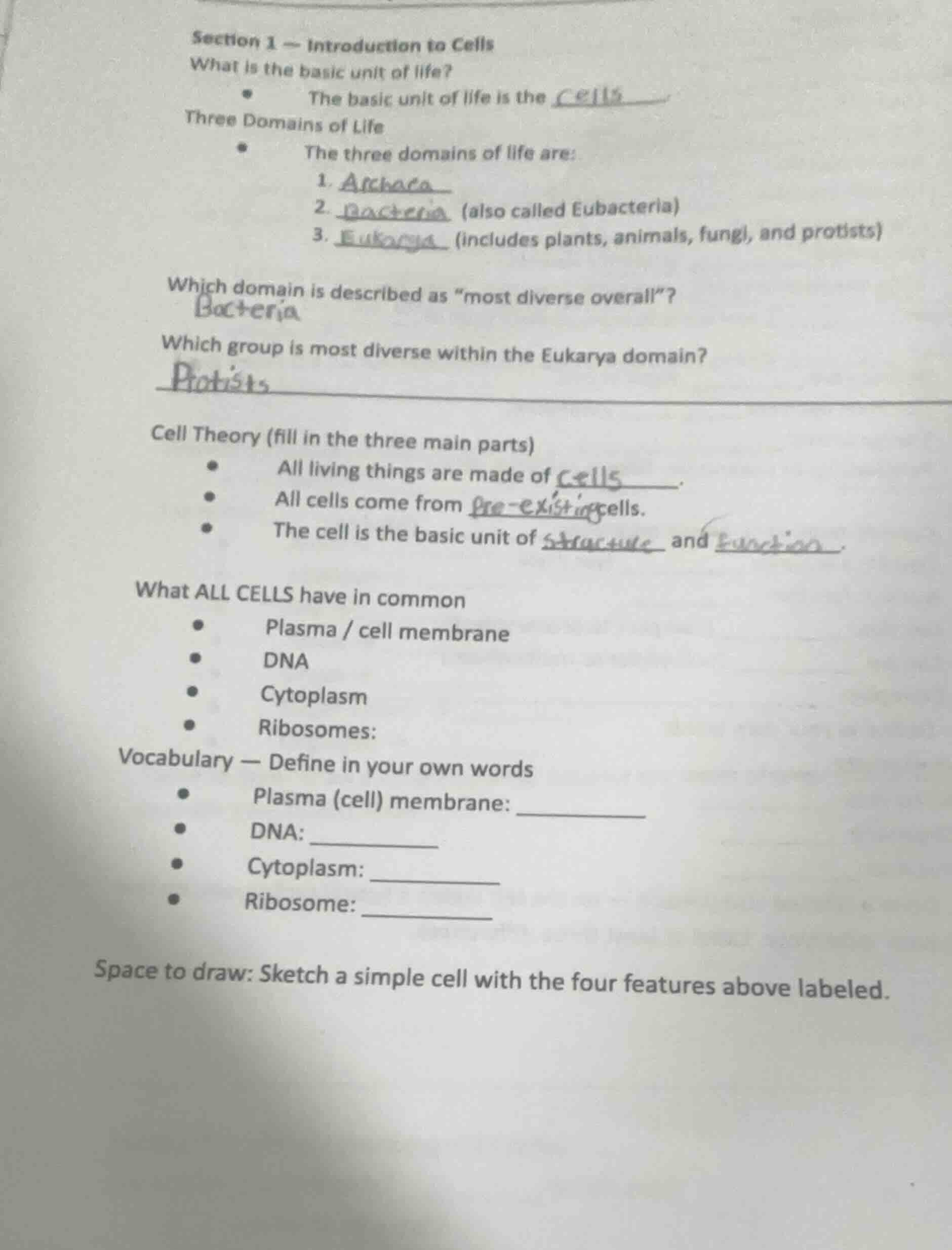
section 1 — introduction to cells
what is the basic unit of life?
- the basic unit of life is the ______.
three domains of life
- the three domains of life are:
- ______
- ______ (also called eubacteria)
- ______ (includes plants, animals, fungi, and protists)
which domain is described as \most diverse overall\?
______
which group is most diverse within the eukarya domain?
______
cell theory (fill in the three main parts)
- all living things are made of ______.
- all cells come from ______ cells.
- the cell is the basic unit of ____ and ____.
what all cells have in common
- plasma / cell membrane
- dna
- cytoplasm
- ribosomes:
vocabulary — define in your own words
- plasma (cell) membrane: ______
- dna: ______
- cytoplasm: ______
- ribosome: ______
space to draw: sketch a simple cell with the four features above labeled.
Brief Explanations
- Vocabulary Definitions:
- Plasma (cell) membrane: A thin, flexible barrier that surrounds the cell, controlling what substances enter and exit.
- DNA: The genetic material that stores instructions for cell growth, function, and reproduction.
- Cytoplasm: The gel-like fluid inside the cell that fills the space between the cell membrane and nucleus (in eukaryotes), holding organelles and supporting cell structures.
- Ribosome: A small cellular structure that builds proteins by reading instructions from DNA.
- Sketch Guidance: Draw a simple circle to represent the cell. Label the outer edge as "Plasma (cell) membrane". Draw a small, irregular shape inside the circle and label it "DNA". Shade the space inside the circle (around the DNA) and label it "Cytoplasm". Add several small dots scattered in the cytoplasm and label them "Ribosomes".

Snap & solve any problem in the app
Get step-by-step solutions on Sovi AI
Photo-based solutions with guided steps
Explore more problems and detailed explanations
- Plasma (cell) membrane: A flexible barrier controlling cell substance flow.
- DNA: Genetic material with cell function instructions.
- Cytoplasm: Gel-like fluid inside the cell, holding structures.
- Ribosome: Small structure that synthesizes proteins.
- Sketch: A circular cell with labeled plasma membrane, DNA, cytoplasm, and ribosomes (as described above).