QUESTION IMAGE
Question
3
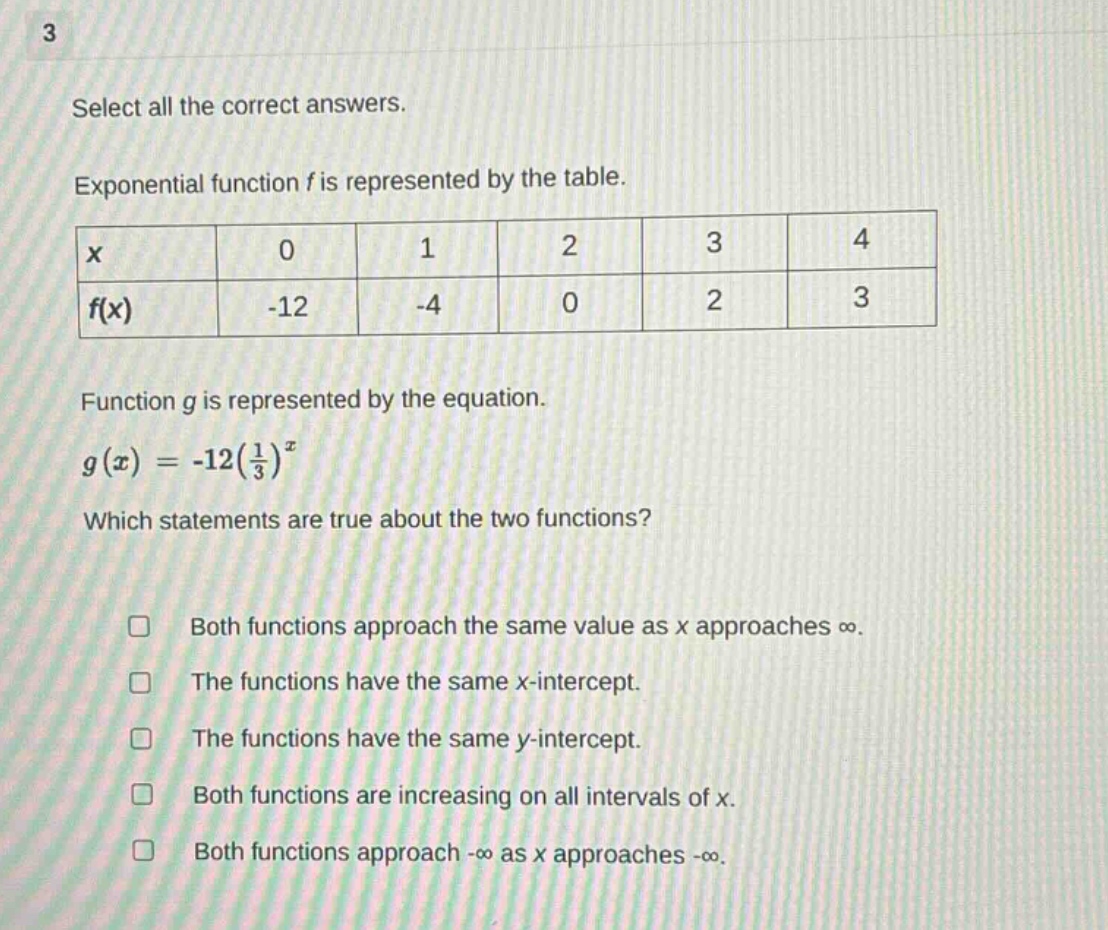
select all the correct answers.
exponential function f is represented by the table.
| x | 0 | 1 | 2 | 3 | 4 |
| f(x) | -12 | -4 | 0 | 2 | 3 |
function g is represented by the equation.
$g(x) = -12\left(\frac{1}{3}\
ight)^x$
which statements are true about the two functions?
- both functions approach the same value as x approaches $\infty$.
- the functions have the same x-intercept.
- the functions have the same y-intercept.
- both functions are increasing on all intervals of x.
- both functions approach $-\infty$ as x approaches $-\infty$.
Step 1: Analyze the y - intercept
For a function \(y = h(x)\), the y - intercept is the value of \(h(0)\).
- For function \(f\): From the table, when \(x = 0\), \(f(0)=- 12\).
- For function \(g\): Substitute \(x = 0\) into \(g(x)=-12(\frac{1}{3})^{x}\). We know that any non - zero number to the power of \(0\) is \(1\), so \(g(0)=-12\times(\frac{1}{3})^{0}=-12\times1 = - 12\). So the functions have the same y - intercept.
Step 2: Analyze the x - intercept
The x - intercept is the value of \(x\) when \(h(x) = 0\).
- For function \(f\): From the table, when \(f(x)=0\), \(x = 2\).
- For function \(g\): Set \(g(x)=0\), then \(-12(\frac{1}{3})^{x}=0\). But \((\frac{1}{3})^{x}>0\) for all real \(x\), and \(- 12
eq0\), so \(-12(\frac{1}{3})^{x}
eq0\) for all real \(x\). So the functions do not have the same x - intercept.
Step 3: Analyze the end - behavior as \(x
ightarrow\infty\)
- For function \(f\): From the table, as \(x\) increases (\(x = 0,1,2,3,4\)), \(f(x)\) values are \(-12,-4,0,2,3\). It seems that as \(x
ightarrow\infty\), \(f(x)\) is increasing and will go to \(\infty\) (since the differences between consecutive \(f(x)\) values: \(-4-(-12) = 8\), \(0 - (-4)=4\), \(2 - 0 = 2\), \(3 - 2=1\), but the overall trend is increasing).
- For function \(g\): The function \(g(x)=-12(\frac{1}{3})^{x}\) is an exponential function with base \(b=\frac{1}{3}\) (where \(0 < b<1\)) and a negative coefficient. As \(x
ightarrow\infty\), \((\frac{1}{3})^{x}
ightarrow0\) (because for \(0 < b<1\), \(b^{x}\) approaches \(0\) as \(x
ightarrow\infty\)), so \(g(x)=-12\times(\frac{1}{3})^{x}
ightarrow0\) as \(x
ightarrow\infty\). So the functions do not approach the same value as \(x
ightarrow\infty\).
Step 4: Analyze the increasing/decreasing behavior
- For function \(f\): From the table, as \(x\) increases from \(0\) to \(1\) to \(2\) to \(3\) to \(4\), \(f(x)\) increases from \(-12\) to \(-4\) to \(0\) to \(2\) to \(3\). So \(f(x)\) is increasing on the interval \([0,4]\) (and seems to be increasing for all \(x\) in its domain).
- For function \(g\): The function \(g(x)=-12(\frac{1}{3})^{x}\). We can rewrite it as \(g(x)=-12\times3^{-x}\). The derivative of \(g(x)\) with respect to \(x\) (using the chain rule) is \(g^\prime(x)=-12\times\ln(3^{-1})\times(- 3^{-x})=-12\times(-\ln3)\times3^{-x}=12\ln3\times3^{-x}\). Since \(\ln3>0\) and \(3^{-x}>0\) for all real \(x\), \(g^\prime(x)>0\) for all real \(x\). So \(g(x)\) is increasing for all \(x\). Wait, but let's check with values. When \(x = 0\), \(g(0)=-12\); when \(x = 1\), \(g(1)=-12\times\frac{1}{3}=-4\); when \(x = 2\), \(g(2)=-12\times\frac{1}{9}=-\frac{4}{3}\approx - 1.33\); when \(x = 3\), \(g(3)=-12\times\frac{1}{27}=-\frac{4}{9}\approx - 0.44\). As \(x\) increases, \(g(x)\) is increasing (from \(-12\) to \(-4\) to \(-\frac{4}{3}\) to \(-\frac{4}{9}\) etc.). Wait, but earlier when we thought about the end - behavior as \(x
ightarrow\infty\), \(g(x)\) approaches \(0\) from the negative side and is increasing. And \(f(x)\) is also increasing. But wait, let's re - check the end - behavior for \(f(x)\). If we assume the function \(f\) is exponential (the problem says it's an exponential function), the general form of an exponential function is \(f(x)=a\times b^{x}+c\) (if it's a non - standard exponential, but the table values: from \(x = 0\) to \(x = 1\), \(f(1)-f(0)=8\); \(x = 1\) to \(x = 2\), \(f(2)-f(1)=4\); \(x = 2\) to \(x = 3\), \(f(3)-f(2)=2\); \(x = 3\) to \(x = 4\), \(f(4)-f(3)=1\). The differences are halving each time, which is a characteristic of a function of the form \…

Snap & solve any problem in the app
Get step-by-step solutions on Sovi AI
Photo-based solutions with guided steps
Explore more problems and detailed explanations
The correct statements are:
- The functions have the same y - intercept.
- Both functions are increasing on all intervals of \(x\).
- Both functions approach \(-\infty\) as \(x\) approaches \(-\infty\).
So the correct options (checking the boxes) are:
- The functions have the same y - intercept.
- Both functions are increasing on all intervals of \(x\).
- Both functions approach \(-\infty\) as \(x\) approaches \(-\infty\).