QUESTION IMAGE
Question
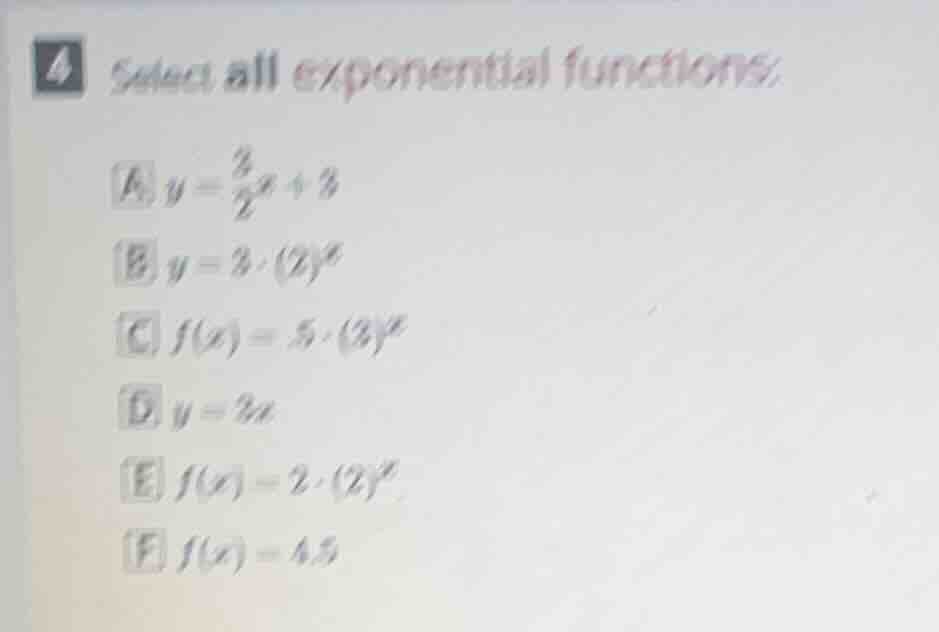
4 select all exponential functions:
a ( y = \frac{3}{2^x} + 3 )
b ( y = 3 cdot (2)^x )
c ( f(x) = .5 cdot (3)^x )
d ( y = 3x )
e ( f(x) = 2 cdot (2)^x )
f ( f(x) = 4.5 )
Step1: Recall exponential function form
An exponential function has the form $y = a \cdot b^x$ where $a
eq 0$, $b>0$, $b
eq 1$, and $x$ is the exponent.
Step2: Analyze each option
- A: $y=\frac{3}{2^x}+3 = 3 \cdot 2^{-x} + 3$: This has an extra constant term, so it is a transformation of an exponential function but not a pure exponential function in the standard form.
- B: $y=3 \cdot (2)^x$: Matches $y=a \cdot b^x$ with $a=3$, $b=2$.
- C: $f(x)=.5 \cdot (3)^x$: Matches $y=a \cdot b^x$ with $a=0.5$, $b=3$.
- D: $y=3x$: This is a linear function, not exponential.
- E: $f(x)=2 \cdot (2)^x$: Matches $y=a \cdot b^x$ with $a=2$, $b=2$.
- F: $f(x)=4.5$: This is a constant function, not exponential.

Snap & solve any problem in the app
Get step-by-step solutions on Sovi AI
Photo-based solutions with guided steps
Explore more problems and detailed explanations
B. $y=3 \cdot (2)^x$, C. $f(x)=.5 \cdot (3)^x$, E. $f(x)=2 \cdot (2)^x$