QUESTION IMAGE
Question
select all the trapezoids.
To determine trapezoids, recall the definition: a quadrilateral with at least one pair of parallel sides (in some definitions, exactly one pair). Let's analyze each figure:
Step 1: Analyze the blue figure
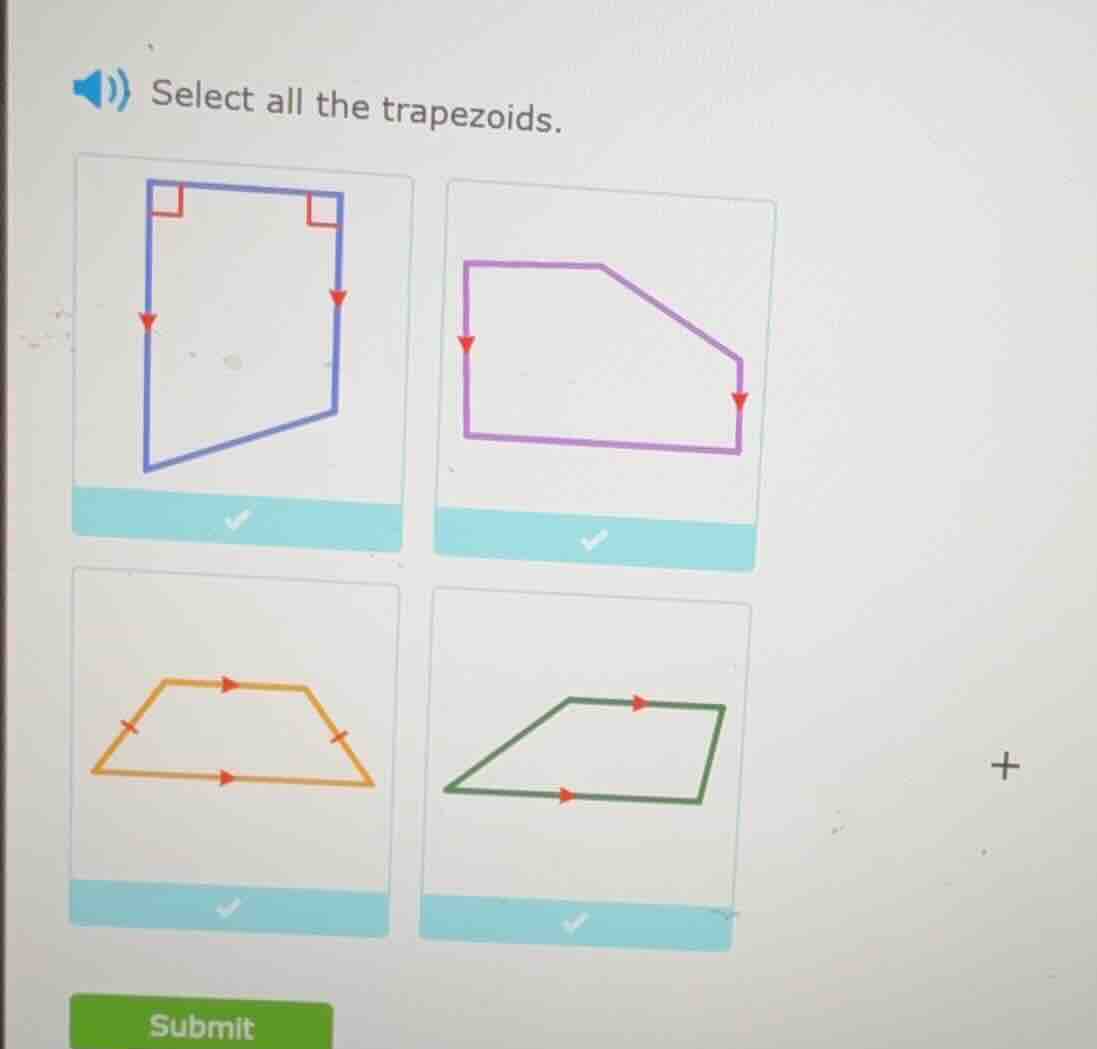
It has two right angles and two sides with arrows (indicating parallelism). So, it has one pair of parallel sides (the vertical sides with arrows) → trapezoid.
Step 2: Analyze the purple figure
It has one pair of vertical sides with arrows (parallel) and a slanted side. Wait, no—wait, the purple figure: let's check sides. Wait, actually, the purple figure has a non - parallel side? Wait, no, re - evaluating: the blue figure (first) has two parallel sides (vertical, arrows), purple: does it have a pair? Wait, maybe my initial thought was wrong. Wait, no—wait, the orange figure (third) is an isosceles trapezoid (two parallel sides, the top and bottom, arrows), and the green figure (fourth) has two parallel sides (the top and bottom, arrows). Wait, the purple figure: let's check the sides. The purple figure has a right angle on the left, a slanted top, and a vertical right side? Wait, no, maybe the original selection is correct? Wait, no—wait, the definition of a trapezoid (in the inclusive definition: at least one pair of parallel sides).
Wait, the first figure (blue): two vertical sides (arrows) are parallel → trapezoid.
Second figure (purple): does it have a pair of parallel sides? The left side and the right side? The left is vertical, right is vertical? Wait, no, the purple figure's left side is vertical, right side is vertical? Wait, no, the purple figure: top is slanted, bottom is horizontal, left is vertical, right is vertical? Wait, no, the purple figure's left side is vertical, right side is vertical (arrows on left and right? Wait, the arrows: first figure has arrows on left and right (vertical), second has arrow on left (vertical) and right (vertical)? Wait, no, the second figure's left side has an arrow, right side has an arrow. So left and right sides are parallel (both vertical) → trapezoid.
Third figure (orange): top and bottom sides (arrows) are parallel → trapezoid (isosceles trapezoid).
Fourth figure (green): top and bottom sides (arrows) are parallel → trapezoid.
Wait, but maybe the purple figure was misjudged. Wait, no—if the arrows indicate parallel sides, then:
- Blue: left and right (vertical) parallel → trapezoid.
- Purple: left and right (vertical) parallel → trapezoid.
- Orange: top and bottom (horizontal) parallel → trapezoid.
- Green: top and bottom (horizontal) parallel → trapezoid.
But maybe the purple figure is not a trapezoid? Wait, no—let's re - check. A trapezoid is a quadrilateral with at least one pair of parallel sides. So if a quadrilateral has one pair, it's a trapezoid.
So all four figures have at least one pair of parallel sides (indicated by arrows or the shape):
- Blue: two vertical parallel sides.
- Purple: two vertical parallel sides (left and right).
- Orange: top and bottom parallel.
- Green: top and bottom parallel.

Snap & solve any problem in the app
Get step-by-step solutions on Sovi AI
Photo-based solutions with guided steps
Explore more problems and detailed explanations
All four figures (the blue - bordered, purple - bordered, orange - bordered, and green - bordered quadrilaterals) are trapezoids as each has at least one pair of parallel sides.