QUESTION IMAGE
Question
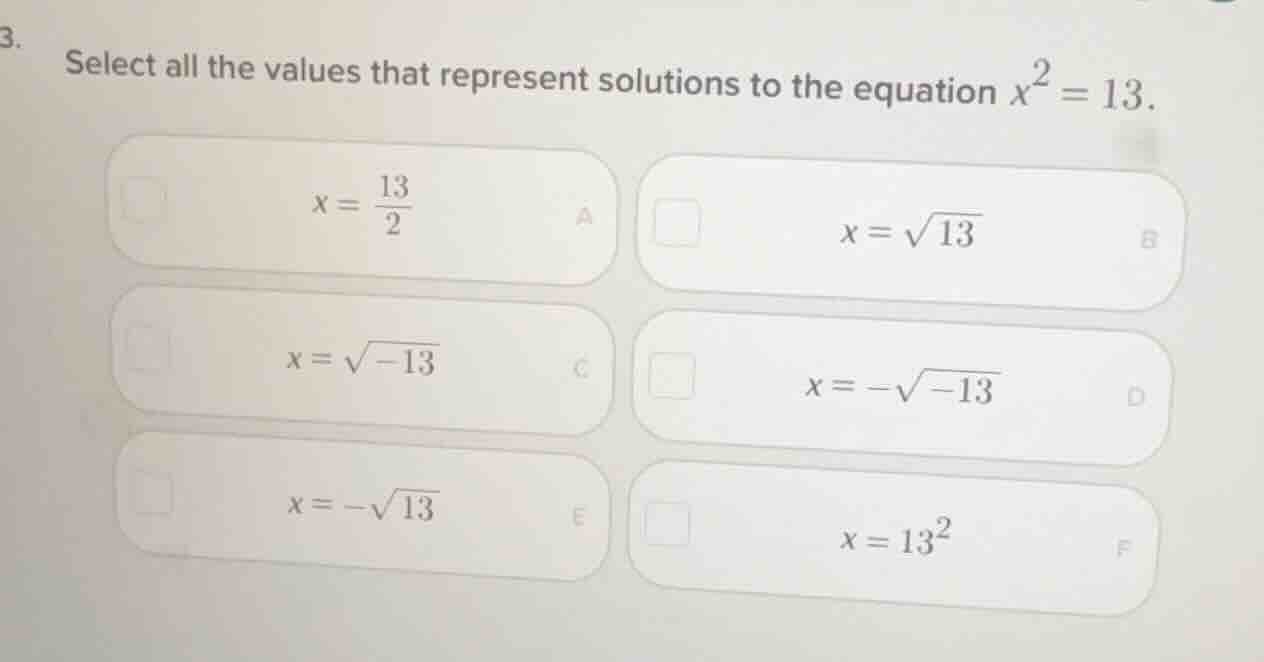
- select all the values that represent solutions to the equation $x^2 = 13$.
$x = \frac{13}{2}$ (a) $x = \sqrt{13}$ (b)
$x = \sqrt{-13}$ (c) $x = -\sqrt{-13}$ (d)
$x = -\sqrt{13}$ (e) $x = 13^2$ (f)
Step1: Solve the equation \(x^2 = 13\)
To solve for \(x\), we take the square root of both sides. Remember that when we take the square root of a number, we get both a positive and a negative root. So, \(x=\pm\sqrt{13}\), which means \(x = \sqrt{13}\) or \(x=-\sqrt{13}\).
Step2: Analyze each option
- Option A: \(x = \frac{13}{2}\). Squaring this gives \((\frac{13}{2})^2=\frac{169}{4}
eq13\), so it's not a solution.
- Option B: \(x = \sqrt{13}\). Squaring \(\sqrt{13}\) gives \((\sqrt{13})^2 = 13\), so it is a solution.
- Option C: \(x=\sqrt{- 13}\). The square root of a negative number is not a real number, and our original equation \(x^2 = 13\) (where 13 is positive) has real solutions, so this is not a solution.
- Option D: \(x = -\sqrt{-13}\). Again, this involves the square root of a negative number, so it's not a real solution for our equation.
- Option E: \(x=-\sqrt{13}\). Squaring \(-\sqrt{13}\) gives \((-\sqrt{13})^2=(- 1)^2\times(\sqrt{13})^2 = 13\), so it is a solution.
- Option F: \(x = 13^2=169\). Squaring 169 gives \(169^2
eq13\), so it's not a solution.

Snap & solve any problem in the app
Get step-by-step solutions on Sovi AI
Photo-based solutions with guided steps
Explore more problems and detailed explanations
B. \(x = \sqrt{13}\), E. \(x=-\sqrt{13}\)