QUESTION IMAGE
Question
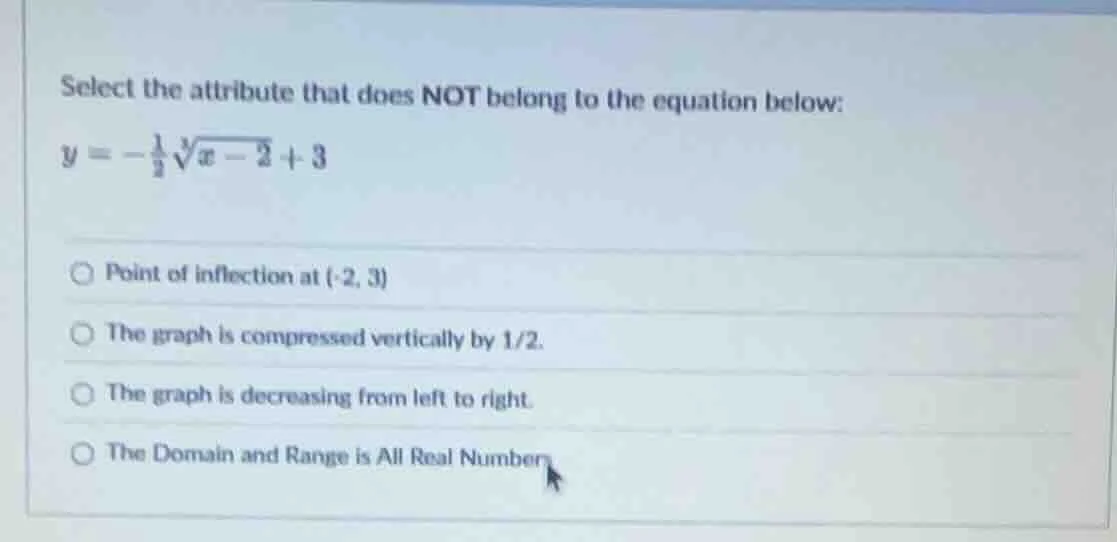
select the attribute that does not belong to the equation below:
$y = -\frac{1}{2}\sqrt3{x - 2} + 3$
point of inflection at (-2, 3)
the graph is compressed vertically by 1/2.
the graph is decreasing from left to right.
the domain and range is all real numbers
Step1: Analyze vertical compression
The coefficient $-\frac{1}{2}$ means vertical compression by $\frac{1}{2}$ (negative sign is reflection). This attribute is valid.
Step2: Check increasing/decreasing behavior
The derivative of $y = -\frac{1}{2}(x-2)^{\frac{1}{3}} + 3$ is $y' = -\frac{1}{6}(x-2)^{-\frac{2}{3}} = -\frac{1}{6\sqrt[3]{(x-2)^2}}$. Since $y' < 0$ for all $x
eq 2$, the graph is decreasing. This attribute is valid.
Step3: Verify domain and range
For $\sqrt[3]{x-2}$, $x$ can be any real number (cube roots accept all reals). As $x$ varies over all reals, $\sqrt[3]{x-2}$ also varies over all reals, so $y$ does too. Domain and range are all real numbers. This attribute is valid.
Step4: Find point of inflection
The second derivative is $y'' = \frac{1}{9}(x-2)^{-\frac{5}{3}} = \frac{1}{9\sqrt[3]{(x-2)^5}}$. The concavity changes at $x=2$, so the inflection point is at $x=2$. Substitute $x=2$ into the original equation: $y = -\frac{1}{2}\sqrt[3]{2-2} + 3 = 3$. The inflection point is $(2, 3)$, not $(-2, 3)$. This attribute is invalid.

Snap & solve any problem in the app
Get step-by-step solutions on Sovi AI
Photo-based solutions with guided steps
Explore more problems and detailed explanations
Point of inflection at (-2, 3)