QUESTION IMAGE
Question
select the correct answer
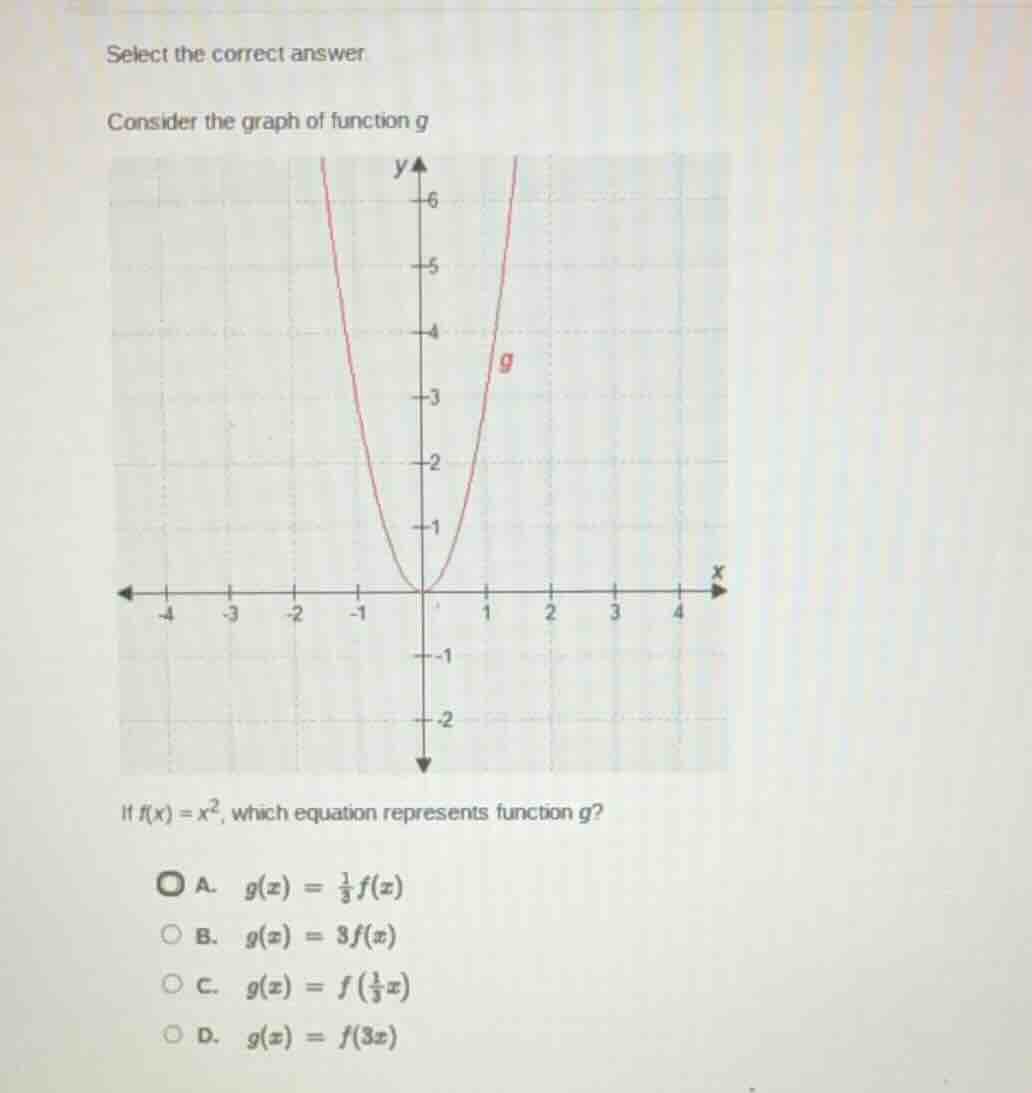
consider the graph of function g
graph of a parabola g with vertex at the origin, opening upwards, passing through (1, 3) or similar?
if f(x) = x², which equation represents function g?
a. g(x) = (1/3)f(x)
b. g(x) = 3f(x)
c. g(x) = f((1/3)x)
d. g(x) = f(3x)
Step1: Analyze the parent function and transformation
The parent function is \( f(x) = x^2 \), which is a parabola opening upwards with vertex at the origin. For function \( g(x) \), we need to determine the transformation from \( f(x) \). Let's check the points. For \( f(x)=x^2 \), when \( x = 1 \), \( f(1)=1 \). For \( g(x) \), when \( x = 1 \), from the graph, let's see the value. Wait, actually, let's consider the horizontal or vertical stretch/compression.
Wait, another approach: Let's take a point on \( g(x) \). Let's see, when \( x = 1 \), what's \( g(1) \)? From the graph, at \( x = 1 \), \( g(1) \) seems to be \( 3 \)? Wait, no, wait the graph: the parabola \( g(x) \) at \( x = 1 \), let's check the y - value. Wait, the standard \( f(x)=x^2 \) at \( x = 1 \) is \( 1 \), at \( x = 1 \), if \( g(1) = 3 \)? Wait, no, maybe I misread. Wait, actually, let's check the transformation.
Wait, the function \( g(x) \) is a horizontal compression or vertical stretch? Wait, let's check the options. Option C: \( g(x)=f(\frac{1}{3}x)=(\frac{1}{3}x)^2=\frac{1}{9}x^2 \), which would be a horizontal stretch. Option D: \( g(x)=f(3x)=(3x)^2 = 9x^2 \), which is a horizontal compression. Option A: \( g(x)=\frac{1}{3}f(x)=\frac{1}{3}x^2 \), vertical compression. Option B: \( g(x)=3f(x)=3x^2 \), vertical stretch.
Wait, let's take a point on \( g(x) \). Let's take \( x = 1 \). From the graph, when \( x = 1 \), what's \( g(1) \)? Let's see the graph: the parabola passes through, maybe \( (1, 3) \)? Wait, no, the standard \( f(x)=x^2 \) at \( x = 1 \) is \( 1 \). If \( g(1) = 3 \), then \( g(1)=3f(1) \), so \( g(x)=3f(x) \)? Wait, no, wait the graph: the vertex is at the origin, and it's a parabola. Wait, maybe I made a mistake. Wait, let's check the options again.
Wait, let's consider the transformation. The function \( f(x)=x^2 \). Let's see the graph of \( g(x) \): when \( x = 1 \), what is \( g(1) \)? Looking at the graph, the parabola at \( x = 1 \) is at \( y = 3 \)? Wait, no, maybe the grid: each square is 1 unit. So at \( x = 1 \), the y - coordinate of \( g(x) \) is 3? Wait, no, the graph: the red parabola, at \( x = 1 \), the y - value is 3? Wait, the standard \( f(x)=x^2 \) at \( x = 1 \) is 1. So if \( g(1)=3 \), then \( g(1)=3f(1) \), so \( g(x)=3f(x) \), which is option B? Wait, no, wait maybe I misread the graph. Wait, maybe the graph is \( g(x)=f(3x) \)? Wait, no, let's calculate \( f(3x)=(3x)^2 = 9x^2 \), so at \( x = 1 \), \( 9(1)^2 = 9 \), which is too big. Wait, maybe the graph is \( g(x)=3f(x) \), so \( 3x^2 \), at \( x = 1 \), \( 3(1)^2 = 3 \), which matches the graph? Wait, the graph at \( x = 1 \), the y - value is 3? Let's check the graph again. The y - axis has marks at 1, 2, 3, 4, 5, 6. The parabola at \( x = 1 \) is at y = 3? Then \( g(1)=3 \), and \( f(1)=1 \), so \( g(1)=3f(1) \), so \( g(x)=3f(x) \), which is option B. Wait, but let's check another point. At \( x = 0 \), \( g(0)=0 \), \( f(0)=0 \), so that's consistent. At \( x = 2 \), \( g(2) \) would be \( 3*(2)^2 = 12 \), but the graph doesn't show that, but maybe the graph is scaled. Wait, maybe I made a mistake. Wait, the options:
Option A: \( g(x)=\frac{1}{3}f(x)=\frac{1}{3}x^2 \), at \( x = 1 \), \( y=\frac{1}{3} \), which is too small.
Option B: \( g(x)=3f(x)=3x^2 \), at \( x = 1 \), \( y = 3 \), which matches the graph (if the graph at \( x = 1 \) is 3).
Option C: \( g(x)=f(\frac{1}{3}x)=(\frac{1}{3}x)^2=\frac{1}{9}x^2 \), at \( x = 1 \), \( y=\frac{1}{9} \), too small.
Option D: \( g(x)=f(3x)=(3x)^2 = 9x^2 \), at \( x = 1 \), \( y = 9 \), too big.
S…

Snap & solve any problem in the app
Get step-by-step solutions on Sovi AI
Photo-based solutions with guided steps
Explore more problems and detailed explanations
B. \( g(x) = 3f(x) \)