QUESTION IMAGE
Question
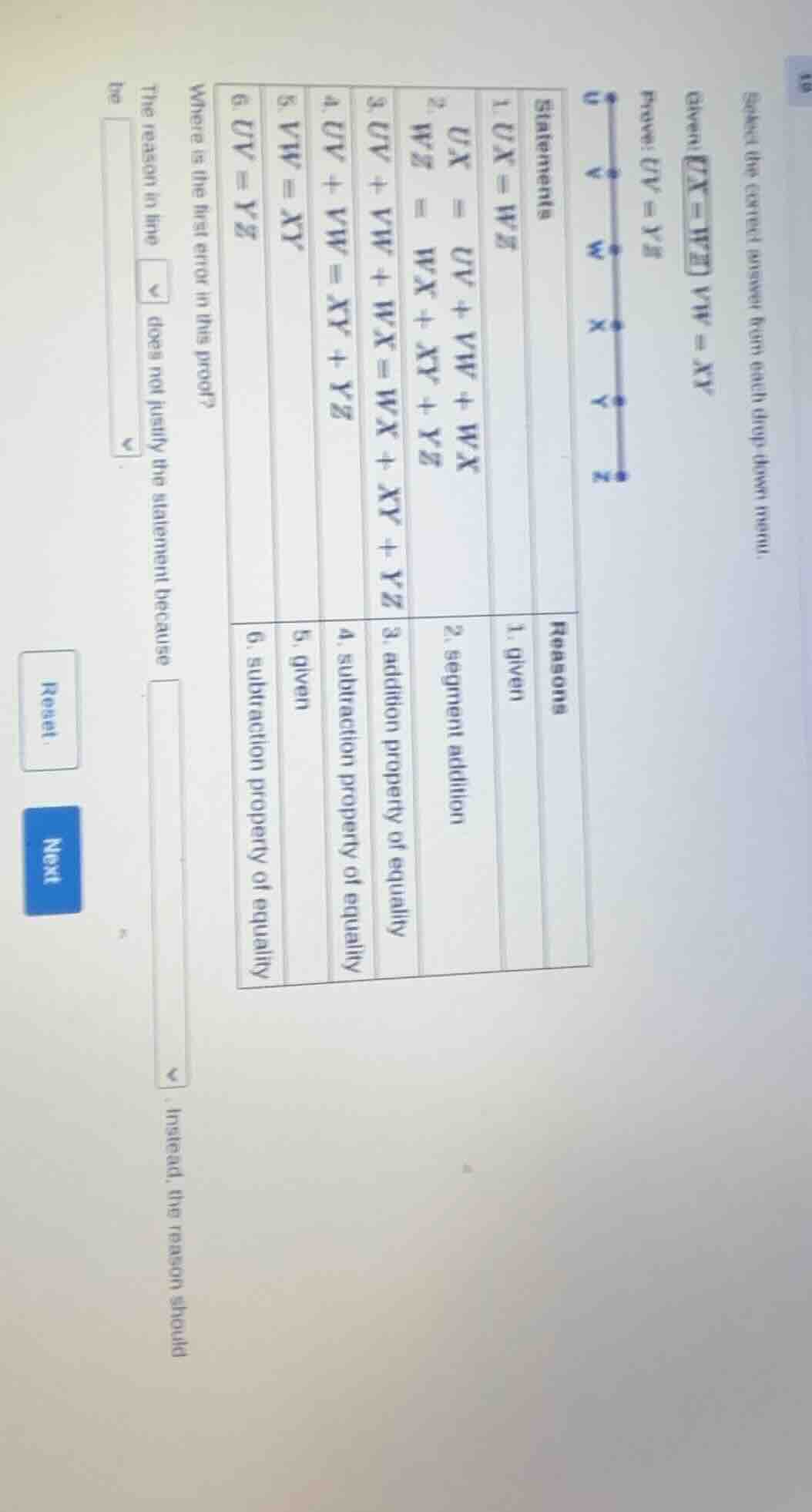
select the correct answer from each drop - down menu. given (overline{ux}=overline{wz}), (overline{vw}=overline{xy}), prove: (overline{uv}=overline{yz})
where is the first error in this proof?
the reason in line (\boldsymbol{downarrow}) does not justify the statement because (\boldsymbol{downarrow}). instead, the reason should be
statements | reasons
--- | ---
- (ux = wz) | 1. given
- (ux=uv + vw+wx); (wz = wx+xy + yz) | 2. segment addition
- (uv + vw+wx=wx + xy+yz) | 3. addition property of equality
- (uv + vw=xy + yz) | 4. subtraction property of equality
- (vw = xy) | 5. given
- (uv = yz) | 6. subtraction property of equality
To determine the first error in the proof, we analyze each step:
Step 1: Analyze Step 3
Statement 3: \( UV + VW + WX = WX + XY + YZ \)
Reason: "addition property of equality"
The addition property of equality states that if \( a = b \), then \( a + c = b + c \). However, Step 3 is not adding the same segment to both sides of a previous equation. Instead, it is attempting to equate two sums (from Step 2: \( WZ = WX + XY + YZ \) and Step 1: \( UX = WZ \), \( UX = UV + VW + WX \))—this is actually the substitution property (replacing \( WZ \) with \( UX \) and vice versa), not the addition property.
Step 2: Verify Other Steps
- Step 1: Given \( UX = WZ \) (valid).
- Step 2: \( UX = UV + VW + WX \) and \( WZ = WX + XY + YZ \) (segment addition postulate, valid).
- Step 4: \( UV + VW = XY + YZ \) (subtraction of \( WX \) from both sides, valid if Step 3 were corrected).
Thus, the first error is in Step 3 (reason: "addition property of equality" is incorrect; the correct reason should be substitution or transitive property, not addition).
The first error occurs in Step 3. The "addition property of equality" is misapplied here—Step 3 equates two sums (from segment addition) via substitution/transitivity, not by adding a common term to both sides.

Snap & solve any problem in the app
Get step-by-step solutions on Sovi AI
Photo-based solutions with guided steps
Explore more problems and detailed explanations
The first error is in Step 3 (the reason "addition property of equality" does not justify the statement, as it misapplies the addition property; the correct reasoning should involve substitution or transitivity, not addition).