QUESTION IMAGE
Question
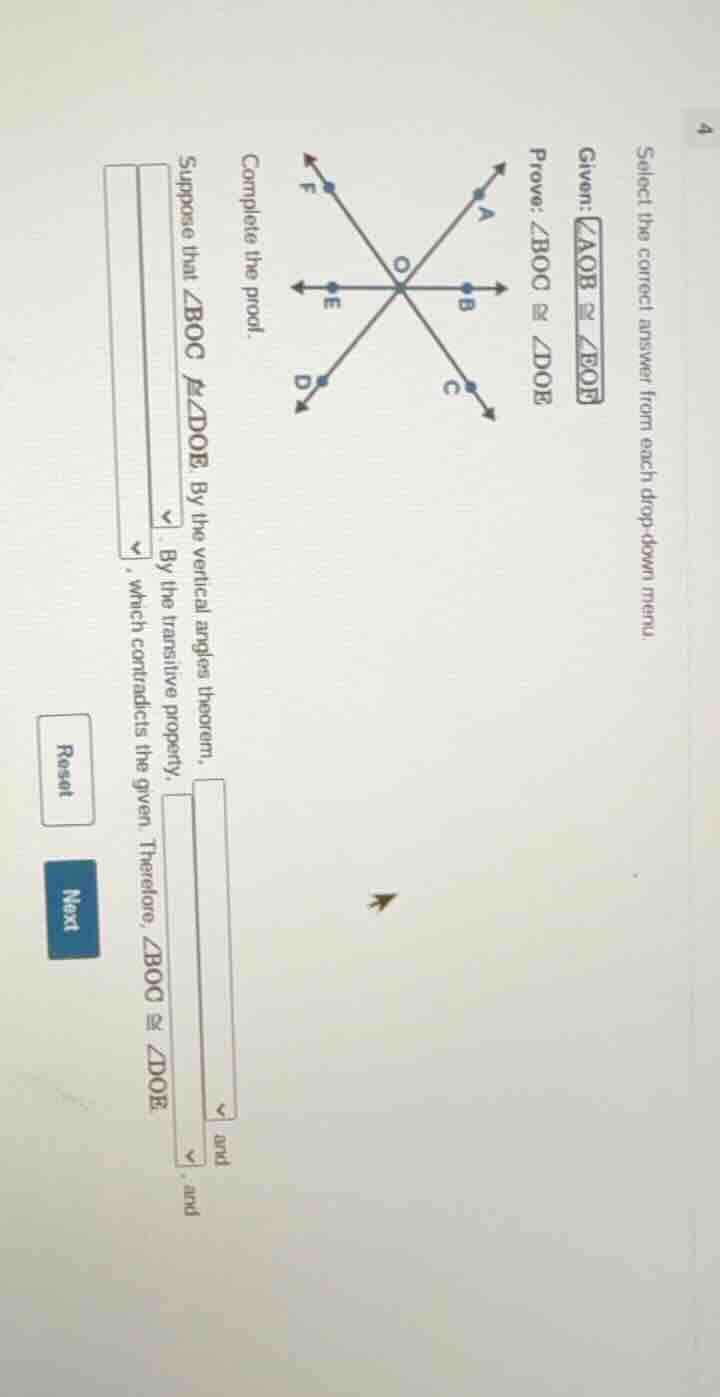
select the correct answer from each drop - down menu. given: \\(\angle aob \cong \angle eof\\) prove: \\(\angle boc \cong \angle dob\\) complete the proof. suppose that \\(\angle boc \
ot\cong \angle doe\\). by the vertical angles theorem, \\(\underline{\quad}\\) and \\(\underline{\quad}\\). by the transitive property, \\(\underline{\quad}\\), which contradicts the given. therefore, \\(\angle boc \cong \angle doe\\)
To solve this proof, we analyze the given information and use properties of congruent angles and vertical angles:
Step 1: Identify Vertical Angles
First, recall the vertical angles theorem: vertical angles are congruent. From the diagram, $\angle AOB$ and $\angle EOF$ are given as congruent ($\angle AOB \cong \angle EOF$). We also need to identify other vertical angle pairs. Notice that $\angle AOB$ and $\angle DOE$ are vertical angles? Wait, no—wait, let’s re-examine. Wait, the goal is to prove $\angle BOC \cong \angle DOE$. Let’s use the given $\angle AOB \cong \angle EOF$ and vertical angles.
Wait, the proof structure is: *Suppose that $\angle BOC
ot\cong \angle DOE$* (this is a proof by contradiction). Then, by vertical angles, $\angle AOB \cong \angle DOE$? Wait, no—wait, vertical angles: $\angle AOB$ and $\angle DOE$? Wait, maybe $\angle AOB \cong \angle DOE$ (vertical angles) and $\angle EOF \cong \angle BOC$ (vertical angles)? Wait, no, let’s correct.
Wait, the given is $\angle AOB \cong \angle EOF$. If we suppose $\angle BOC
ot\cong \angle DOE$, then by vertical angles:
- $\angle AOB$ and $\angle DOE$ are vertical angles? No, $\angle AOB$ and $\angle DOE$—wait, maybe $\angle AOB \cong \angle DOE$ (vertical angles) and $\angle EOF \cong \angle BOC$ (vertical angles). Then, since $\angle AOB \cong \angle EOF$ (given), by transitivity, $\angle DOE \cong \angle BOC$—but we supposed they are not congruent, so contradiction.
Wait, the first blank (after “By the vertical angles theorem,”) should be $\angle AOB \cong \angle DOE$ (vertical angles) and $\angle EOF \cong \angle BOC$ (vertical angles). Then, since $\angle AOB \cong \angle EOF$ (given), by transitivity, $\angle DOE \cong \angle BOC$, contradicting the supposition that $\angle BOC
ot\cong \angle DOE$.
Filling the Blanks (Proof by Contradiction)
- First Dropdown (after “By the vertical angles theorem,”): $\boldsymbol{\angle AOB \cong \angle DOE}$ (vertical angles are congruent).
- Second Dropdown (and...): $\boldsymbol{\angle EOF \cong \angle BOC}$ (another pair of vertical angles, congruent by vertical angles theorem).
- Third Dropdown (By the transitive property...): Since $\angle AOB \cong \angle EOF$ (given), $\angle AOB \cong \angle DOE$ (vertical angles), and $\angle EOF \cong \angle BOC$ (vertical angles), by transitivity, $\angle DOE \cong \angle BOC$. This contradicts the supposition that $\angle BOC
ot\cong \angle DOE$, so $\angle BOC \cong \angle DOE$.
Final Answer (Key Fills for the Proof)
- First blank (vertical angles): $\boldsymbol{\angle AOB \cong \angle DOE}$
- Second blank (and...): $\boldsymbol{\angle EOF \cong \angle BOC}$
- The contradiction arises because the supposition ($\angle BOC
ot\cong \angle DOE$) conflicts with the transitive property, so $\angle BOC \cong \angle DOE$ must hold.
(Note: The exact dropdown options depend on the provided choices, but the logical steps use vertical angles and transitive property of congruence.)

Snap & solve any problem in the app
Get step-by-step solutions on Sovi AI
Photo-based solutions with guided steps
Explore more problems and detailed explanations
To solve this proof, we analyze the given information and use properties of congruent angles and vertical angles:
Step 1: Identify Vertical Angles
First, recall the vertical angles theorem: vertical angles are congruent. From the diagram, $\angle AOB$ and $\angle EOF$ are given as congruent ($\angle AOB \cong \angle EOF$). We also need to identify other vertical angle pairs. Notice that $\angle AOB$ and $\angle DOE$ are vertical angles? Wait, no—wait, let’s re-examine. Wait, the goal is to prove $\angle BOC \cong \angle DOE$. Let’s use the given $\angle AOB \cong \angle EOF$ and vertical angles.
Wait, the proof structure is: *Suppose that $\angle BOC
ot\cong \angle DOE$* (this is a proof by contradiction). Then, by vertical angles, $\angle AOB \cong \angle DOE$? Wait, no—wait, vertical angles: $\angle AOB$ and $\angle DOE$? Wait, maybe $\angle AOB \cong \angle DOE$ (vertical angles) and $\angle EOF \cong \angle BOC$ (vertical angles)? Wait, no, let’s correct.
Wait, the given is $\angle AOB \cong \angle EOF$. If we suppose $\angle BOC
ot\cong \angle DOE$, then by vertical angles:
- $\angle AOB$ and $\angle DOE$ are vertical angles? No, $\angle AOB$ and $\angle DOE$—wait, maybe $\angle AOB \cong \angle DOE$ (vertical angles) and $\angle EOF \cong \angle BOC$ (vertical angles). Then, since $\angle AOB \cong \angle EOF$ (given), by transitivity, $\angle DOE \cong \angle BOC$—but we supposed they are not congruent, so contradiction.
Wait, the first blank (after “By the vertical angles theorem,”) should be $\angle AOB \cong \angle DOE$ (vertical angles) and $\angle EOF \cong \angle BOC$ (vertical angles). Then, since $\angle AOB \cong \angle EOF$ (given), by transitivity, $\angle DOE \cong \angle BOC$, contradicting the supposition that $\angle BOC
ot\cong \angle DOE$.
Filling the Blanks (Proof by Contradiction)
- First Dropdown (after “By the vertical angles theorem,”): $\boldsymbol{\angle AOB \cong \angle DOE}$ (vertical angles are congruent).
- Second Dropdown (and...): $\boldsymbol{\angle EOF \cong \angle BOC}$ (another pair of vertical angles, congruent by vertical angles theorem).
- Third Dropdown (By the transitive property...): Since $\angle AOB \cong \angle EOF$ (given), $\angle AOB \cong \angle DOE$ (vertical angles), and $\angle EOF \cong \angle BOC$ (vertical angles), by transitivity, $\angle DOE \cong \angle BOC$. This contradicts the supposition that $\angle BOC
ot\cong \angle DOE$, so $\angle BOC \cong \angle DOE$.
Final Answer (Key Fills for the Proof)
- First blank (vertical angles): $\boldsymbol{\angle AOB \cong \angle DOE}$
- Second blank (and...): $\boldsymbol{\angle EOF \cong \angle BOC}$
- The contradiction arises because the supposition ($\angle BOC
ot\cong \angle DOE$) conflicts with the transitive property, so $\angle BOC \cong \angle DOE$ must hold.
(Note: The exact dropdown options depend on the provided choices, but the logical steps use vertical angles and transitive property of congruence.)