QUESTION IMAGE
Question
select the correct answer from each drop - down menu.
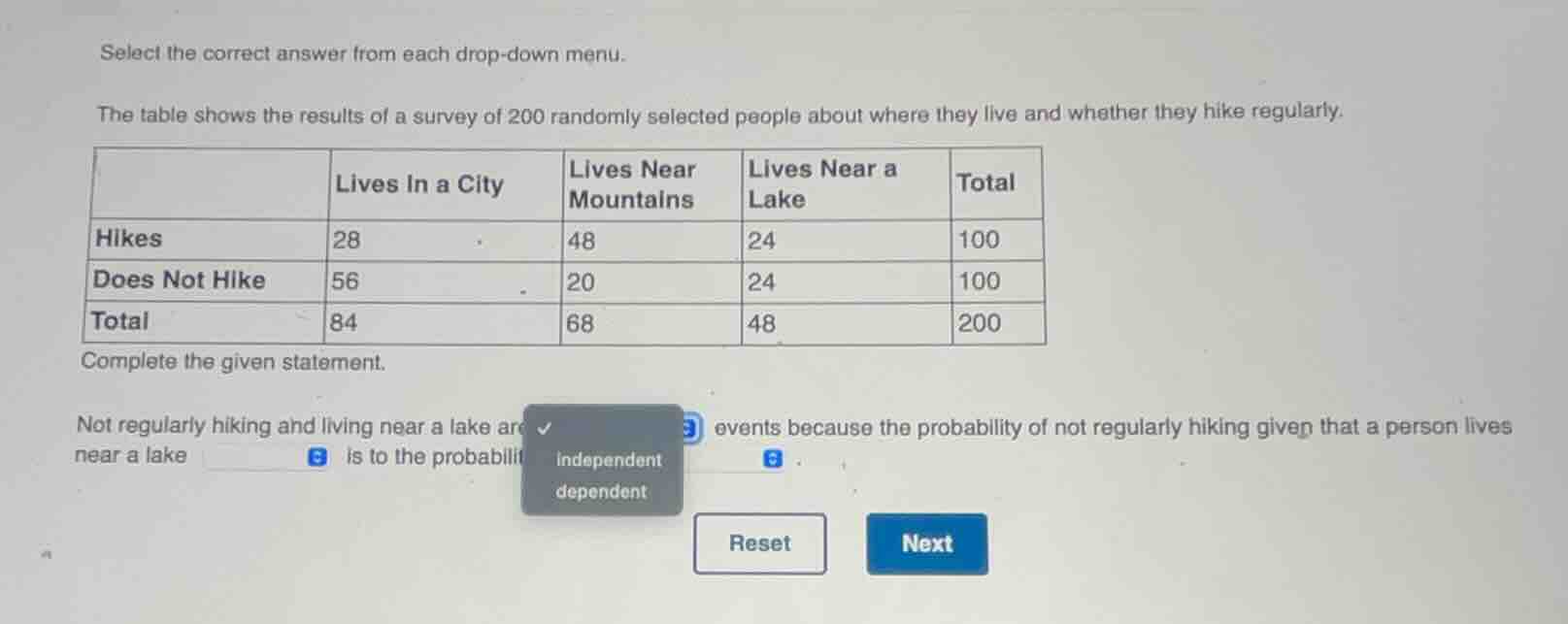
the table shows the results of a survey of 200 randomly selected people about where they live and whether they hike regularly.
| lives in a city | lives near mountains | lives near a lake | total | |
|---|---|---|---|---|
| does not hike | 56 | 20 | 24 | 100 |
| total | 84 | 68 | 48 | 200 |
complete the given statement.
not regularly hiking and living near a lake are events because the probability of not regularly hiking given that a person lives near a lake is to the probabilit | independent
dependent |
| reset | next |
Step1: Define independent events
Two events \(A\) (does not hike) and \(B\) (lives near a lake) are independent if \(P(A|B) = P(A)\).
Step2: Calculate \(P(A|B)\)
\(P(A|B)=\frac{\text{People who don't hike and live near lake}}{\text{Total people near lake}}=\frac{24}{48}=0.5\)
Step3: Calculate \(P(A)\)
\(P(A)=\frac{\text{Total people who don't hike}}{\text{Total surveyed}}=\frac{100}{200}=0.5\)
Step4: Compare probabilities
Since \(P(A|B)=P(A)=0.5\), the events are independent.

Snap & solve any problem in the app
Get step-by-step solutions on Sovi AI
Photo-based solutions with guided steps
Explore more problems and detailed explanations
Not regularly hiking and living near a lake are independent events because the probability of not regularly hiking given that a person lives near a lake is equal to the probability of not regularly hiking (for all surveyed people).