QUESTION IMAGE
Question
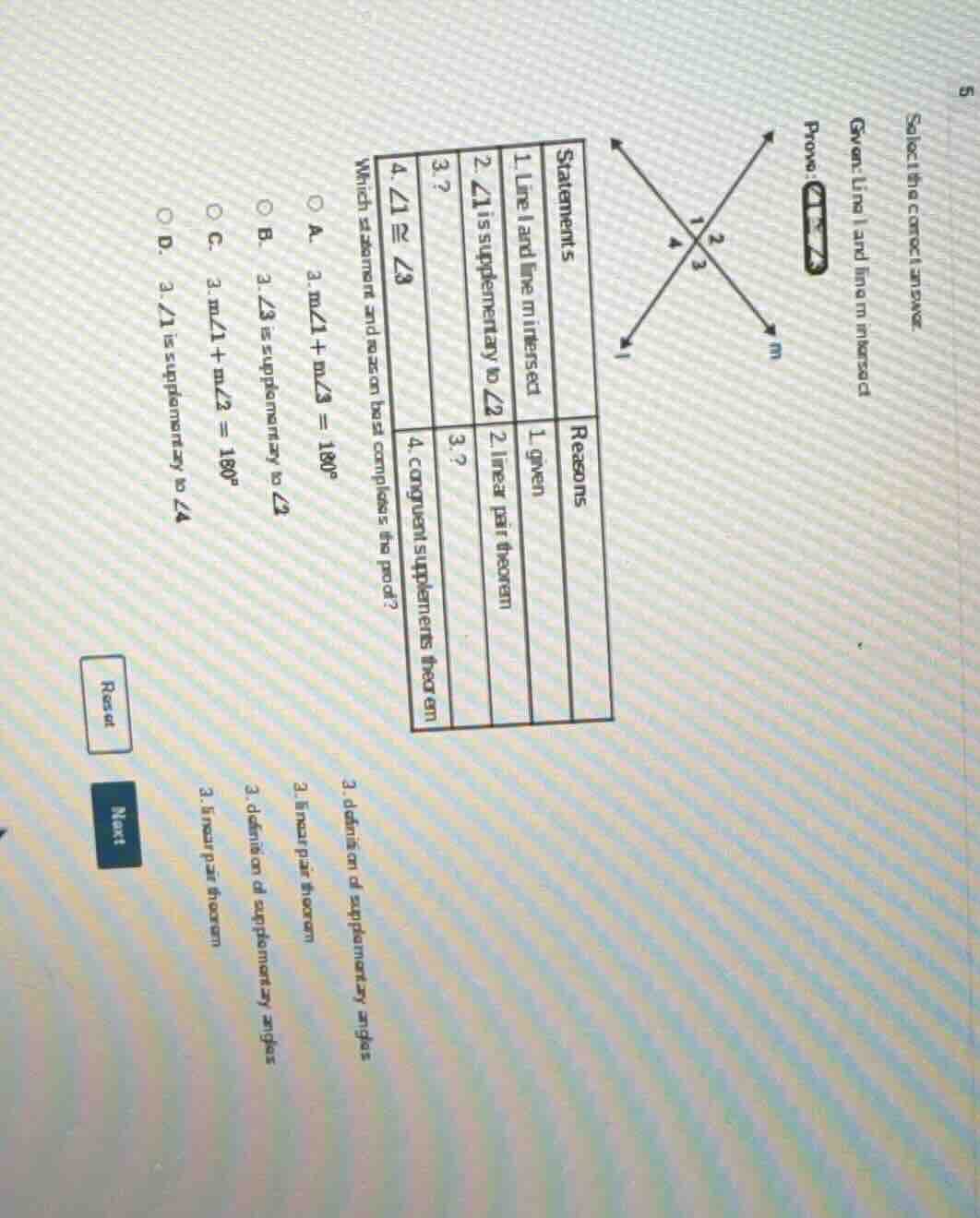
select the correct answer. given: line l and line m intersect prove: diagram of intersecting lines l and m with angles 1,2,3,4 statements: 1. line l and line m intersect 2. ∠1 is supplementary to ∠2 3.? 4. ∠1 ≅ ∠3 reasons: 1. given 2. linear pair theorem 3.? 4. congruent supplements theorem which statement and reason best completes the proof? a. 3. m∠1 + m∠3 = 180° b. 3. ∠3 is supplementary to ∠2 c. 3. m∠1 + m∠2 = 180° d. 3. ∠1 is supplementary to ∠4
To solve this, we analyze the proof structure. We know that ∠1 and ∠2 are supplementary (linear pair theorem), so \( m\angle1 + m\angle2 = 180^\circ \). For the next step, we need a statement that relates to vertical angles or supplementary angles. ∠2 and ∠3 are vertical angles? No, wait, ∠1 and ∠3: Wait, actually, ∠2 and ∠3 are supplementary? No, let's check the options. The correct statement for step 3 should be that ∠1 is supplementary to ∠3? Wait, no. Wait, the linear pair theorem gives \( m\angle1 + m\angle2 = 180^\circ \). Then, if we can say \( m\angle2 + m\angle3 = 180^\circ \) (linear pair again), but no. Wait, the options: Option D says "∠1 is supplementary to ∠4"? No, wait the options for the statement: Wait, the problem is about the proof of vertical angles or supplementary angles. Wait, the correct statement for step 3 (to lead to ∠1 ≅ ∠3 by congruent supplements theorem) should be that ∠1 and ∠3 are both supplementary to ∠2. Wait, no, the linear pair theorem gives \( m\angle1 + m\angle2 = 180^\circ \), and if we can say \( m\angle2 + m\angle3 = 180^\circ \) (so ∠2 and ∠3 are supplementary), then by congruent supplements theorem, ∠1 ≅ ∠3. But the options for the statement: Let's check the options. Wait, the options are:
A. \( m\angle1 + m\angle3 = 180^\circ \)
B. ∠3 is supplementary to ∠2
C. \( m\angle1 + m\angle2 = 180^\circ \) (but that's step 2? No, step 2 is ∠1 supplementary to ∠2, so step 3 should be another supplementary relationship. Wait, no, the linear pair theorem is step 2: \( m\angle1 + m\angle2 = 180^\circ \) (linear pair theorem). Then step 3 should be \( m\angle2 + m\angle3 = 180^\circ \) (linear pair theorem again), but that's not an option. Wait, the options given:
Wait the options for the statement (step 3) are:
A. \( m\angle1 + m\angle3 = 180^\circ \)
B. ∠3 is supplementary to ∠2
C. \( m\angle1 + m\angle2 = 180^\circ \) (but that's step 2)
D. ∠1 is supplementary to ∠4
Wait, no, maybe I misread. Wait the problem is: Given line l and line m intersect, ∠1 supplementary to ∠2 (linear pair), then step 3: which statement? Then step 4: ∠1 ≅ ∠3 (congruent supplements theorem). So the congruent supplements theorem says that if two angles are supplementary to the same angle, they are congruent. So ∠1 is supplementary to ∠2, and ∠3 is supplementary to ∠2, so ∠1 ≅ ∠3. Therefore, step 3 should be that ∠3 is supplementary to ∠2. Wait, but ∠2 and ∠3: are they supplementary? Yes, because they form a linear pair. So step 3: ∠3 is supplementary to ∠2 (statement), and the reason would be linear pair theorem. Then step 4: ∠1 ≅ ∠3 (congruent supplements theorem). So the correct statement for step 3 is "∠3 is supplementary to ∠2", which is option B? Wait no, option B says "∠3 is supplementary to ∠2"? Wait the options:
Wait the options are:
A. \( m\angle1 + m\angle3 = 180^\circ \)
B. ∠3 is supplementary to ∠2
C. \( m\angle1 + m\angle2 = 180^\circ \)
D. ∠1 is supplementary to ∠4
Wait, no, the original options (from the image):
A. \( 3. m\angle1 + m\angle3 = 180^\circ \)
B. \( 3. \angle3 \) is supplementary to \( \angle2 \)
C. \( 3. m\angle1 + m\angle2 = 180^\circ \)
D. \( 3. \angle1 \) is supplementary to \( \angle4 \)
Wait, no, maybe the options are:
Wait the user's image:
Options:
A. 3. \( m\angle1 + m\angle3 = 180^\circ \)
B. 3. \( \angle3 \) is supplementary to \( \angle2 \)
C. 3. \( m\angle1 + m\angle2 = 180^\circ \)
D. 3. \( \angle1 \) is supplementary to \( \angle4 \)
Wait, but step 2 is \( \angle1 \) is supplementary to \( \angle2 \) (linear pair theorem, so \( m\angle1 + m\angle2 = 180^\cir…

Snap & solve any problem in the app
Get step-by-step solutions on Sovi AI
Photo-based solutions with guided steps
Explore more problems and detailed explanations
B. 3. \( \angle3 \) is supplementary to \( \angle2 \)