QUESTION IMAGE
Question
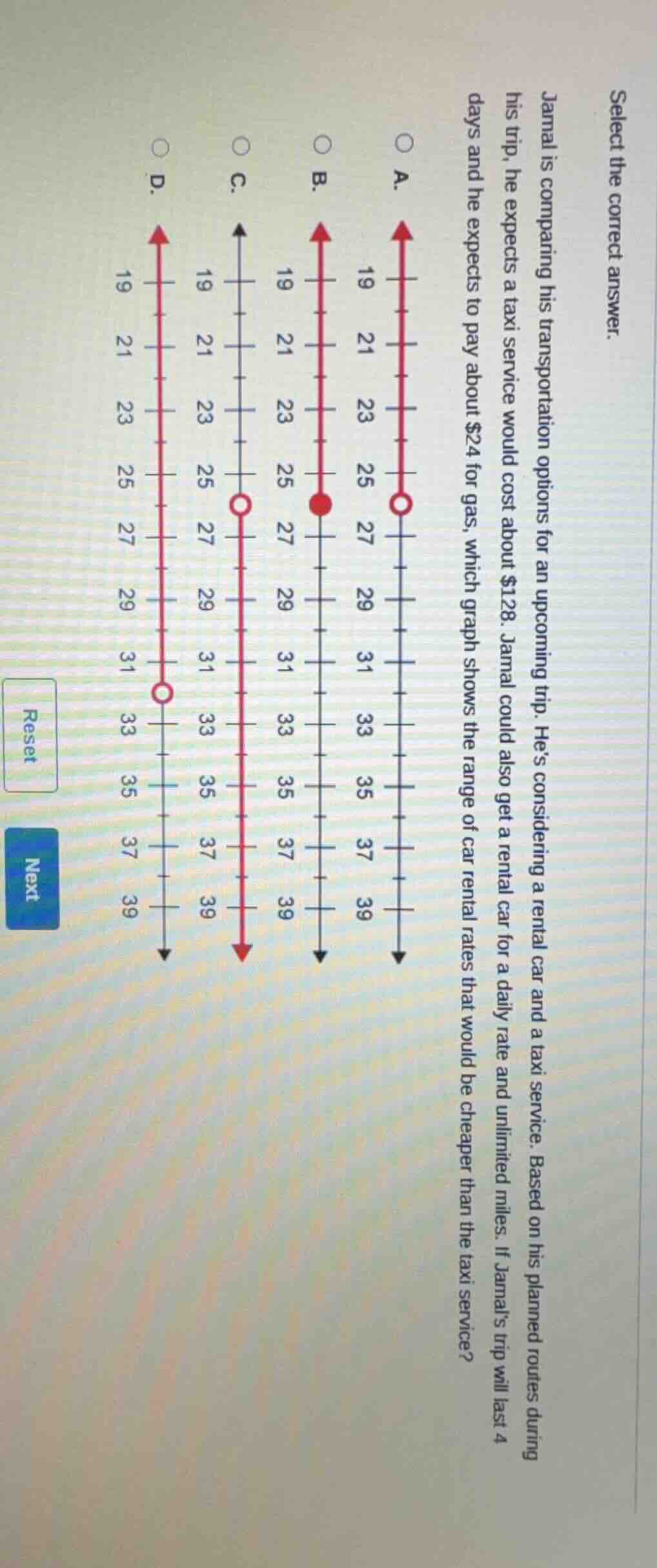
select the correct answer. jamal is comparing his transportation options for an upcoming trip. he’s considering a rental car and a taxi service. based on his planned routes during his trip, he expects a taxi service would cost about $128. jamal could also get a rental car for a daily rate and unlimited miles. if jamal’s trip will last 4 days and he expects to pay about $24 for gas, which graph shows the range of car rental rates that would be cheaper than the taxi service? (options a, b, c, d with number lines as shown in the image)
Step1: Define the cost function for car rental
Let \( d \) be the daily rate of the rental car. The total cost for the rental car for 4 days plus gas (\$24) should be less than the taxi cost (\$128). So the inequality is \( 4d + 24 < 128 \).
Step2: Solve the inequality for \( d \)
Subtract 24 from both sides: \( 4d < 128 - 24 \)
\( 4d < 104 \)
Divide both sides by 4: \( d < \frac{104}{4} \)
\( d < 26 \)
Step3: Analyze the number lines
We need a number line that shows \( d < 26 \). An open circle at 26 (since 26 is not included) and an arrow pointing to the left (for values less than 26). Looking at the options, option A has an open circle at 26 and the arrow to the left (wait, no, let's re - check the options. Wait, maybe I made a mistake in the direction. Wait, the total cost of rental car is \( 4d+24 \). We want \( 4d + 24<128\), so \( 4d<104\), \( d < 26 \). So the daily rate \( d \) must be less than 26. So the number line should have an open circle at 26 and the arrow going to the left (for values less than 26). Wait, looking at the options:
- Option A: Open circle at 26, arrow to the left (wait, the arrow in A is going up? Wait, no, the number lines: Let's re - examine the problem. The number lines are for the range of car rental rates (daily rate \( d \)). So we found \( d < 26 \). So the correct number line should have an open circle at 26 (since \( d = 26 \) would give \( 4\times26+24=104 + 24=128 \), which is not less than 128) and the arrow pointing to the left (for values less than 26). Looking at the options, option A has an open circle at 26 and the arrow to the left (assuming the number line is oriented with lower numbers on the left). Wait, maybe the initial analysis of the arrow direction was wrong. Let's check the options again.
Wait, maybe I mixed up the direction. Let's re - solve:
Total cost of rental car: \( C = 4d+24 \). We want \( C<128 \), so \( 4d + 24<128\Rightarrow4d<104\Rightarrow d < 26 \). So the daily rate \( d \) must be less than 26. So on the number line, we have an open circle at 26 (because \( d = 26 \) is not included) and the arrow pointing to the left (towards lower numbers). Looking at the options:
- Option A: Open circle at 26, arrow to the left (assuming the number line increases to the right, so left is lower values). So option A is correct.

Snap & solve any problem in the app
Get step-by-step solutions on Sovi AI
Photo-based solutions with guided steps
Explore more problems and detailed explanations
A. (The number line with open circle at 26 and arrow to the left)