QUESTION IMAGE
Question
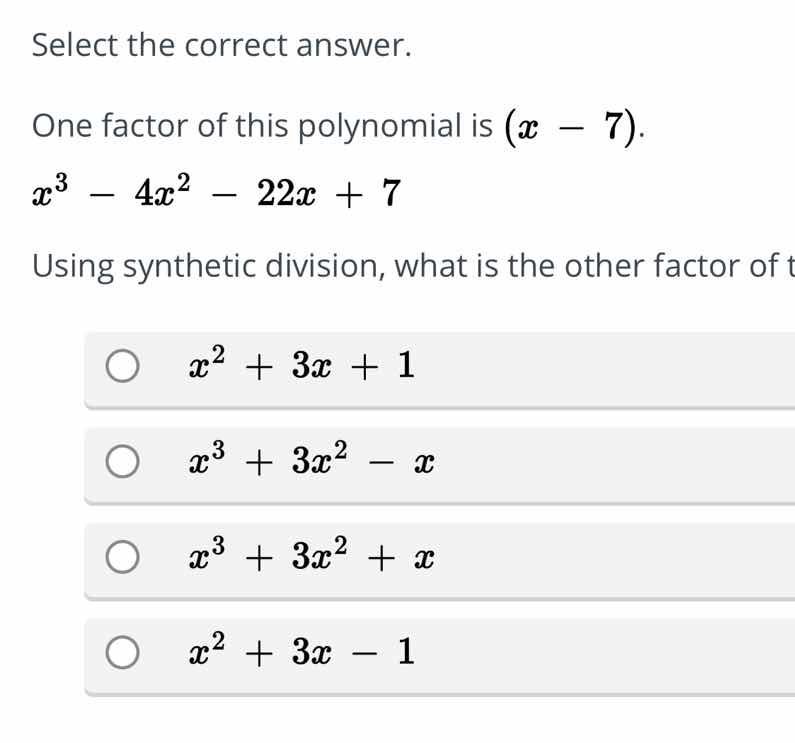
select the correct answer. one factor of this polynomial is (x - 7). x³ - 4x² - 22x + 7 using synthetic division, what is the other factor of t options: x² + 3x + 1; x³ + 3x² - x; x³ + 3x² + x; x² + 3x - 1
Step1: Set up synthetic division
For the factor \((x - 7)\), we use \(x=7\) in synthetic division. The coefficients of the polynomial \(x^{3}-4x^{2}-22x + 7\) are \(1\), \(-4\), \(-22\), \(7\).
We set up the synthetic division as follows:
Bring down the first coefficient \(1\).
Step2: Multiply and add
Multiply \(1\) by \(7\) to get \(7\). Add this to the second coefficient: \(-4+7 = 3\).
Multiply \(3\) by \(7\) to get \(21\). Add this to the third coefficient: \(-22 + 21=-1\).
Multiply \(-1\) by \(7\) to get \(-7\). Add this to the fourth coefficient: \(7+(-7)=0\) (which is the remainder, as expected since \((x - 7)\) is a factor).
The coefficients of the quotient polynomial are \(1\), \(3\), \(-1\)? Wait, no, wait. Wait, the polynomial is cubic, so after dividing by a linear factor, the quotient should be quadratic. Wait, let's re - do the synthetic division correctly.
Wait, the polynomial is \(x^{3}-4x^{2}-22x + 7\). The coefficients are \(a_3 = 1\), \(a_2=-4\), \(a_1=-22\), \(a_0 = 7\).
Synthetic division with root \(r = 7\):
\[
\]
Wait, no, wait, when we do synthetic division for \(x^{3}+ax^{2}+bx + c\) divided by \(x - r\), the quotient is \(x^{2}+(a + r)x+(b + r(a + r))\) and the remainder is \(c+r(b + r(a + r))\). Wait, in our case, the coefficients after division are \(1\) (for \(x^{2}\)), \(3\) (for \(x\)), and \(-1\)? Wait, no, the last addition was \(7+(-7) = 0\), the third addition was \(-22+21=-1\), the second addition was \(-4 + 7=3\), and the first coefficient is \(1\). So the quotient polynomial is \(x^{2}+3x-1\)? Wait, no, wait, the third coefficient (the coefficient of \(x\)) is \(-1\)? Wait, no, let's check the arithmetic again.
First coefficient: \(1\) (bring down).
Multiply \(1\times7 = 7\). Add to \(-4\): \(-4 + 7=3\) (this is the coefficient of \(x\) in the quotient? No, wait, the quotient is a quadratic, so the first term is \(x^{2}\) (coefficient \(1\)), the second term is \(x\) with coefficient \(3\), and the constant term? Wait, no, let's do the multiplication step by step.
After bringing down \(1\):
- Multiply \(1\) by \(7\) to get \(7\). Add to the second coefficient \(-4\): \(-4+7 = 3\) (this is the coefficient of \(x\) in the quotient? No, the quotient is \(x^{2}+bx + c\), so the coefficient of \(x^{2}\) is \(1\), the coefficient of \(x\) is \(3\), and then we multiply \(3\) by \(7\) to get \(21\). Add to the third coefficient \(-22\): \(-22 + 21=-1\) (this is the constant term \(c\) of the quotient). Then multiply \(-1\) by \(7\) to get \(-7\). Add to the fourth coefficient \(7\): \(7+(-7)=0\) (remainder).
So the quotient polynomial is \(x^{2}+3x - 1\).
Wait, but let's verify by multiplying \((x - 7)(x^{2}+3x - 1)\):
\[
\]
Which matches the original polynomial.

Snap & solve any problem in the app
Get step-by-step solutions on Sovi AI
Photo-based solutions with guided steps
Explore more problems and detailed explanations
D. \(x^{2}+3x - 1\) (assuming the last option is D, but in the given options, the last option is \(x^{2}+3x - 1\))