QUESTION IMAGE
Question
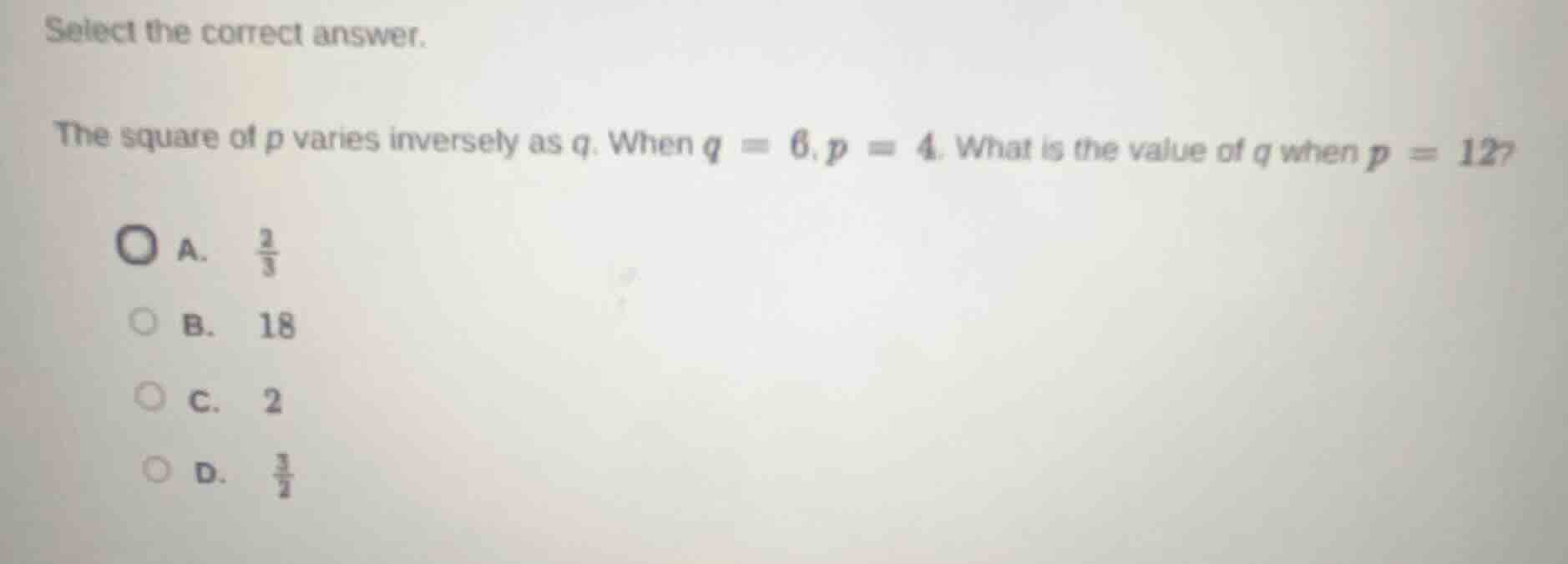
select the correct answer. the square of p varies inversely as q. when q = 6, p = 4. what is the value of q when p = 12? a. \\(\frac{2}{3}\\) b. 18 c. 2 d. \\(\frac{2}{3}\\)
Step1: Define inverse variation formula
The square of \( p \) varies inversely as \( q \), so the relationship is \( p^2 = \frac{k}{q} \) (where \( k \) is the constant of variation).
Step2: Find the constant \( k \)
When \( q = 6 \) and \( p = 4 \), substitute into the formula: \( 4^2=\frac{k}{6} \).
Simplify: \( 16=\frac{k}{6} \), then \( k = 16\times6 = 96 \).
Step3: Find \( q \) when \( p = 12 \)
Now the formula is \( p^2=\frac{96}{q} \). Substitute \( p = 12 \): \( 12^2=\frac{96}{q} \).
Simplify: \( 144=\frac{96}{q} \).
Solve for \( q \): \( q=\frac{96}{144}=\frac{2}{3} \)? Wait, no, wait. Wait, maybe I made a mistake. Wait, inverse variation: \( p^2 \) varies inversely as \( q \), so \( p^2 = \frac{k}{q} \), so \( k = p^2 q \). When \( p = 4 \), \( q = 6 \), so \( k = 16\times6 = 96 \). Then when \( p = 12 \), \( p^2 = 144 \), so \( 144 = \frac{96}{q} \), so \( q = \frac{96}{144} = \frac{2}{3} \)? But the options have A as \( \frac{2}{3} \) (wait, the first option is A. \( \frac{2}{3} \)? Wait, the original problem's option A: maybe a typo, but let's check again. Wait, maybe I messed up the formula. Wait, inverse variation: if \( y \) varies inversely as \( x \), then \( y = \frac{k}{x} \). So here, \( p^2 \) varies inversely as \( q \), so \( p^2 = \frac{k}{q} \), so \( k = p^2 q \). So when \( p = 4 \), \( q = 6 \), \( k = 16*6 = 96 \). Then when \( p = 12 \), \( p^2 = 144 \), so \( 144 = 96 / q \), so \( q = 96 / 144 = 2/3 \). So the correct answer is A. \( \frac{2}{3} \). Wait, but let's check again. Wait, maybe the problem was written with a typo, but according to the calculation, \( q = 2/3 \) when \( p = 12 \). So the correct option is A. \( \frac{2}{3} \).

Snap & solve any problem in the app
Get step-by-step solutions on Sovi AI
Photo-based solutions with guided steps
Explore more problems and detailed explanations
A. \( \frac{2}{3} \)