QUESTION IMAGE
Question
select the correct answer.
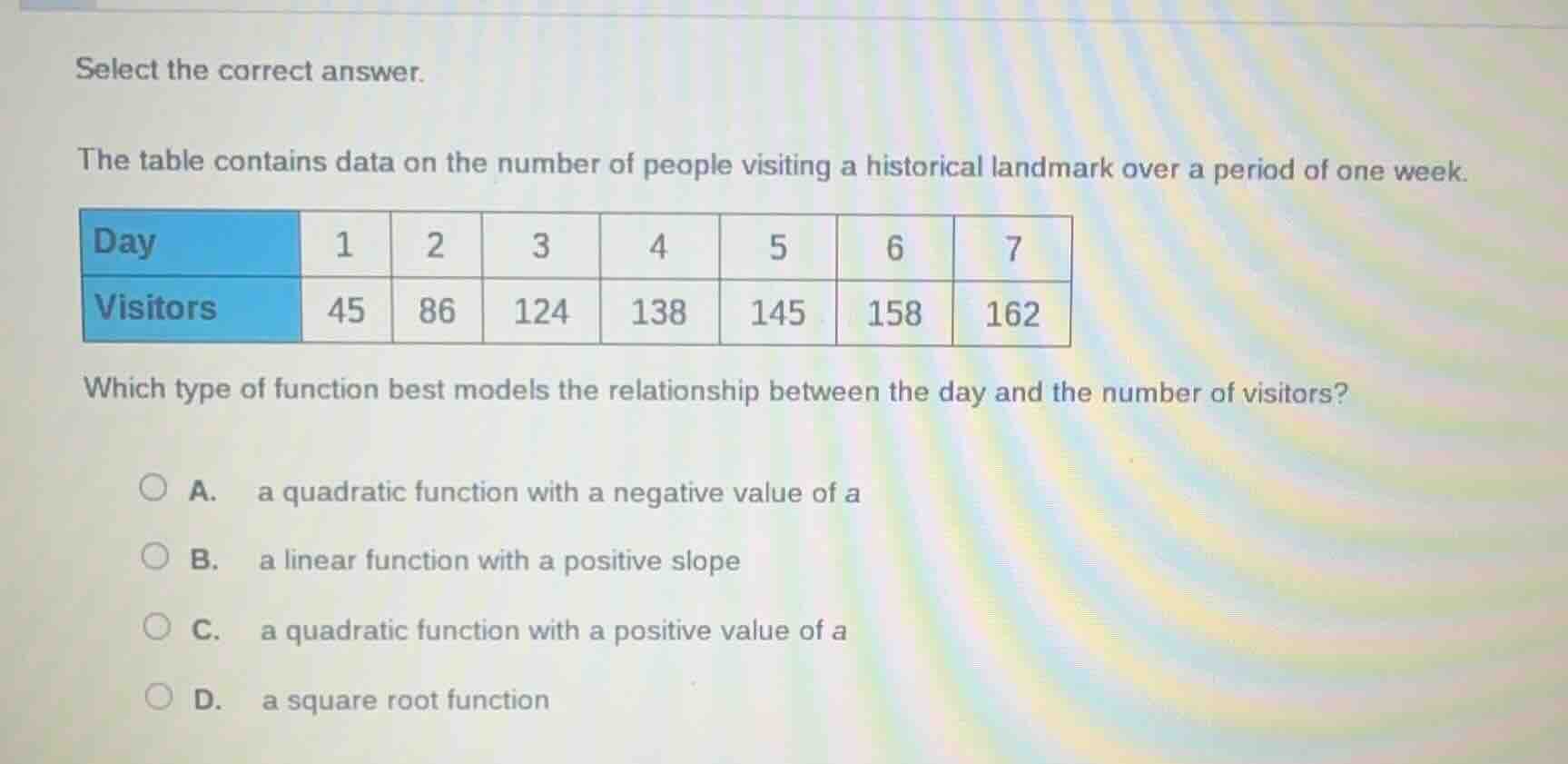
the table contains data on the number of people visiting a historical landmark over a period of one week.
day | 1 | 2 | 3 | 4 | 5 | 6 | 7
visitors | 45 | 86 | 124 | 138 | 145 | 158 | 162
which type of function best models the relationship between the day and the number of visitors?
a. a quadratic function with a negative value of a
b. a linear function with a positive slope
c. a quadratic function with a positive value of a
d. a square root function
Step1: Analyze the trend of visitors
We first look at the change in the number of visitors each day. Let's calculate the differences between consecutive days:
- From Day 1 to Day 2: \(86 - 45 = 41\)
- From Day 2 to Day 3: \(124 - 86 = 38\)
- From Day 3 to Day 4: \(138 - 124 = 14\)
- From Day 4 to Day 5: \(145 - 138 = 7\)
- From Day 5 to Day 6: \(158 - 145 = 13\)
- From Day 6 to Day 7: \(162 - 158 = 4\)
Step2: Analyze the second differences (for quadratic check)
Now, calculate the differences of these differences (second differences):
- \(38 - 41 = -3\)
- \(14 - 38 = -24\)
- \(7 - 14 = -7\)
- \(13 - 7 = 6\)
- \(4 - 13 = -9\)
The second differences are not constant, but the number of visitors is increasing, and the rate of increase is slowing down and then maybe slightly changing, but overall, the data shows a curve that opens upwards (since the number of visitors is increasing and the first differences are positive, and the quadratic function with a positive \(a\) would model a curve that opens upwards, fitting the trend of increasing visitors with a curve). A linear function would have constant first differences, which we don't have. A square root function would have a different growth pattern. Also, the quadratic function with positive \(a\) (opening upwards) fits the general trend of increasing visitors over time with a curved relationship (since the first differences are decreasing then changing, indicating a quadratic rather than linear).

Snap & solve any problem in the app
Get step-by-step solutions on Sovi AI
Photo-based solutions with guided steps
Explore more problems and detailed explanations
C. a quadratic function with a positive value of a