QUESTION IMAGE
Question
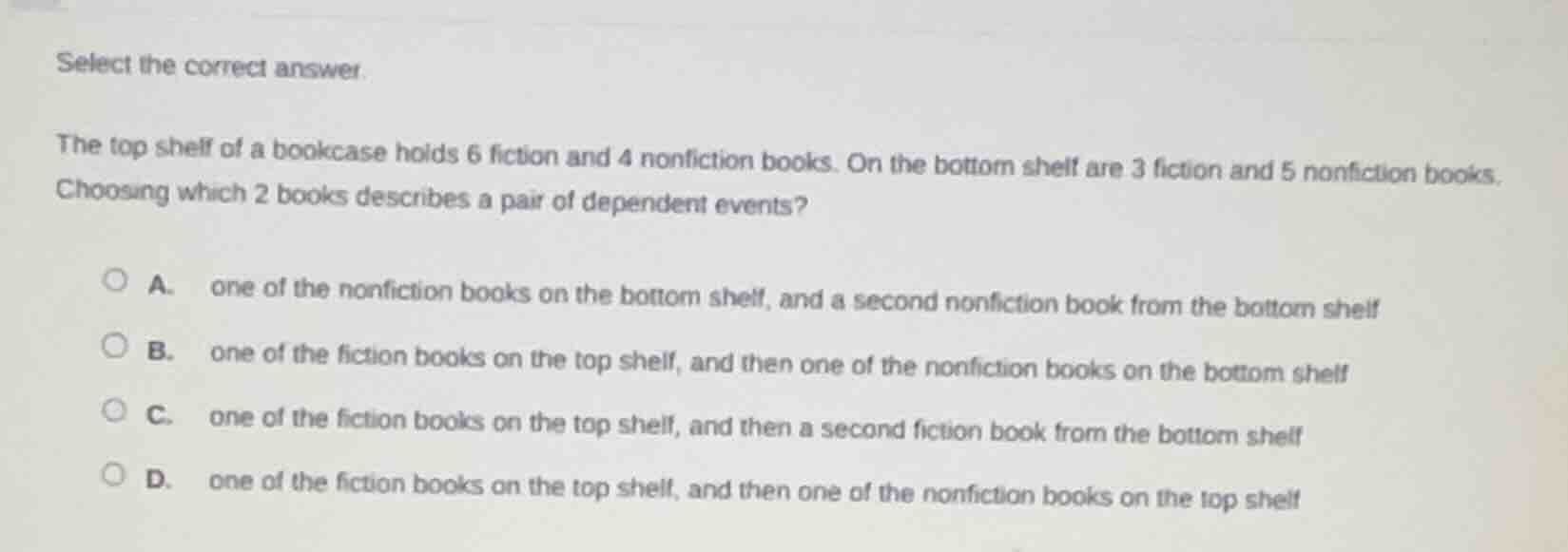
select the correct answer.
the top shelf of a bookcase holds 6 fiction and 4 nonfiction books. on the bottom shelf are 3 fiction and 5 nonfiction books.
choosing which 2 books describes a pair of dependent events?
a. one of the nonfiction books on the bottom shelf, and a second nonfiction book from the bottom shelf
b. one of the fiction books on the top shelf, and then one of the nonfiction books on the bottom shelf
c. one of the fiction books on the top shelf, and then a second fiction book from the bottom shelf
d. one of the fiction books on the top shelf, and then one of the nonfiction books on the top shelf
To determine dependent events, we recall that dependent events are those where the outcome of the first event affects the outcome of the second event (usually when we are not replacing the first item chosen). Let's analyze each option:
Option A:
- First event: Choosing one non - fiction book from the bottom shelf (there are 5 non - fiction books out of \(3 + 5=8\) books on the bottom shelf).
- Second event: Choosing a second non - fiction book from the bottom shelf. After choosing the first non - fiction book from the bottom shelf, the number of non - fiction books left on the bottom shelf is \(5- 1 = 4\) and the total number of books left on the bottom shelf is \(8 - 1=7\). So the outcome of the first event (removing one non - fiction book from the bottom shelf) affects the probability of the second event. These are dependent events. But let's check the other options to be sure.
Option B:
- First event: Choosing a fiction book from the top shelf (the top shelf has 6 fiction and 4 non - fiction books).
- Second event: Choosing a non - fiction book from the bottom shelf (the bottom shelf has 3 fiction and 5 non - fiction books). The choice of a book from the top shelf does not affect the number of books on the bottom shelf. So these are independent events.
Option C:
- First event: Choosing a fiction book from the top shelf.
- Second event: Choosing a fiction book from the bottom shelf. The choice of a book from the top shelf does not affect the number of fiction books on the bottom shelf. So these are independent events.
Option D:
- First event: Choosing a fiction book from the top shelf (top shelf has 6 fiction and 4 non - fiction books).
- Second event: Choosing a non - fiction book from the top shelf. The top shelf has a fixed number of books. But when we choose a fiction book first from the top shelf, we are not removing a non - fiction book. Wait, actually, the top shelf has \(6 + 4=10\) books. If we choose a fiction book first (6 choices), the number of non - fiction books on the top shelf is still 4, and the total number of books on the top shelf is still 10? No, wait, if we are choosing books without replacement (which is the usual case for such problems), if we choose a fiction book from the top shelf first, the total number of books on the top shelf for the second choice is \(10 - 1=9\), but the number of non - fiction books is still 4. However, in option A, when we choose a non - fiction book from the bottom shelf first, the number of non - fiction books on the bottom shelf for the second choice is reduced. But in option D, the first choice is a fiction book and the second is a non - fiction book from the same (top) shelf. But in option A, both choices are from the same shelf (bottom) and we are choosing the same type (non - fiction) without replacement, so the first choice affects the second. But wait, let's re - examine option D. If we are choosing two books, and the first is a fiction from the top and the second is a non - fiction from the top, when we take the first book (fiction) from the top shelf, the total number of books on the top shelf for the second draw is \(6 + 4-1 = 9\), but the number of non - fiction books is still 4. However, in option A, when we take the first non - fiction from the bottom shelf (5 non - fiction out of 8), then the second non - fiction from the bottom shelf has 4 non - fiction out of 7. So the probability of the second event in option A is affected by the first event. But wait, let's go back.
Wait, the key for dependent events is that the outcome of the first event ch…

Snap & solve any problem in the app
Get step-by-step solutions on Sovi AI
Photo-based solutions with guided steps
Explore more problems and detailed explanations
A. one of the nonfiction books on the bottom shelf, and a second nonfiction book from the bottom shelf