QUESTION IMAGE
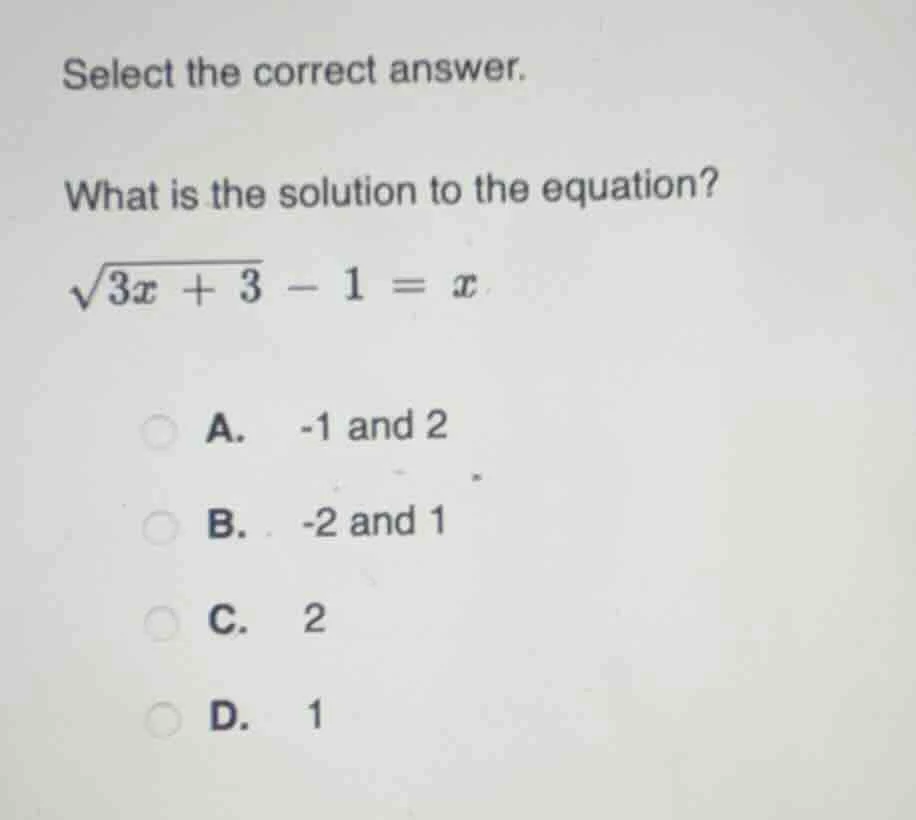
Question
select the correct answer.
what is the solution to the equation?
\\(\sqrt{3x + 3} - 1 = x\\)
a. -1 and 2
b. -2 and 1
c. 2
d. 1
Step1: Isolate the square root term
Add 1 to both sides of the equation \(\sqrt{3x + 3}-1=x\) to get \(\sqrt{3x + 3}=x + 1\).
Step2: Square both sides
Square both sides of the equation \(\sqrt{3x + 3}=x + 1\) to eliminate the square root. We have \((\sqrt{3x + 3})^2=(x + 1)^2\), which simplifies to \(3x+3=x^{2}+2x + 1\).
Step3: Rearrange into quadratic equation
Rearrange the equation \(3x + 3=x^{2}+2x + 1\) to standard quadratic form \(ax^{2}+bx + c = 0\). Subtract \(3x+3\) from both sides: \(x^{2}+2x + 1-(3x + 3)=0\), which simplifies to \(x^{2}-x - 2=0\).
Step4: Solve the quadratic equation
Factor the quadratic equation \(x^{2}-x - 2=0\). We get \((x - 2)(x+1)=0\). Setting each factor equal to zero gives \(x-2 = 0\) or \(x + 1=0\), so \(x = 2\) or \(x=-1\).
Step5: Check for extraneous solutions
- For \(x = 2\): Substitute into the original equation \(\sqrt{3(2)+3}-1=\sqrt{9}-1=3 - 1=2\), which is equal to \(x = 2\), so \(x = 2\) is a valid solution.
- For \(x=-1\): Substitute into the original equation \(\sqrt{3(-1)+3}-1=\sqrt{0}-1=-1\), but the left - hand side is \(-1\) and the right - hand side is \(x=-1\). Wait, but we need to check the domain of the square root. The expression under the square root \(3x + 3\geq0\), when \(x=-1\), \(3(-1)+3 = 0\geq0\). But let's check the original equation again: \(\sqrt{3(-1)+3}-1=\sqrt{0}-1=-1\), and \(x=-1\), so it seems to work? Wait, no, when we square both sides, we might introduce extraneous solutions. Wait, let's re - check. The original equation is \(\sqrt{3x + 3}-1=x\). When \(x=-1\), \(\sqrt{3(-1)+3}-1=\sqrt{0}-1=-1\), and the right - hand side is \(x=-1\). But if we consider the domain of the square root function, \(3x + 3\geq0\Rightarrow x\geq - 1\). But let's check the equation again. Wait, maybe I made a mistake. Wait, when \(x=-1\), \(\sqrt{3x + 3}=\sqrt{0}=0\), then \(0-1=-1\), and \(x=-1\). But let's check with the step where we isolated the square root: \(\sqrt{3x + 3}=x + 1\). When \(x=-1\), the right - hand side is \(x + 1=0\), and the left - hand side is \(\sqrt{0}=0\). But when we solve the original equation, let's see the graph or the behavior. Wait, maybe the error is in the fact that when we have \(\sqrt{3x + 3}-1=x\), we can rewrite it as \(\sqrt{3x + 3}=x + 1\). The square root function \(\sqrt{y}\) has a range \(y\geq0\), so \(x + 1\geq0\Rightarrow x\geq - 1\). But when \(x=-1\), the original equation is satisfied, but when we check the quadratic solution, we had \(x = 2\) and \(x=-1\). But let's check the original equation again for \(x=-1\): \(\sqrt{3(-1)+3}-1=\sqrt{0}-1=-1\), and \(x=-1\). But wait, if we consider the function \(y=\sqrt{3x + 3}-1\) and \(y = x\), at \(x=-1\), they intersect? But let's check with \(x = 2\), they intersect at \(x = 2\). Wait, maybe the problem is that when we square both sides, we might have an extraneous solution. Wait, no, in this case, both \(x = 2\) and \(x=-1\) seem to satisfy the original equation? But the options are A. - 1 and 2, B. - 2 and 1, C. 2, D. 1. Wait, maybe I made a mistake in the check. Wait, let's re - evaluate the original equation for \(x=-1\):
Left - hand side: \(\sqrt{3(-1)+3}-1=\sqrt{0}-1=-1\)
Right - hand side: \(x=-1\)
So it does satisfy. But wait, let's check the equation \(\sqrt{3x + 3}-1=x\) for \(x = 2\):
Left - hand side: \(\sqrt{3(2)+3}-1=\sqrt{9}-1=3 - 1=2\)
Right - hand side: \(x = 2\)
So both \(x=-1\) and \(x = 2\) satisfy? But the option A is - 1 and 2. But wait, maybe there is a mistake in my reasoning. Wait, let's consider the domain of the square root: \(3x+3\geq0\Rightar…

Snap & solve any problem in the app
Get step-by-step solutions on Sovi AI
Photo-based solutions with guided steps
Explore more problems and detailed explanations
A. -1 and 2