QUESTION IMAGE
Question
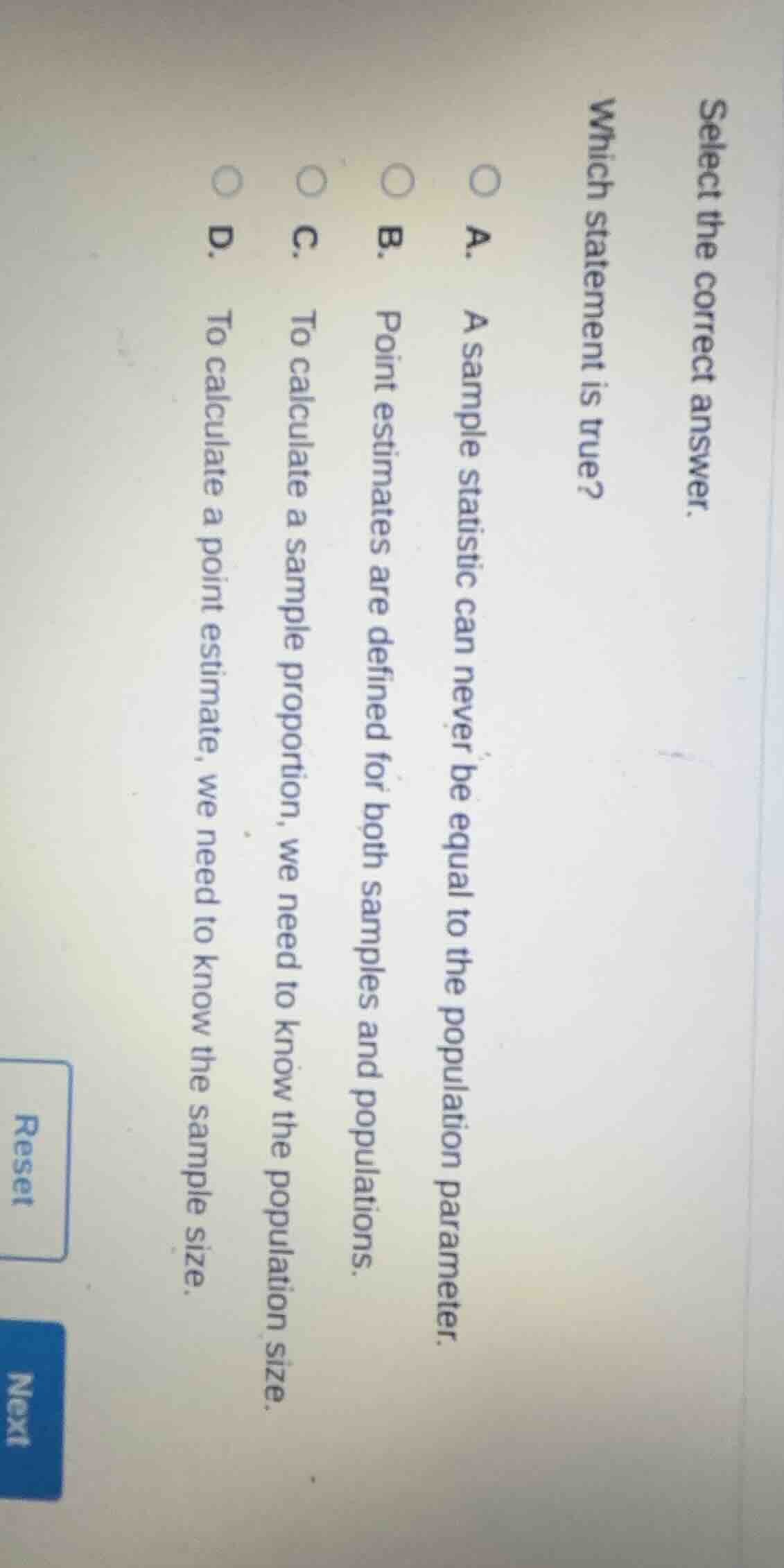
select the correct answer. which statement is true? a. a sample statistic can never be equal to the population parameter. b. point estimates are defined for both samples and populations. c. to calculate a sample proportion, we need to know the population size. d. to calculate a point estimate, we need to know the sample size.
Brief Explanations
- Option A: A sample statistic can be equal to the population parameter (e.g., if the sample is the entire population or by chance), so A is false.
- Option B: Point estimates are used to estimate population parameters from sample statistics, and we can also have point estimates related to samples (or use sample stats as point estimates for population). So point estimates apply to both samples (in the context of estimating population) and can be thought of in relation to populations (though population parameters are exact, point estimates are used to approximate them). This statement is true.
- Option C: To calculate a sample proportion, we need the number of successes in the sample and the sample size (\( \hat{p}=\frac{x}{n} \)), not the population size. So C is false.
- Option D: To calculate a point estimate (e.g., sample mean \( \bar{x}=\frac{\sum x}{n} \), sample proportion \( \hat{p}=\frac{x}{n} \)), we need sample - related information (sum of sample values, number of successes in sample, sample size), not the population size. So D is false.

Snap & solve any problem in the app
Get step-by-step solutions on Sovi AI
Photo-based solutions with guided steps
Explore more problems and detailed explanations
B. Point estimates are defined for both samples and populations.