QUESTION IMAGE
Question
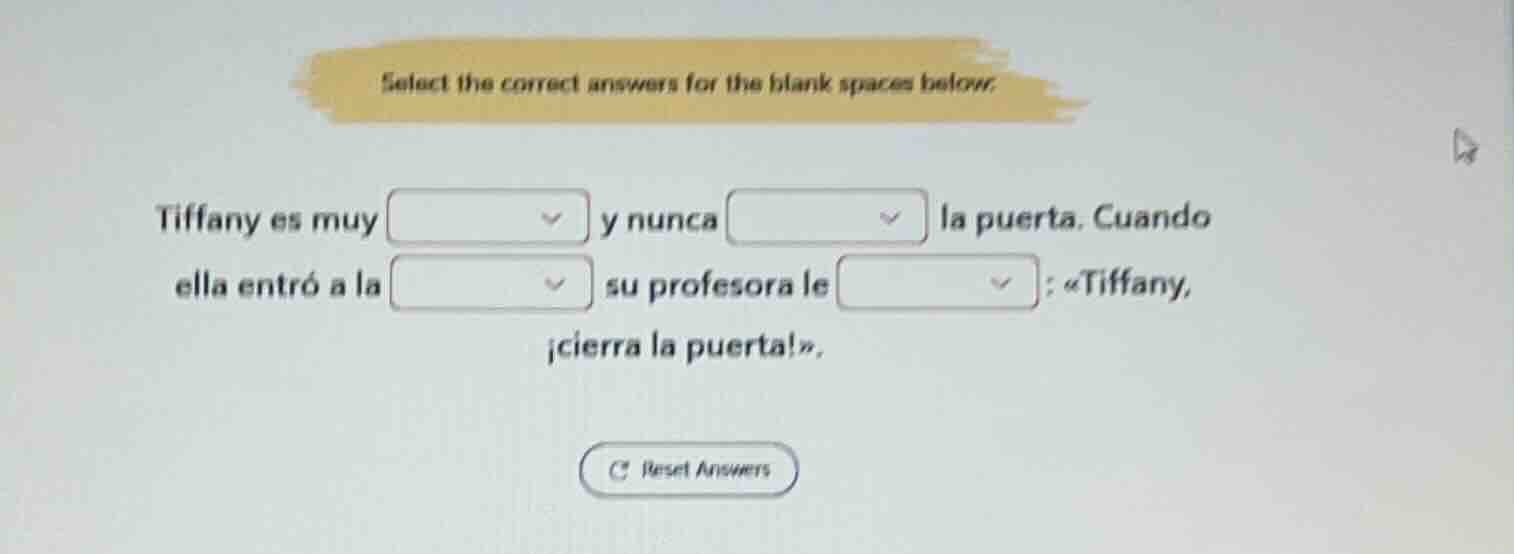
select the correct answers for the blank spaces below.
tiffany es muy
y nunca
la puerta. cuando
ella entró a la
su profesora le
: «tiffany,
¡cierra la puerta!».
reset answers
To solve this Spanish fill - in - the - blank problem, we analyze each blank based on Spanish grammar and context:
First Blank
The structure “es muy + adjective” is used here. We need an adjective to describe Tiffany. A suitable adjective could be “distraída” (distracted).
Second Blank
The phrase “nunca + verb (in present tense, since it's a habitual action)” is required. The verb related to the door action is “cierra” (closes), but since it's a negative habitual action (nunca), the correct verb form is “cierra” in the negative context? Wait, no. Wait, the subject is Tiffany (third - person singular). The action of not closing the door. The verb “cerrar” (to close) in the present tense for third - person singular is “cierra”, but in the negative “nunca cierra”.
Third Blank
The prepositional phrase “entró a la + noun” needs a noun. A suitable noun is “clase” (class), as the context is about entering a place where the teacher is, like a classroom.
Fourth Blank
The structure “le + verb (in past tense, since the action of the teacher speaking happened when she entered)” is needed. The verb “decir” (to say) in the past tense for third - person singular is “dijo”.
Let's assume the possible options (even though the options aren't fully provided, based on common Spanish vocabulary for this context):
- First blank: distraída (adjective, describes Tiffany as distracted)
- Second blank: cierra (verb, “nunca cierra la puerta” - never closes the door)
- Third blank: clase (noun, “entró a la clase” - entered the class)
- Fourth blank: dijo (verb, “su profesora le dijo” - her teacher said to her)
- First blank: "distraída" fits as an adjective to describe Tiffany's state (distracted) in "es muy distraída".
- Second blank: "cierra" is the present - tense, third - person singular form of "cerrar" (to close), and "nunca cierra la puerta" makes sense for a habitual action of not closing the door (in the negative context of "nunca").
- Third blank: "clase" is a logical noun for the place she entered, "entró a la clase" (entered the class).
- Fourth blank: "dijo" is the preterite (past - tense) form of "decir" (to say) for third - person singular, and "su profesora le dijo" correctly conveys that the teacher spoke to her.

Snap & solve any problem in the app
Get step-by-step solutions on Sovi AI
Photo-based solutions with guided steps
Explore more problems and detailed explanations
- distraída
- cierra
- clase
- dijo
(Note: If there were specific options provided, we would choose from them. The above is based on common Spanish vocabulary for this type of context.)