QUESTION IMAGE
Question
select the correct graph below.
a.
-10 -8 -6 -4 -2 0 2 4 6 8 10
b.
-10 -8 -6 -4 -2 0 2 4 6 8 10
c.
-10 -8 -6 -4 -2 0 2 4 6 8 10
d.
-10 -8 -6 -4 -2 0 2 4 6 8 10
e.
-10 -8 -6 -4 -2 0 2 4 6 8 10
f.
-10 -8 -6 -4 -2 0 2 4 6 8 10
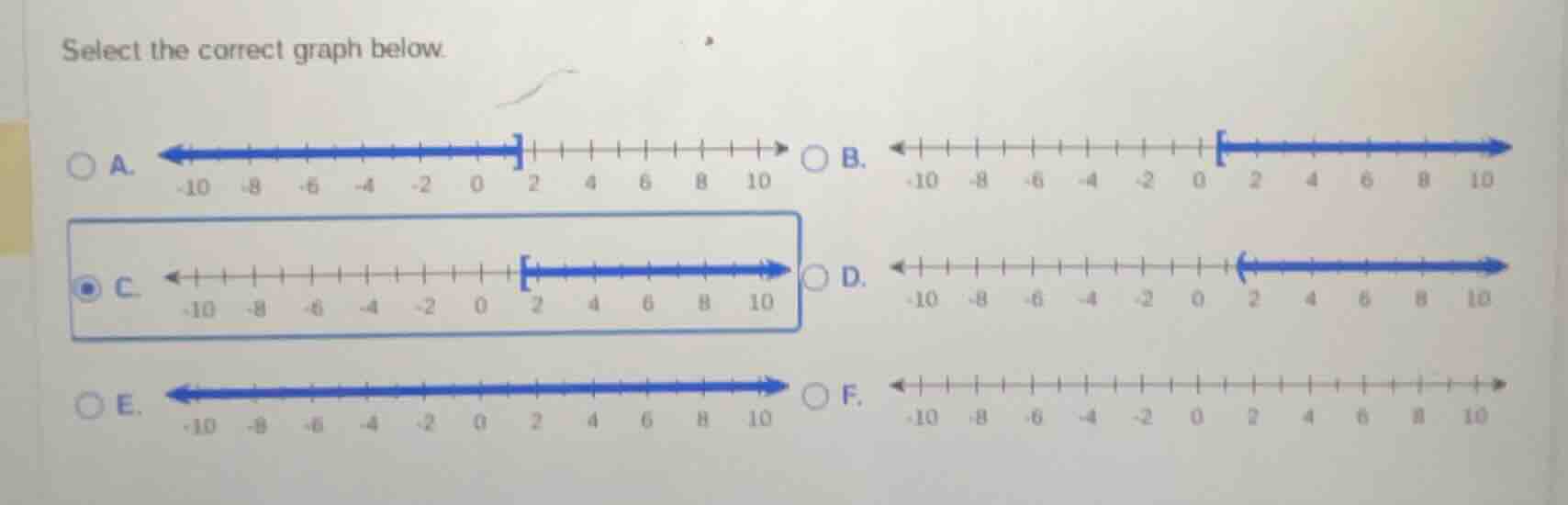
To determine the correct graph, we analyze the number line representations:
Step 1: Understand the number line notation
- A square bracket (e.g.,
]or[) indicates inclusion of the endpoint, while a parenthesis (e.g.,)or() indicates exclusion. - The direction of the arrow (left or right) indicates the set of numbers being represented (e.g., all numbers less than or greater than a given value).
Step 2: Analyze each option
- Option A: The square bracket is at 2, and the arrow points left (numbers ≤ 2). But the bracket is a right bracket
], which typically denotes exclusion, but the arrow direction is left. This is inconsistent. - Option B: The square bracket is at 1 (wait, no, the number line is marked at 0, 2, etc.). Wait, the number line has marks at -10, -8, ..., 10. The bracket is at 1? No, looking again, the number line for B has a square bracket at 1? No, the labels are -10, -8, -6, -4, -2, 0, 2, 4, ..., 10. So the bracket in B is at 1? No, maybe a typo. Wait, the correct graph for a number line with a square bracket at 2 (inclusive) and arrow to the right (numbers ≥ 2) would have a left square bracket
[at 2 and arrow right.
- Option C: The square bracket is at 2 (left bracket
[), and the arrow points right. This represents all numbers ≥ 2 (inclusive of 2). This is the standard notation for \( x \geq 2 \). - Option D: The parenthesis is at 2 (exclusive), arrow right (numbers > 2). But the question likely involves an inclusive endpoint.
- Option E: The entire number line is shaded (all real numbers), which is not typical unless the inequality is \( x \in \mathbb{R} \), but that’s rare.
- Option F: No shading, so incorrect.
The correct graph should represent a set of numbers starting from 2 (inclusive) and extending to the right. Option C has a left square bracket [ at 2 (indicating inclusion) and an arrow pointing right (indicating all numbers greater than or equal to 2). Other options either have incorrect brackets, arrow directions, or no shading.

Snap & solve any problem in the app
Get step-by-step solutions on Sovi AI
Photo-based solutions with guided steps
Explore more problems and detailed explanations
C. The graph with a left square bracket at 2 and an arrow pointing to the right (representing \( x \geq 2 \)).