QUESTION IMAGE
Question
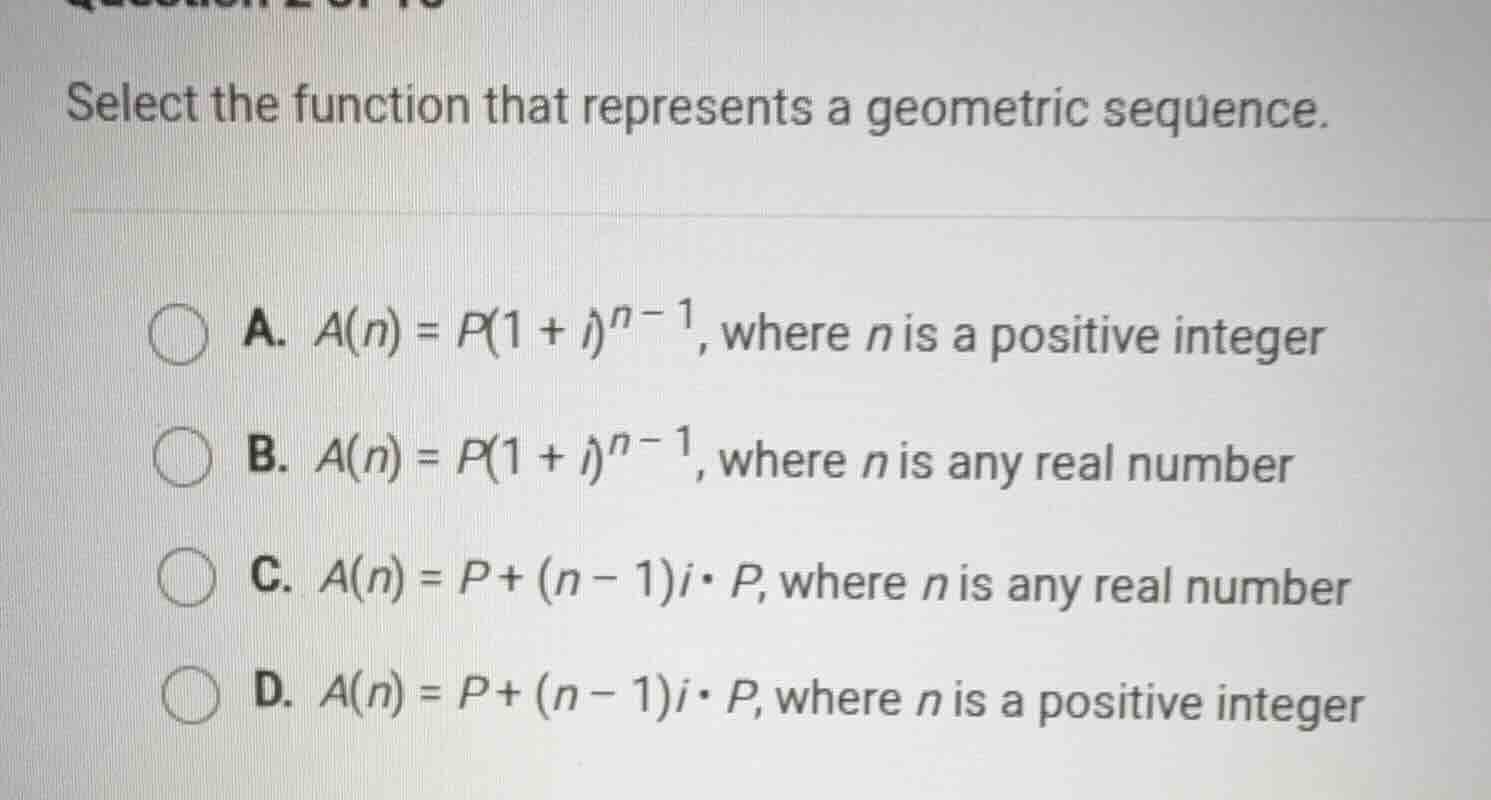
select the function that represents a geometric sequence. a. $a(n) = p(1 + i)^{n - 1}$, where $n$ is a positive integer b. $a(n) = p(1 + i)^{n - 1}$, where $n$ is any real number c. $a(n) = p + (n - 1)i \cdot p$, where $n$ is any real number d. $a(n) = p + (n - 1)i \cdot p$, where $n$ is a positive integer
Step1: Recall geometric sequence form
A geometric sequence has the form $a_n = a_1 r^{n-1}$, where $n$ is a positive integer (sequence terms are defined for counting positions: 1st, 2nd, 3rd, ...).
Step2: Analyze linear vs exponential forms
Options C and D are linear in $n$, matching the arithmetic sequence formula $a_n = a_1 + (n-1)d$, so they are not geometric.
Step3: Check domain of $n$
Geometric sequences are defined for positive integer positions, not all real numbers. So Option B (real number $n$) is invalid, while Option A uses positive integer $n$ and has the exponential form of a geometric sequence.

Snap & solve any problem in the app
Get step-by-step solutions on Sovi AI
Photo-based solutions with guided steps
Explore more problems and detailed explanations
A. $A(n) = P(1 + i)^{n - 1}$, where $n$ is a positive integer