QUESTION IMAGE
Question
select one:
a. $f(x) = \frac{-12(x+1)(x-3)}{(x+3)^2(x-4)}$.
b. $f(x) = \frac{4(x+1)(x-3)}{(x+3)(x-4)}$.
c. $f(x) = \frac{(x+3)^2(x-4)}{12(x+1)(x-3)}$.
d. $f(x) = \frac{12(x+1)(x-3)}{(x+3)^2(x-4)}$.
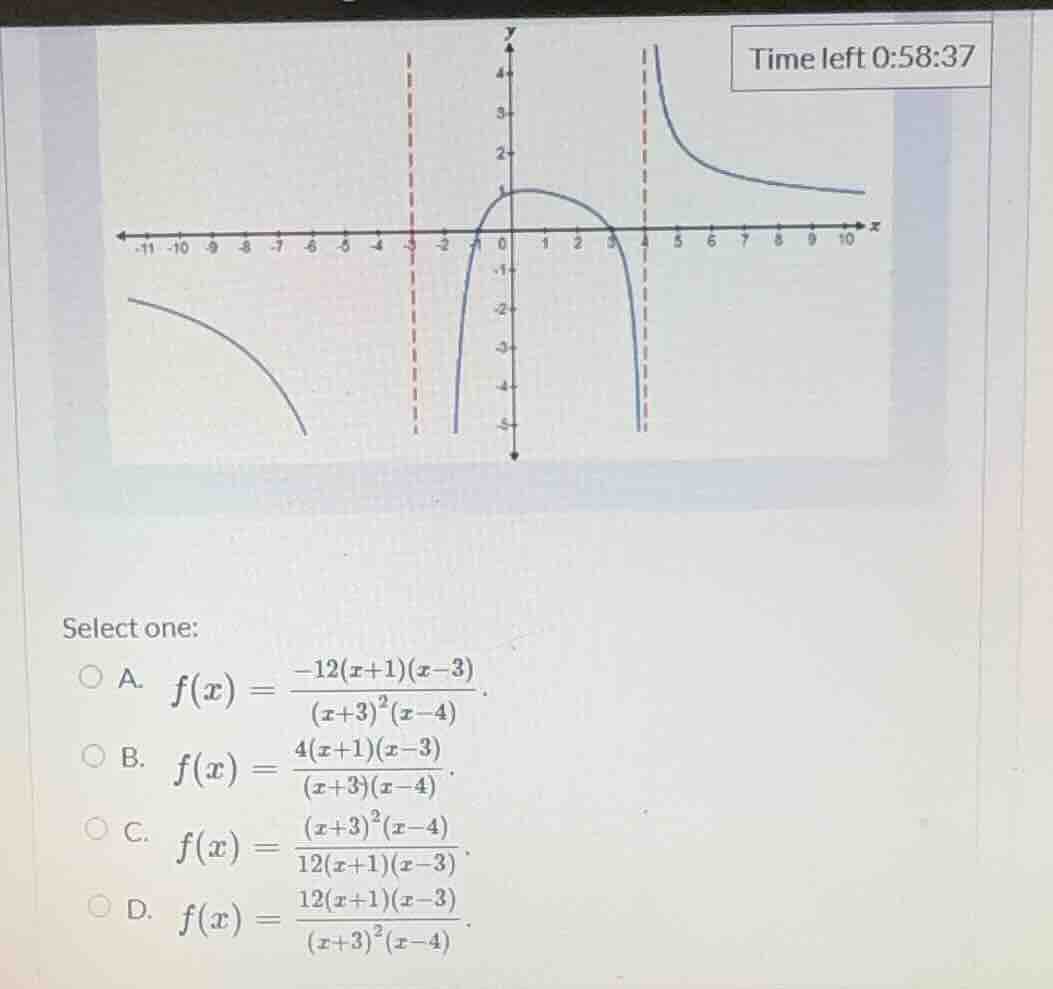
Step1: Identify vertical asymptotes
Vertical asymptotes occur where denominator is 0 (and numerator is not 0). From the graph, vertical asymptotes are $x=-3$ and $x=4$.
- For $x=-3$: The graph shows it is a "double" asymptote (both sides of $x=-3$ go to the same direction of infinity), so $(x+3)^2$ is in the denominator.
- For $x=4$: The graph has opposite behavior on either side, so $(x-4)$ is in the denominator.
Denominator form: $(x+3)^2(x-4)$
Step2: Identify x-intercepts
x-intercepts are where numerator is 0 (denominator not 0). From the graph, intercepts are $x=-1$ and $x=3$.
Numerator form: $k(x+1)(x-3)$, where $k$ is a constant.
Step3: Determine sign of constant $k$
Look at $x>4$: The graph is positive (above x-axis). Plug $x=5$ into numerator/denominator:
- Numerator: $k(5+1)(5-3)=k(6)(2)=12k$
- Denominator: $(5+3)^2(5-4)=64(1)=64>0$
Since $f(5)>0$, $\frac{12k}{64}>0$, so $k>0$.
Step4: Check y-intercept
Y-intercept is at $x=0$, graph shows $f(0)>0$.
For option D: $f(0)=\frac{12(0+1)(0-3)}{(0+3)^2(0-4)}=\frac{12(1)(-3)}{9(-4)}=\frac{-36}{-36}=1>0$, which matches the graph.
For option A: $f(0)=\frac{-12(1)(-3)}{9(-4)}=\frac{36}{-36}=-1<0$, which does not match.

Snap & solve any problem in the app
Get step-by-step solutions on Sovi AI
Photo-based solutions with guided steps
Explore more problems and detailed explanations
D. $f(x) = \frac{12(x+1)(x-3)}{(x+3)^2(x-4)}$