QUESTION IMAGE
Question
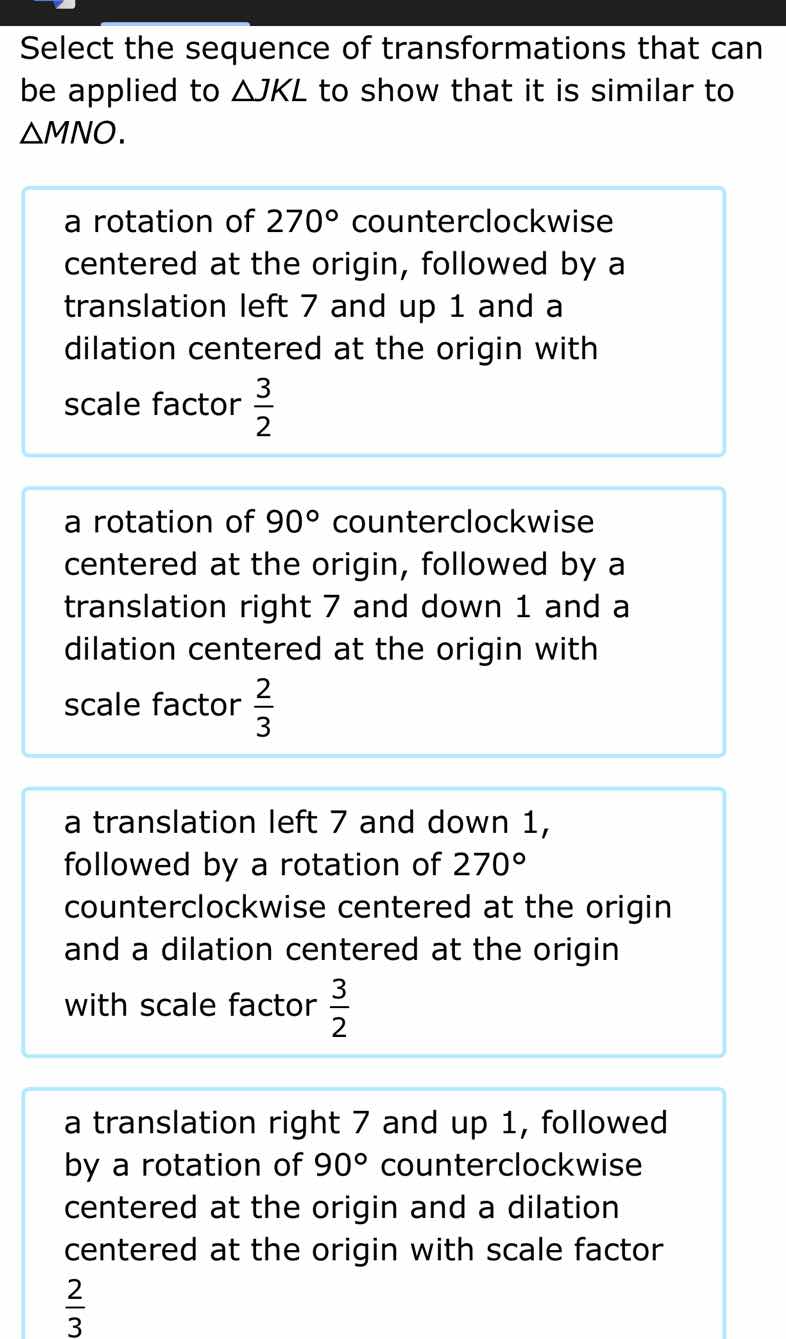
select the sequence of transformations that can be applied to $\triangle jkl$ to show that it is similar to $\triangle mno$.
a rotation of $270^\circ$ counterclockwise centered at the origin, followed by a translation left 7 and up 1 and a dilation centered at the origin with scale factor $\frac{3}{2}$
a rotation of $90^\circ$ counterclockwise centered at the origin, followed by a translation right 7 and down 1 and a dilation centered at the origin with scale factor $\frac{2}{3}$
a translation left 7 and down 1, followed by a rotation of $270^\circ$ counterclockwise centered at the origin and a dilation centered at the origin with scale factor $\frac{3}{2}$
a translation right 7 and up 1, followed by a rotation of $90^\circ$ counterclockwise centered at the origin and a dilation centered at the origin with scale factor $\frac{2}{3}$
To determine the correct sequence of transformations, we analyze the properties of similar triangles (preserved shape, proportional sides via dilation, and congruent angles via rigid transformations like rotation/translation).
Key Observations:
- Dilation Scale Factor: Similar triangles have sides in proportion. If \( \triangle JKL \) is transformed to \( \triangle MNO \), we check the scale factor. Typically, to map a smaller triangle to a larger one, the scale factor is greater than 1 (or vice versa).
- Rotation Direction: A \( 90^\circ \) counterclockwise rotation vs. \( 270^\circ \) counterclockwise (equivalent to \( 90^\circ \) clockwise) affects orientation.
- Translation Direction: Translations adjust position before/after rotation.
Analyzing Each Option:
- Option 1: Rotation \( 270^\circ \) counterclockwise, translation left 7/up 1, dilation \( \frac{3}{2} \).
- \( 270^\circ \) counterclockwise rotation aligns orientation.
- Translation adjusts position.
- Dilation \( \frac{3}{2} \) (scale > 1) enlarges, consistent with similar triangles (proportional sides).
- Option 2: Rotation \( 90^\circ \) counterclockwise, translation right 7/down 1, dilation \( \frac{2}{3} \).
- Dilation \( \frac{2}{3} \) (scale < 1) shrinks, which is inconsistent if \( \triangle JKL \) is smaller than \( \triangle MNO \).
- Option 3: Translation left 7/down 1, rotation \( 270^\circ \) counterclockwise, dilation \( \frac{3}{2} \).
- Translation before rotation can misalign the center of rotation (origin), making the transformation less intuitive for similarity.
- Option 4: Translation right 7/up 1, rotation \( 90^\circ \) counterclockwise, dilation \( \frac{2}{3} \).
- Dilation \( \frac{2}{3} \) (scale < 1) shrinks, inconsistent with similarity if scaling up is needed.
The first option (rotation \( 270^\circ \) counterclockwise, translation left 7/up 1, dilation \( \frac{3}{2} \)) correctly combines rigid transformations (rotation, translation) to align the triangle and dilation to ensure proportional sides, satisfying similarity.

Snap & solve any problem in the app
Get step-by-step solutions on Sovi AI
Photo-based solutions with guided steps
Explore more problems and detailed explanations
a rotation of \( 270^\circ \) counterclockwise centered at the origin, followed by a translation left 7 and up 1 and a dilation centered at the origin with scale factor \( \frac{3}{2} \)