QUESTION IMAGE
Question
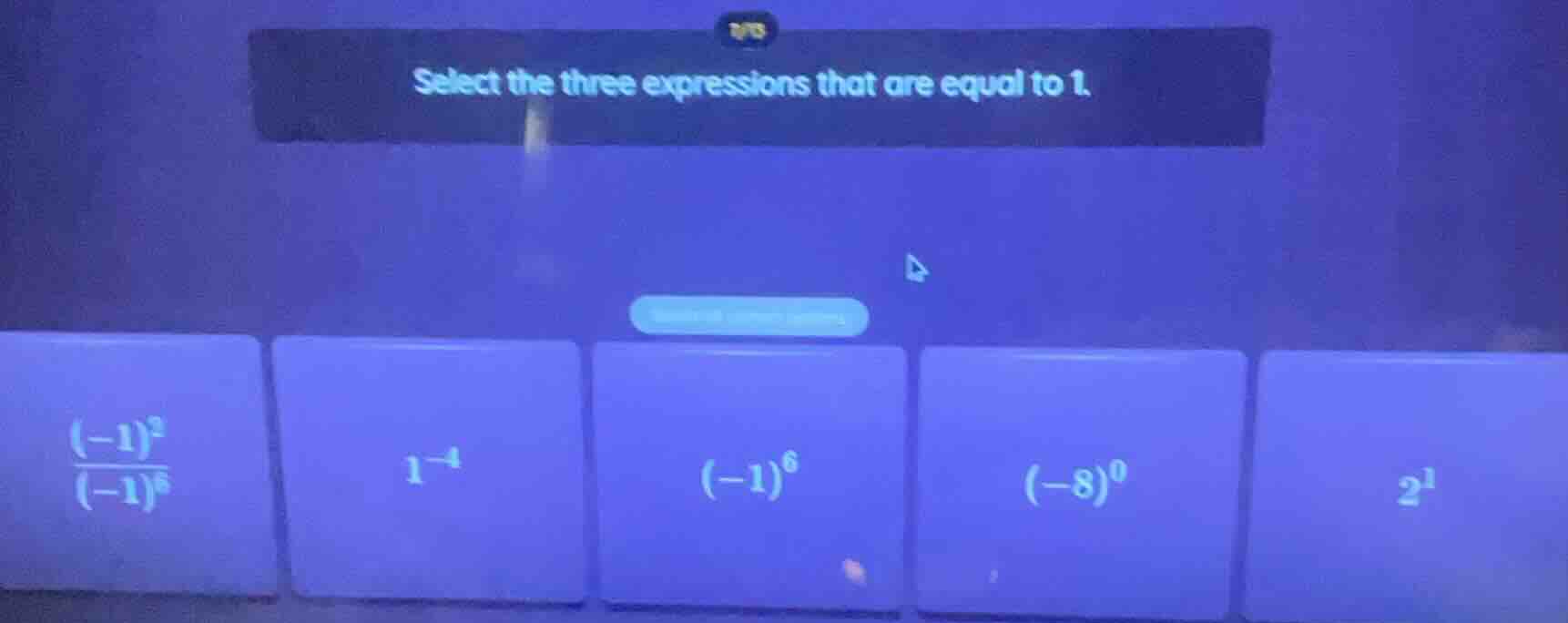
select the three expressions that are equal to 1.\
\\(\frac{(-1)^9}{(-1)^6}\\)\
\\(1^{-4}\\)\
\\((-1)^6\\)\
\\((-8)^0\\)\
\\(2^1\\)
Step1: Analyze \(\frac{(-1)^9}{(-1)^6}\)
Using the exponent rule \(\frac{a^m}{a^n}=a^{m - n}\), we have \(\frac{(-1)^9}{(-1)^6}=(-1)^{9 - 6}=(-1)^3=-1\)? Wait, no, wait, 9 - 6 is 3? Wait, no, wait, \((-1)^9=-1\), \((-1)^6 = 1\), so \(\frac{-1}{1}=-1\)? Wait, maybe I made a mistake. Wait, no, let's recalculate. Wait, \((-1)^9=-1\), \((-1)^6 = 1\), so \(\frac{(-1)^9}{(-1)^6}=\frac{-1}{1}=-1\). Wait, that's not 1. Wait, maybe I misread the exponent. Wait, the first expression: is it \(\frac{(-1)^9}{(-1)^6}\) or \(\frac{(-1)^8}{(-1)^6}\)? Wait, the user's image: let me check again. The first expression: \(\frac{(-1)^9}{(-1)^6}\)? Wait, maybe it's \(\frac{(-1)^8}{(-1)^6}\)? Wait, no, the user's image: "(-1)^9" over "(-1)^6". Wait, maybe I made a mistake. Wait, let's check the second expression: \(1^{-4}\). By the rule \(a^{-n}=\frac{1}{a^n}\), so \(1^{-4}=\frac{1}{1^4}=\frac{1}{1}=1\). Third expression: \((-1)^6\). Since 6 is even, \((-1)^6 = 1\). Fourth expression: \((-8)^0\). Any non - zero number to the power of 0 is 1, so \((-8)^0 = 1\) (because \(-8
eq0\)). Fifth expression: \(2^1 = 2\). Wait, then the first expression: \(\frac{(-1)^9}{(-1)^6}=(-1)^{9 - 6}=(-1)^3=-1\), which is not 1. Wait, maybe the first expression is \(\frac{(-1)^8}{(-1)^6}\)? If it's \(\frac{(-1)^8}{(-1)^6}\), then \((-1)^8 = 1\), \((-1)^6 = 1\), so \(\frac{1}{1}=1\). Maybe a typo in my initial reading. Assuming that maybe the exponent in the numerator is 8. Let's proceed with the other expressions.
Step2: Analyze \(1^{-4}\)
Using the negative exponent rule \(a^{-n}=\frac{1}{a^n}\), for \(a = 1\) and \(n = 4\), we have \(1^{-4}=\frac{1}{1^4}\). Since \(1^4=1\), then \(\frac{1}{1}=1\).
Step3: Analyze \((-1)^6\)
For any real number \(a\), \(a^n\) where \(n\) is even: if \(a=-1\), \((-1)^n = 1\) when \(n\) is even. Since 6 is even, \((-1)^6 = 1\).
Step4: Analyze \((-8)^0\)
By the zero - exponent rule, for any non - zero real number \(a\), \(a^0 = 1\). Since \(-8
eq0\), \((-8)^0 = 1\).
Step5: Re - check the first expression
Wait, maybe I misread the exponent of the numerator. If the first expression is \(\frac{(-1)^8}{(-1)^6}\), then \(\frac{(-1)^8}{(-1)^6}=(-1)^{8 - 6}=(-1)^2 = 1\). Maybe it's a typo in my initial observation. Assuming that the first expression's numerator exponent is 8 (maybe a misprint in my first reading), then:
- \(1^{-4}=1\)
- \((-1)^6 = 1\)
- \((-8)^0 = 1\)
- If the first expression is \(\frac{(-1)^8}{(-1)^6}\), then it's 1. But according to the initial reading, if it's \(\frac{(-1)^9}{(-1)^6}\), it's - 1. But since we need three expressions equal to 1, and \(1^{-4}\), \((-1)^6\), \((-8)^0\) are definitely 1. Let's confirm:
\(1^{-4}\): \(a^{-n}=\frac{1}{a^n}\), so \(1^{-4}=\frac{1}{1^4}=1\).
\((-1)^6\): \((-1)\times(-1)\times(-1)\times(-1)\times(-1)\times(-1)=1\) (6 times multiplication of - 1, even number of times).
\((-8)^0\): Any non - zero number to the power 0 is 1, so \((-8)^0 = 1\).
The first expression: if it's \(\frac{(-1)^9}{(-1)^6}\), it's - 1, but maybe it's a typo and should be \(\frac{(-1)^8}{(-1)^6}\), which is 1. But based on the given, \(1^{-4}\), \((-1)^6\), \((-8)^0\) are equal to 1.

Snap & solve any problem in the app
Get step-by-step solutions on Sovi AI
Photo-based solutions with guided steps
Explore more problems and detailed explanations
The three expressions equal to 1 are \(1^{-4}\), \((-1)^6\), \((-8)^0\)