QUESTION IMAGE
Question
separation of powers scenario #2
in 1918, after wwi, president
wilson had worked very hard
to help create the treaty of
versailles. however, many
americans were worried that
ratifying the treaty, and
therefore joining the league of
nations, would drag america
into future european conflicts.
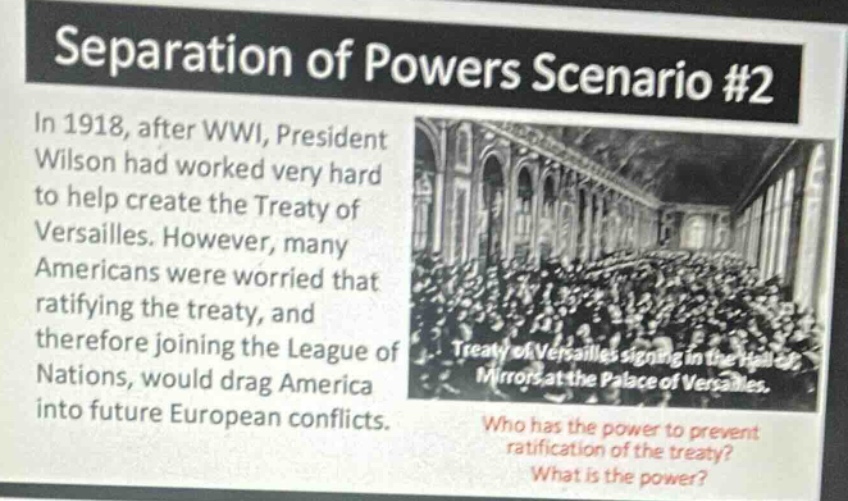
treaty of versailles signing in the hall of
mirrors at the palace of versailles.
who has the power to prevent
ratification of the treaty?
what is the power?
Under the U.S. system of separation of powers, the Constitution grants the Senate the authority to approve or reject treaties negotiated by the executive branch. A treaty requires a two-thirds majority vote in the Senate to be ratified; without this, the treaty cannot take effect.

Snap & solve any problem in the app
Get step-by-step solutions on Sovi AI
Photo-based solutions with guided steps
Explore more problems and detailed explanations
- The U.S. Senate has the power to prevent ratification of the treaty.
- The power is the Senate's constitutional authority to ratify treaties (requiring a two-thirds majority vote to approve, so failing to meet this threshold blocks ratification).