QUESTION IMAGE
Question
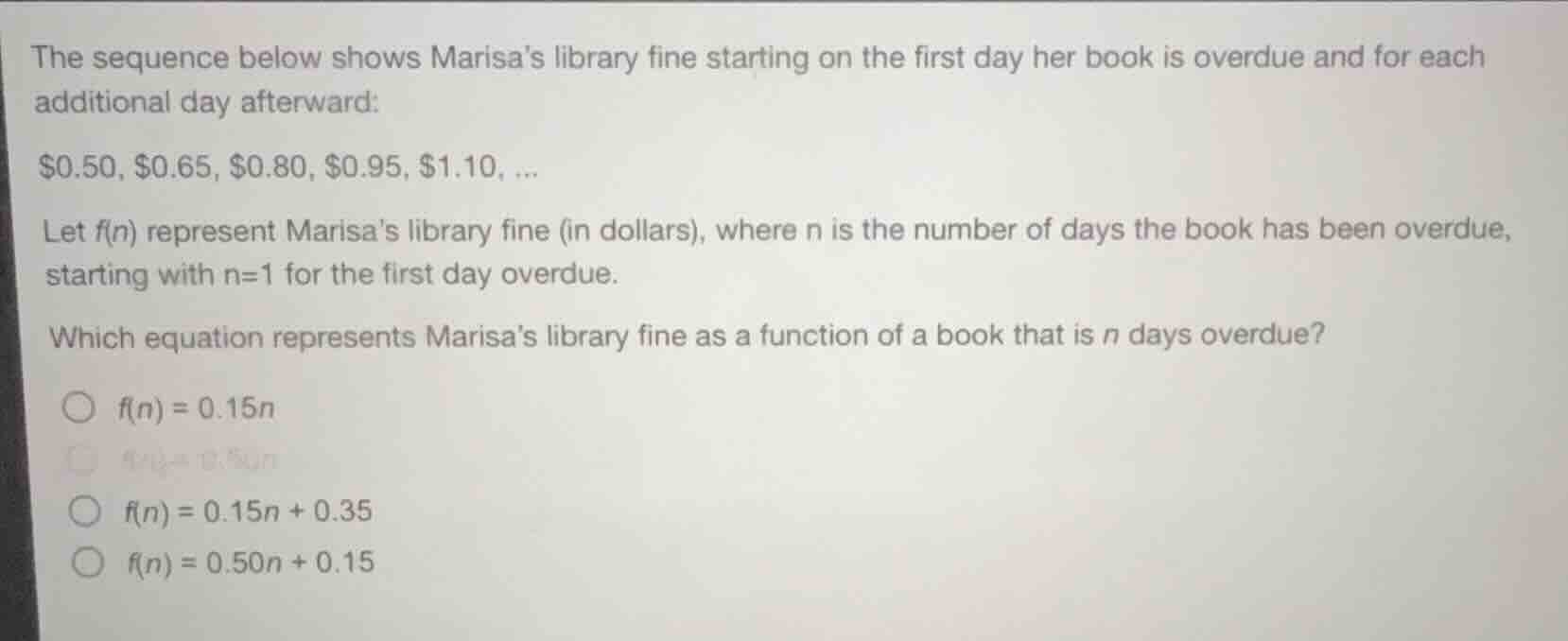
the sequence below shows marisas library fine starting on the first day her book is overdue and for each additional day afterward: $0.50, $0.65, $0.80, $0.95, $1.10, ... let f(n) represent marisas library fine (in dollars), where n is the number of days the book has been overdue, starting with n=1 for the first day overdue. which equation represents marisas library fine as a function of a book that is n days overdue? \\( f(n) = 0.15n \\) \\( f(n) = 0.15n + 0.35 \\) \\( f(n) = 0.50n + 0.15 \\)
Step1: Identify sequence type
This is an arithmetic sequence, where the common difference $d$ between consecutive terms is constant. Calculate $d$:
$d = 0.65 - 0.50 = 0.15$
Step2: Recall arithmetic sequence formula
The general form for an arithmetic sequence function (starting at $n=1$) is:
$f(n) = a_1 + (n-1)d$
where $a_1 = 0.50$ is the first term.
Step3: Substitute values and simplify
Substitute $a_1=0.50$ and $d=0.15$ into the formula:
$f(n) = 0.50 + (n-1)(0.15)$
$f(n) = 0.50 + 0.15n - 0.15$
$f(n) = 0.15n + 0.35$
Step4: Verify with given values
Test $n=1$: $f(1)=0.15(1)+0.35=0.50$ (matches the first day fine)
Test $n=2$: $f(2)=0.15(2)+0.35=0.65$ (matches the second day fine)

Snap & solve any problem in the app
Get step-by-step solutions on Sovi AI
Photo-based solutions with guided steps
Explore more problems and detailed explanations
$f(n) = 0.15n + 0.35$