QUESTION IMAGE
Question
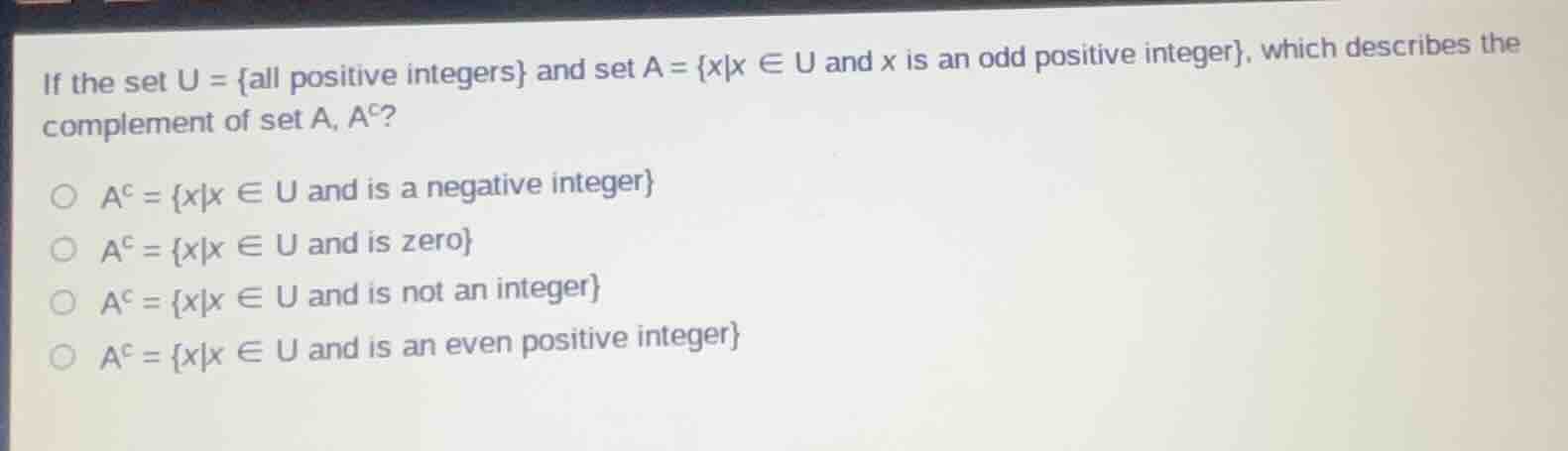
if the set u = {all positive integers} and set a = {x|x ∈ u and x is an odd positive integer}, which describes the complement of set a, ( a^c )?
( a^c = {x|x ∈ u \text{ and is a negative integer}} )
( a^c = {x|x ∈ u \text{ and is zero}} )
( a^c = {x|x ∈ u \text{ and is not an integer}} )
( a^c = {x|x ∈ u \text{ and is an even positive integer}} )
The universal set \( U \) is all positive integers. The set \( A \) is the set of odd positive integers. The complement of a set \( A \) (denoted \( A^c \)) consists of all elements in \( U \) that are not in \( A \). Since positive integers are either odd or even, the elements not in \( A \) (odd positive integers) must be the even positive integers in \( U \). Let's analyze each option:
- The first option is incorrect because \( U \) contains only positive integers, not negative integers.
- The second option is incorrect because zero is not a positive integer, so it is not in \( U \).
- The third option is incorrect because all elements of \( U \) are integers, so there are no elements in \( U \) that are not integers.
- The fourth option is correct because the even positive integers are exactly the elements of \( U \) that are not in \( A \) (the odd positive integers).

Snap & solve any problem in the app
Get step-by-step solutions on Sovi AI
Photo-based solutions with guided steps
Explore more problems and detailed explanations
\( A^c = \{x|x \in U \text{ and is an even positive integer}\} \) (the fourth option)