QUESTION IMAGE
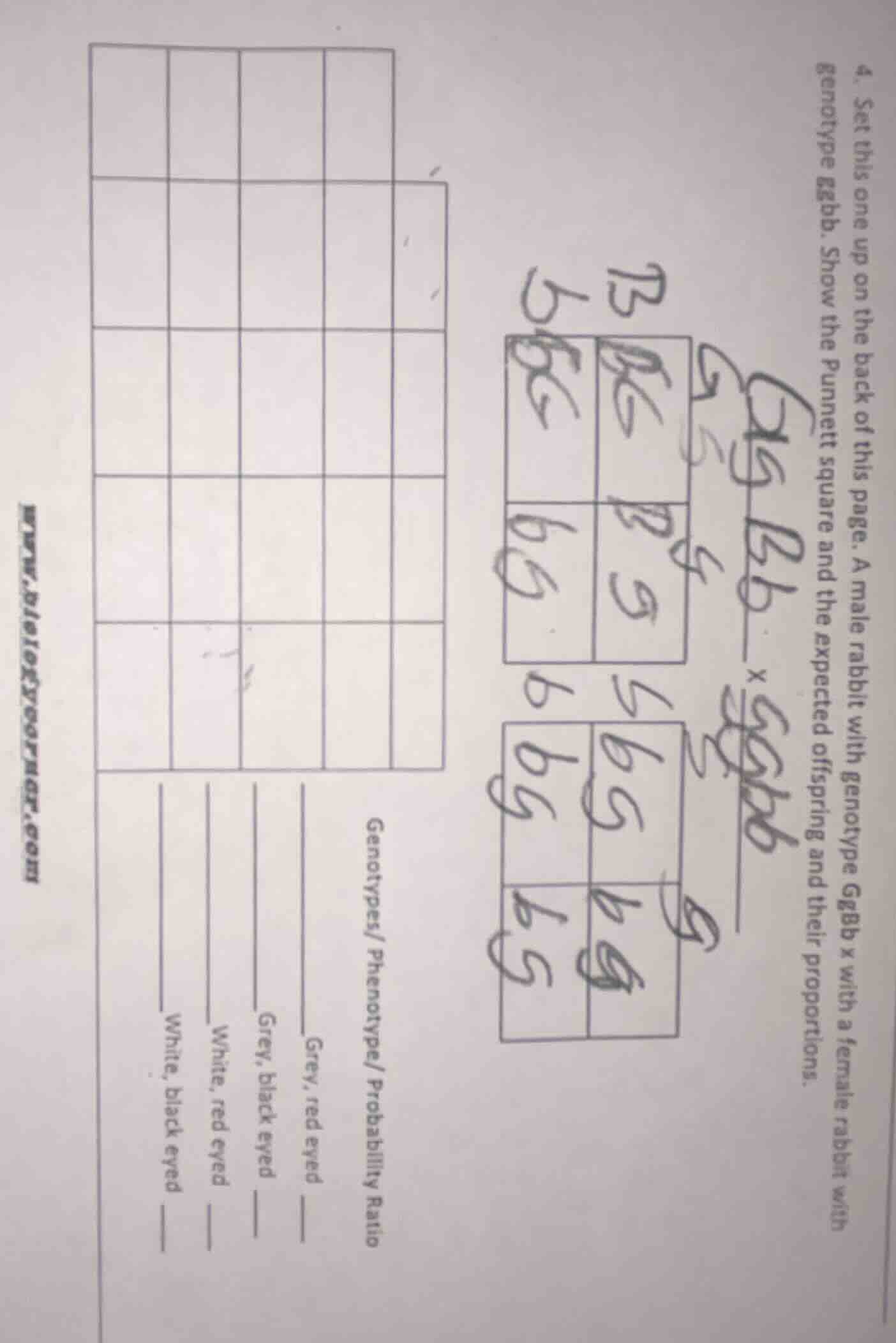
Question
- set this one up on the back of this page. a male rabbit with genotype ggbb x with a female rabbit with genotype rabb. show the punnett square and the expected offspring and their proportions.
genotypes/ phenotype/ probability ratio
grey, red eyed ____
grey, black eyed ____
white, red eyed ____
white, black eyed ____
Step1: Analyze the Genotypes
The male rabbit has genotype \( GgBb \) and the female rabbit has genotype \( ggbb \). We can use the Punnett square method to determine the possible genotypes of the offspring. First, we find the possible gametes for each parent. The male \( GgBb \) can produce gametes: \( GB \), \( Gb \), \( gB \), \( gb \). The female \( ggbb \) can only produce gametes: \( gb \).
Step2: Construct the Punnett Square
We create a 4x1 Punnett square (since the female has only one type of gamete) and combine the gametes:
| \( gb \) | |
|---|---|
| \( Gb \) | \( Ggbb \) |
| \( gB \) | \( ggBb \) |
| \( gb \) | \( ggbb \) |
Step3: Determine Phenotypes and Probabilities
Now we analyze the phenotypes. Let's assume:
- \( G \) (grey) is dominant over \( g \) (white), and \( B \) (black eyes) is dominant over \( b \) (red eyes).
- \( GgBb \): Grey, black eyed (probability \( \frac{1}{4} \))
- \( Ggbb \): Grey, red eyed (probability \( \frac{1}{4} \))
- \( ggBb \): White, black eyed (probability \( \frac{1}{4} \))
- \( ggbb \): White, red eyed (probability \( \frac{1}{4} \))
Wait, but the table in the problem has different phenotype descriptions. Let's re - evaluate the eye color and fur color. Maybe the fur color: \( G \) - grey, \( g \) - white; eye color: \( B \) - black, \( b \) - red.
Now, let's match with the given phenotype categories:
- Grey, red eyed: Genotype \( Ggbb \), probability \( \frac{1}{4} \) or 25% (since there are 4 possible offspring genotypes, each with equal probability as the female has only one gamete type and the male has four, and the Punnett square has 4 cells).
- Grey, black eyed: Genotype \( GgBb \), probability \( \frac{1}{4} \) or 25%.
- White, red eyed: Genotype \( ggbb \), probability \( \frac{1}{4} \) or 25%.
- White, black eyed: Genotype \( ggBb \), probability \( \frac{1}{4} \) or 25%.
But the table in the problem has:
- Grey, red eyed: Let's see the Punnett square results. The number of \( Ggbb \) is 1 out of 4, so probability \( \frac{1}{4} \) or 25% (or \( \frac{1}{4} \) in ratio terms, so the ratio for Grey, red eyed is 1, Grey, black eyed is 1, White, red eyed is 1, White, black eyed is 1. So the probability ratio for each is \( \frac{1}{4} \)).
Wait, maybe the initial assumption about dominance is different. Let's re - check. If the male is \( GgBb \) and female is \( ggbb \), the Punnett square gives four genotypes, each with probability \( \frac{1}{4} \).
For the phenotypes:
- Grey, red eyed (\( Ggbb \)): 1/4
- Grey, black eyed (\( GgBb \)): 1/4
- White, red eyed (\( ggbb \)): 1/4
- White, black eyed (\( ggBb \)): 1/4
So the probability ratios (or counts) for each phenotype:
- Grey, red eyed: 1
- Grey, black eyed: 1
- White, red eyed: 1
- White, black eyed: 1

Snap & solve any problem in the app
Get step-by-step solutions on Sovi AI
Photo-based solutions with guided steps
Explore more problems and detailed explanations
- Grey, red eyed: \( \frac{1}{4} \) (or 1 in 4 ratio)
- Grey, black eyed: \( \frac{1}{4} \) (or 1 in 4 ratio)
- White, red eyed: \( \frac{1}{4} \) (or 1 in 4 ratio)
- White, black eyed: \( \frac{1}{4} \) (or 1 in 4 ratio)
(If we consider the ratio as the number of each phenotype, since there are 4 offspring, each phenotype has 1, so the ratio for each is 1, and the total ratio is 1:1:1:1 for the four phenotypes respectively.)