QUESTION IMAGE
Question
1.
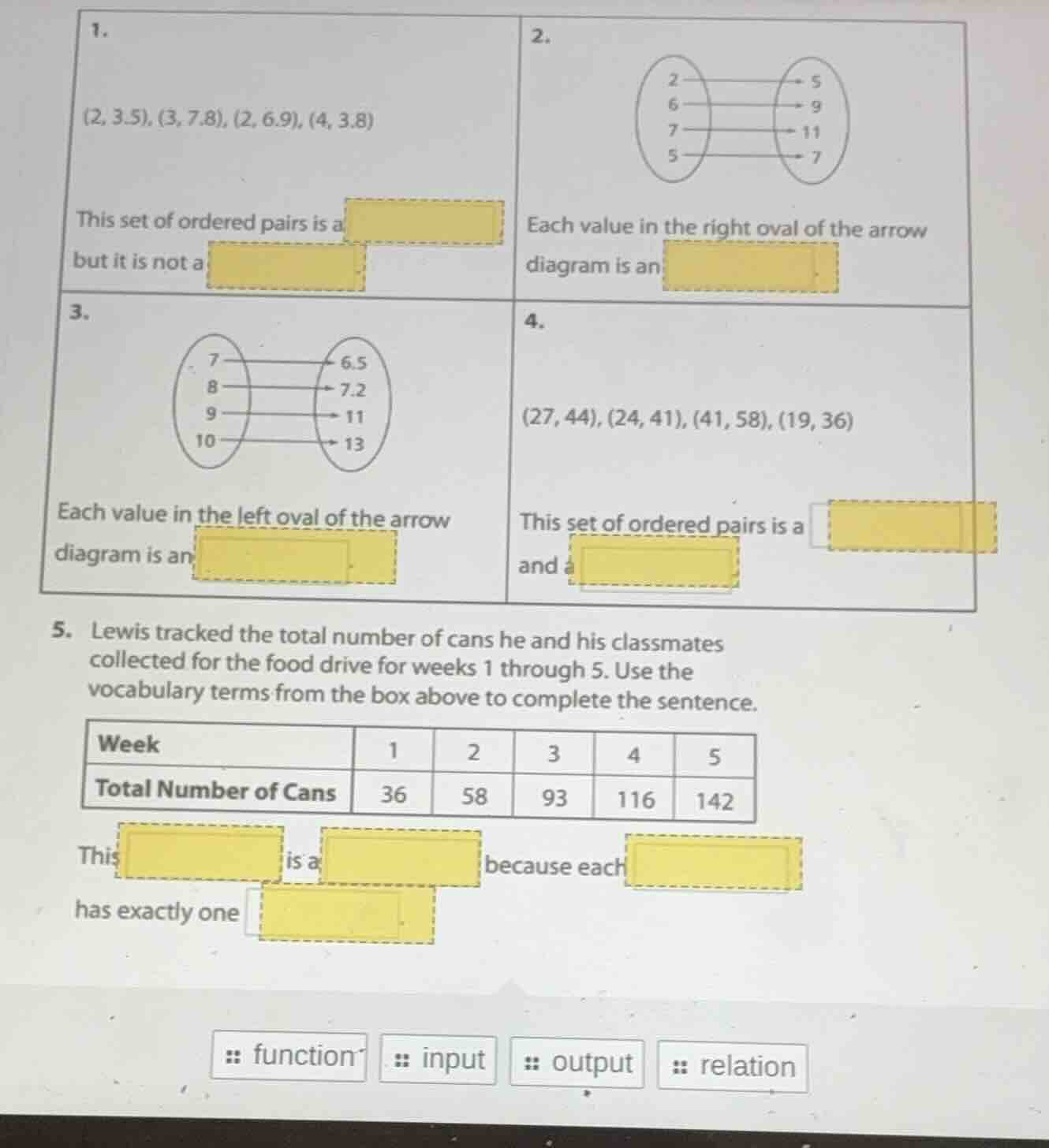
(2, 3.5), (3, 7.8), (2, 6.9), (4, 3.8)
this set of ordered pairs is a
but it is not a
2.
each value in the right oval of the arrow
diagram is an
3.
each value in the left oval of the arrow
diagram is an
4.
(27, 44), (24, 41), (41, 58), (19, 36)
this set of ordered pairs is a
and a
- lewis tracked the total number of cans he and his classmates
collected for the food drive for weeks 1 through 5. use the
vocabulary terms from the box above to complete the sentence.
week | 1 | 2 | 3 | 4 | 5
total number of cans | 36 | 58 | 93 | 116 | 142
this is a because each
has exactly one
:: function :: input :: output :: relation
Step1: Analyze Q1 ordered pairs
Ordered pairs: $(2, 3.5), (3, 7.8), (2, 6.9), (4, 3.8)$. A relation is any set of ordered pairs. A function requires each input to have only one output; here input 2 maps to two outputs.
Step2: Analyze Q2 arrow diagram
Right oval values are the results of mapping left oval values, so they are outputs.
Step3: Analyze Q3 arrow diagram
Left oval values are the values being mapped, so they are inputs.
Step4: Analyze Q4 ordered pairs
Ordered pairs: $(27, 44), (24, 41), (41, 58), (19, 36)$. It is a relation (set of ordered pairs), and each input has exactly one output, so it is a function.
Step5: Analyze Q5 table
The table links weeks (inputs) to cans (outputs). It is a relation (set of paired values), a function (each week has one can count), with weeks as inputs and cans as outputs.

Snap & solve any problem in the app
Get step-by-step solutions on Sovi AI
Photo-based solutions with guided steps
Explore more problems and detailed explanations
- This set of ordered pairs is a relation but it is not a function
- Each value in the right oval of the arrow diagram is an output
- Each value in the left oval of the arrow diagram is an input
- This set of ordered pairs is a relation and a function
- This relation is a function because each input has exactly one output