QUESTION IMAGE
Question
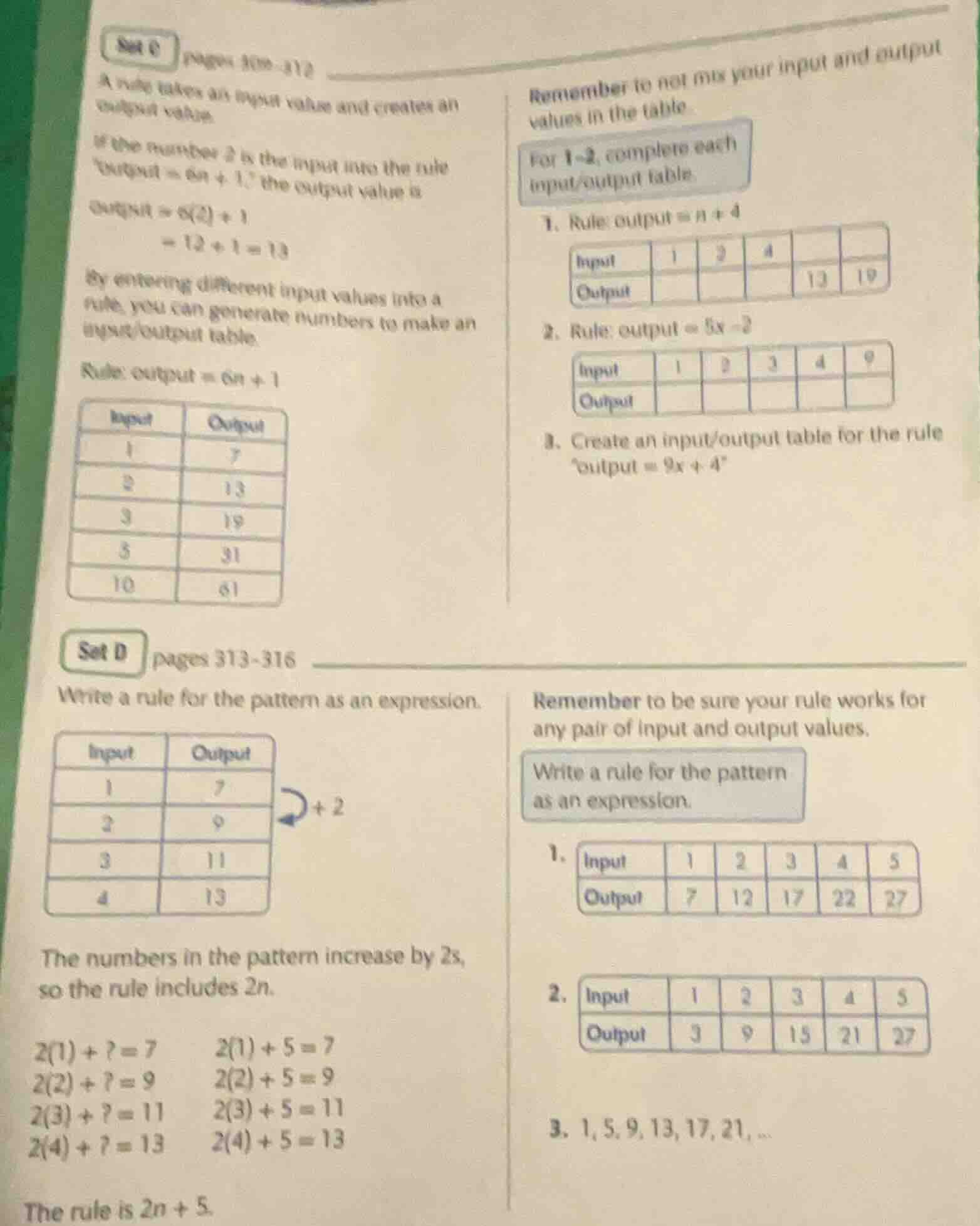
set c pages 310 - 312 a rule takes an input value and creates an output value. if the number 2 is the input into the rule output = 6n + 1, the output value is output = 6(2) + 1 = 12 + 1 = 13 by entering different input values into a rule, you can generate numbers to make an input/output table. rule: output = 6n + 1 input output 1 7 2 13 3 19 5 31 10 61 remember to not mix your input and output values in the table. for 1 - 2, complete each input/output table. 1. rule: output = n + 4 input 1 2 4 output 13 19 2. rule: output = 5x - 2 input 1 2 3 4 9 output 3. create an input/output table for the rule output = 9x + 4 set d pages 313 - 316 write a rule for the pattern as an expression. input output 1 7 2 9 3 11 4 13 + 2 the numbers in the pattern increase by 2x, so the rule includes 2n. 2(1) +? = 7 2(1) + 5 = 7 2(2) +? = 9 2(2) + 5 = 9 2(3) +? = 11 2(3) + 5 = 11 2(4) +? = 13 2(4) + 5 = 13 the rule is 2n + 5. remember to be sure your rule works for any pair of input and output values. write a rule for the pattern as an expression. 1. input 1 2 3 4 5 output 7 12 17 22 27 2. input 1 2 3 4 5 output 3 9 15 21 27 3. 1, 5, 9, 13, 17, 21,...
Problem 1 (Set C, 1)
Step 1: Find Output for Input 1
Using the rule \( \text{output} = n + 4 \), substitute \( n = 1 \):
\( \text{output} = 1 + 4 = 5 \)
Step 2: Find Output for Input 2
Substitute \( n = 2 \):
\( \text{output} = 2 + 4 = 6 \)
Step 3: Find Output for Input 4
Substitute \( n = 4 \):
\( \text{output} = 4 + 4 = 8 \)
Step 4: Find Input for Output 13
Solve \( n + 4 = 13 \) for \( n \):
\( n = 13 - 4 = 9 \)
Step 5: Find Input for Output 19
Solve \( n + 4 = 19 \) for \( n \):
\( n = 19 - 4 = 15 \)
Problem 2 (Set C, 2)
Step 1: Find Output for Input 1
Using the rule \( \text{output} = 5x - 2 \), substitute \( x = 1 \):
\( \text{output} = 5(1) - 2 = 3 \)
Step 2: Find Output for Input 2
Substitute \( x = 2 \):
\( \text{output} = 5(2) - 2 = 8 \)
Step 3: Find Output for Input 3
Substitute \( x = 3 \):
\( \text{output} = 5(3) - 2 = 13 \)
Step 4: Find Output for Input 4
Substitute \( x = 4 \):
\( \text{output} = 5(4) - 2 = 18 \)
Step 5: Find Output for Input 9
Substitute \( x = 9 \):
\( \text{output} = 5(9) - 2 = 43 \)
Problem 3 (Set C, 3)
Step 1: Choose Inputs (e.g., 1, 2, 3, 4, 5)
Let’s pick inputs \( x = 1, 2, 3, 4, 5 \).
Step 2: Calculate Output for \( x = 1 \)
Using \( \text{output} = 9x + 4 \):
\( \text{output} = 9(1) + 4 = 13 \)
Step 3: Calculate Output for \( x = 2 \)
Substitute \( x = 2 \):
\( \text{output} = 9(2) + 4 = 22 \)
Step 4: Calculate Output for \( x = 3 \)
Substitute \( x = 3 \):
\( \text{output} = 9(3) + 4 = 31 \)
Step 5: Calculate Output for \( x = 4 \)
Substitute \( x = 4 \):
\( \text{output} = 9(4) + 4 = 40 \)
Step 6: Calculate Output for \( x = 5 \)
Substitute \( x = 5 \):
\( \text{output} = 9(5) + 4 = 49 \)
Problem 1 (Set D, 1)

Snap & solve any problem in the app
Get step-by-step solutions on Sovi AI
Photo-based solutions with guided steps
Explore more problems and detailed explanations
Step 1: Identify the Pattern
Sequence: \( 1, 5, 9, 13, 17, 21, \dots \)
The common difference is \( 4 \) (slope \( m = 4 \)).
Step 2: Find the Rule
Let the rule be \( a_n = 4n + b \).
Substitute \( n = 1 \), \( a_1 = 1 \):
\( 4(1) + b = 1 \implies b = -3 \).
Thus, the rule is \( a_n = 4n - 3 \).
Final Answers (Tables/Solutions)
Set C, 1:
| Input | 1 | 2 | 4 | 9 | 15 |
|---|
Set C, 2:
| Input | 1 | 2 | 3 | 4 | 9 |
|---|
Set C, 3 (Sample Table):
| Input (\( x \)) | 1 | 2 | 3 | 4 | 5 |
|---|
Set D, 1:
Rule: \( \text{output} = 5n + 2 \)
Set D, 2:
Rule: \( \text{output} = 6n - 3 \)
Set D, 3:
Rule: \( a_n = 4n - 3 \) (or \( \text{output} = 4n - 3 \) for input \( n \))