QUESTION IMAGE
Question
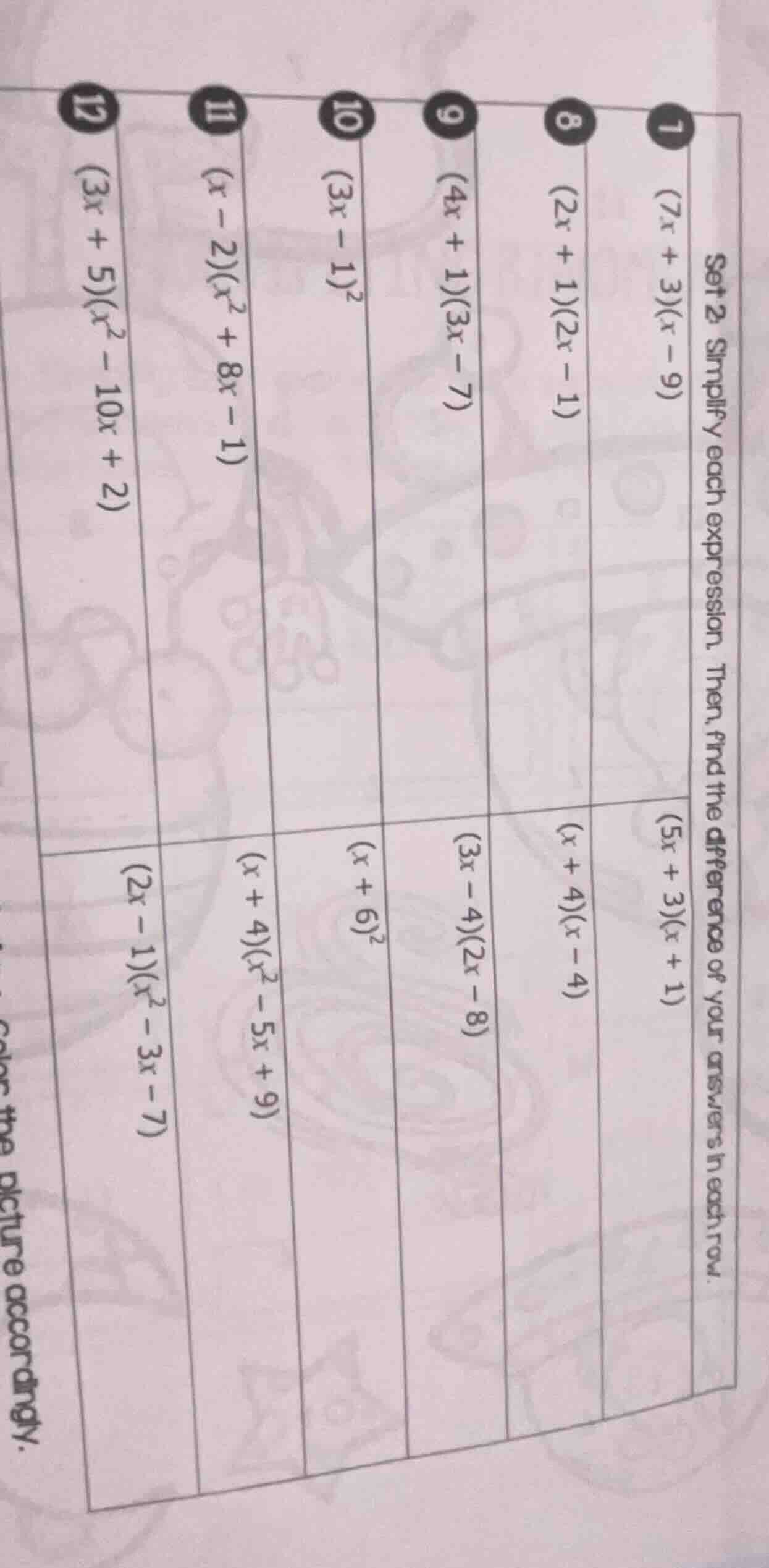
set 2 simplify each expression. then, find the difference of your answers in each row.
1 (7x + 3)(x - 9)
(5x + 3)(x + 1)
8 (2x + 1)(2x - 1)
(x + 4)(x - 4)
9 (4x + 1)(3x - 7)
(3x - 4)(2x - 8)
10 (3x - 1)^2
(x + 6)^2
11 (x - 2)(x^2 + 8x - 1)
(x + 4)(x^2 - 5x + 9)
12 (3x + 5)(x^2 - 10x + 2)
(2x - 1)(x^2 - 3x - 7)
Let's solve one of the problems, say problem 1: \((7x + 3)(x - 9)\) and \((5x + 3)(x + 1)\), then find their difference.
Step 1: Expand \((7x + 3)(x - 9)\)
Using the distributive property (FOIL method):
\[
\]
Step 2: Expand \((5x + 3)(x + 1)\)
Using the distributive property (FOIL method):
\[
\]
Step 3: Find the difference \((7x^{2}-60x - 27)-(5x^{2}+8x + 3)\)
Subtract the second expanded form from the first:
\[
\]
Let's solve problem 8: \((2x + 1)(2x - 1)\) and \((x + 4)(x - 4)\), then find their difference.
Step 1: Expand \((2x + 1)(2x - 1)\)
Using the difference of squares formula \((a + b)(a - b)=a^{2}-b^{2}\), where \(a = 2x\) and \(b = 1\):
\[
(2x + 1)(2x - 1)=(2x)^{2}-1^{2}=4x^{2}-1
\]
Step 2: Expand \((x + 4)(x - 4)\)
Using the difference of squares formula \((a + b)(a - b)=a^{2}-b^{2}\), where \(a=x\) and \(b = 4\):
\[
(x + 4)(x - 4)=x^{2}-4^{2}=x^{2}-16
\]
Step 3: Find the difference \((4x^{2}-1)-(x^{2}-16)\)
Subtract the second expanded form from the first:
\[
\]
Let's solve problem 9: \((4x + 1)(3x - 7)\) and \((3x - 4)(2x - 8)\), then find their difference.
Step 1: Expand \((4x + 1)(3x - 7)\)
Using the distributive property:
\[
\]
Step 2: Expand \((3x - 4)(2x - 8)\)
Using the distributive property:
\[
\]
Step 3: Find the difference \((12x^{2}-25x - 7)-(6x^{2}-32x + 32)\)
Subtract the second expanded form from the first:
\[
\]
Let's solve problem 10: \((3x - 1)^{2}\) and \((x + 6)^{2}\), then find their difference.
Step 1: Expand \((3x - 1)^{2}\)
Using the perfect square formula \((a - b)^{2}=a^{2}-2ab + b^{2}\), where \(a = 3x\) and \(b = 1\):
\[
(3x - 1)^{2}=(3x)^{2}-2\cdot3x\cdot1+1^{2}=9x^{2}-6x + 1
\]
Step 2: Expand \((x + 6)^{2}\)
Using the perfect square formula \((a + b)^{2}=a^{2}+2ab + b^{2}\), where \(a=x\) and \(b = 6\):
\[
(x + 6)^{2}=x^{2}+2\cdot x\cdot6+6^{2}=x^{2}+12x + 36
\]
Step 3: Find the difference \((9x^{2}-6x + 1)-(x^{2}+12x + 36)\)
Subtract the second expanded form from the first:
\[
\]
Let's solve problem 11: \((x - 2)(x^{2}+8x - 1)\) and \((x + 4)(x^{2}-5x + 9)\), then find their difference.
Step 1: Expand \((x - 2)(x^{2}+8x - 1)\)
Using the distributive property:
\[
\]
Step 2: Expand \((x + 4)(x^{2}-5x + 9)\)
Using the distributive property:
\[
\begin{align*}
&x(x^{2}-5x + 9)…

Snap & solve any problem in the app
Get step-by-step solutions on Sovi AI
Photo-based solutions with guided steps
Explore more problems and detailed explanations
Let's solve one of the problems, say problem 1: \((7x + 3)(x - 9)\) and \((5x + 3)(x + 1)\), then find their difference.
Step 1: Expand \((7x + 3)(x - 9)\)
Using the distributive property (FOIL method):
\[
\]
Step 2: Expand \((5x + 3)(x + 1)\)
Using the distributive property (FOIL method):
\[
\]
Step 3: Find the difference \((7x^{2}-60x - 27)-(5x^{2}+8x + 3)\)
Subtract the second expanded form from the first:
\[
\]
Let's solve problem 8: \((2x + 1)(2x - 1)\) and \((x + 4)(x - 4)\), then find their difference.
Step 1: Expand \((2x + 1)(2x - 1)\)
Using the difference of squares formula \((a + b)(a - b)=a^{2}-b^{2}\), where \(a = 2x\) and \(b = 1\):
\[
(2x + 1)(2x - 1)=(2x)^{2}-1^{2}=4x^{2}-1
\]
Step 2: Expand \((x + 4)(x - 4)\)
Using the difference of squares formula \((a + b)(a - b)=a^{2}-b^{2}\), where \(a=x\) and \(b = 4\):
\[
(x + 4)(x - 4)=x^{2}-4^{2}=x^{2}-16
\]
Step 3: Find the difference \((4x^{2}-1)-(x^{2}-16)\)
Subtract the second expanded form from the first:
\[
\]
Let's solve problem 9: \((4x + 1)(3x - 7)\) and \((3x - 4)(2x - 8)\), then find their difference.
Step 1: Expand \((4x + 1)(3x - 7)\)
Using the distributive property:
\[
\]
Step 2: Expand \((3x - 4)(2x - 8)\)
Using the distributive property:
\[
\]
Step 3: Find the difference \((12x^{2}-25x - 7)-(6x^{2}-32x + 32)\)
Subtract the second expanded form from the first:
\[
\]
Let's solve problem 10: \((3x - 1)^{2}\) and \((x + 6)^{2}\), then find their difference.
Step 1: Expand \((3x - 1)^{2}\)
Using the perfect square formula \((a - b)^{2}=a^{2}-2ab + b^{2}\), where \(a = 3x\) and \(b = 1\):
\[
(3x - 1)^{2}=(3x)^{2}-2\cdot3x\cdot1+1^{2}=9x^{2}-6x + 1
\]
Step 2: Expand \((x + 6)^{2}\)
Using the perfect square formula \((a + b)^{2}=a^{2}+2ab + b^{2}\), where \(a=x\) and \(b = 6\):
\[
(x + 6)^{2}=x^{2}+2\cdot x\cdot6+6^{2}=x^{2}+12x + 36
\]
Step 3: Find the difference \((9x^{2}-6x + 1)-(x^{2}+12x + 36)\)
Subtract the second expanded form from the first:
\[
\]
Let's solve problem 11: \((x - 2)(x^{2}+8x - 1)\) and \((x + 4)(x^{2}-5x + 9)\), then find their difference.
Step 1: Expand \((x - 2)(x^{2}+8x - 1)\)
Using the distributive property:
\[
\]
Step 2: Expand \((x + 4)(x^{2}-5x + 9)\)
Using the distributive property:
\[
\]
Step 3: Find the difference \((x^{3}+6x^{2}-17x + 2)-(x^{3}-x^{2}-11x + 36)\)
Subtract the second expanded form from the first:
\[
\]
Let's solve problem 12: \((3x + 5)(x^{2}-10x + 2)\) and \((2x - 1)(x^{2}-3x - 7)\), then find their difference.
Step 1: Expand \((3x + 5)(x^{2}-10x + 2)\)
Using the distributive property:
\[
\]
Step 2: Expand \((2x - 1)(x^{2}-3x - 7)\)
Using the distributive property:
\[
\]
Step 3: Find the difference \((3x^{3}-25x^{2}-44x + 10)-(2x^{3}-7x^{2}-11x + 7)\)
Subtract the second expanded form from the first:
\[
\]