QUESTION IMAGE
Question
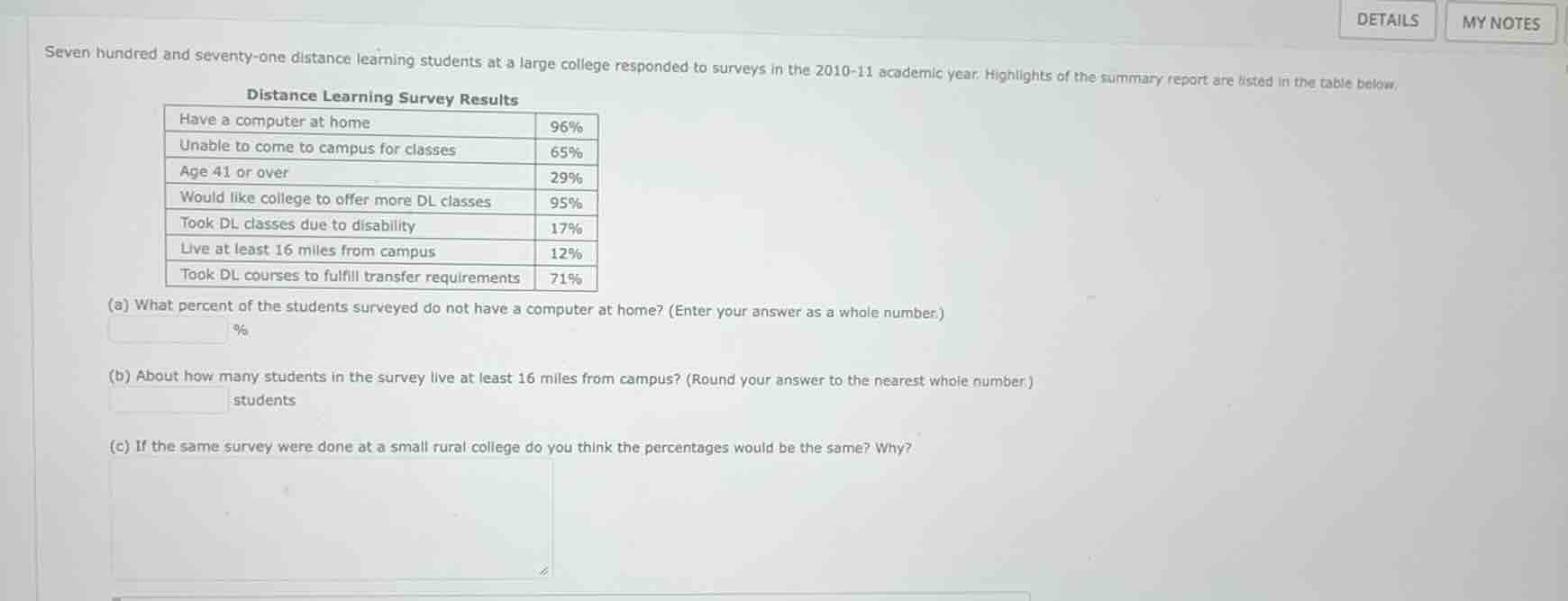
seven hundred and seventy - one distance learning students at a large college responded to surveys in the 2010 - 11 academic year. highlights of the summary report are listed in the table below.
distance learning survey results
| have a computer at home | 96% |
|---|---|
| age 41 or over | 29% |
| would like college to offer more dl classes | 95% |
| took dl classes due to disability | 17% |
| live at least 16 miles from campus | 12% |
| took dl courses to fulfill transfer requirements | 71% |
(a) what percent of the students surveyed do not have a computer at home? (enter your answer as a whole number.)
%
(b) about how many students in the survey live at least 16 miles from campus? (round your answer to the nearest whole number.)
students
(c) if the same survey were done at a small rural college do you think the percentages would be the same? why?
Part (a)
Step1: Recall total percentage
The total percentage of students is 100%.
Step2: Subtract the percentage with a computer
The percentage of students with a computer at home is 96%. So, the percentage without a computer is $100 - 96 = 4$.
Step1: Identify the total number of students and the percentage
Total number of students, $n = 771$. Percentage of students who live at least 16 miles from campus is 12%.
Step2: Calculate the number of students
Number of students = $n \times \text{percentage} = 771 \times \frac{12}{100} = 771 \times 0.12 = 92.52$. Rounding to the nearest whole number gives 93.
A small rural college likely has different student demographics (e.g., shorter distances from campus, different access to technology, different age groups, different disability rates, and different transfer requirements) compared to a large college. These differences would lead to different percentages for the survey questions. For example, rural students may live closer to campus, so the percentage of students living at least 16 miles from campus would be lower. Also, access to computers or reasons for taking distance learning classes might differ due to the rural setting's unique characteristics (e.g., lower population density, different technological infrastructure).

Snap & solve any problem in the app
Get step-by-step solutions on Sovi AI
Photo-based solutions with guided steps
Explore more problems and detailed explanations
4