QUESTION IMAGE
Question
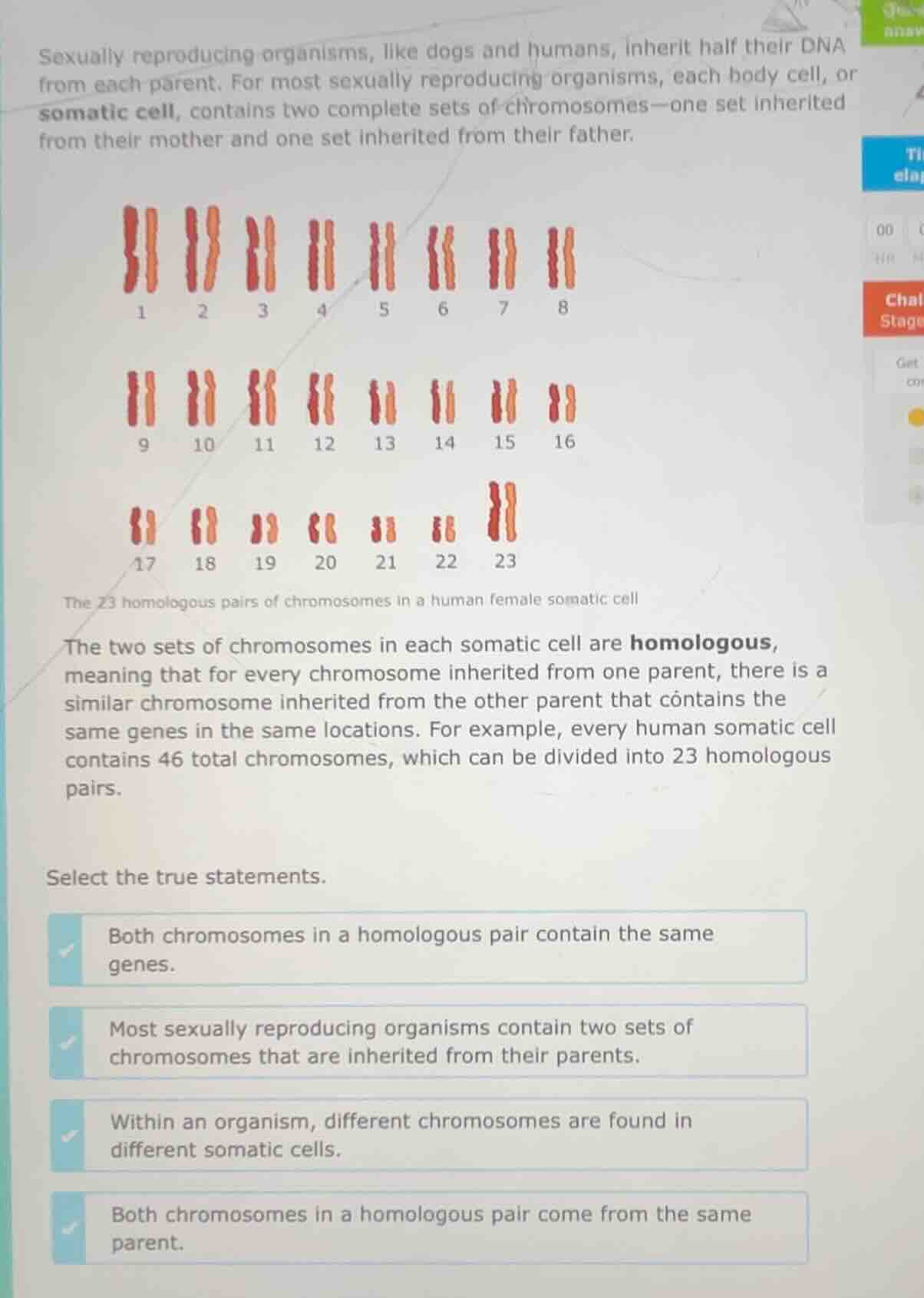
sexually reproducing organisms, like dogs and humans, inherit half their dna from each parent. for most sexually reproducing organisms, each body cell, or somatic cell, contains two complete sets of chromosomes—one set inherited from their mother and one set inherited from their father.
the 23 homologous pairs of chromosomes in a human female somatic cell
the two sets of chromosomes in each somatic cell are homologous, meaning that for every chromosome inherited from one parent, there is a similar chromosome inherited from the other parent that contains the same genes in the same locations. for example, every human somatic cell contains 46 total chromosomes, which can be divided into 23 homologous pairs.
select the true statements.
both chromosomes in a homologous pair contain the same genes.
most sexually reproducing organisms contain two sets of chromosomes that are inherited from their parents.
within an organism, different chromosomes are found in different somatic cells.
both chromosomes in a homologous pair come from the same parent.
- The text states homologous chromosomes have the same genes in the same locations, so the first statement is true.
- It specifies most sexually reproducing organisms inherit one set of chromosomes from each parent (two total sets), so the second statement is true.
- All somatic cells in an organism have the same chromosome set, so the third statement is false.
- Homologous pairs consist of one chromosome from each parent, not the same parent, so the fourth statement is false.

Snap & solve any problem in the app
Get step-by-step solutions on Sovi AI
Photo-based solutions with guided steps
Explore more problems and detailed explanations
A. Both chromosomes in a homologous pair contain the same genes.
B. Most sexually reproducing organisms contain two sets of chromosomes that are inherited from their parents.