QUESTION IMAGE
Question
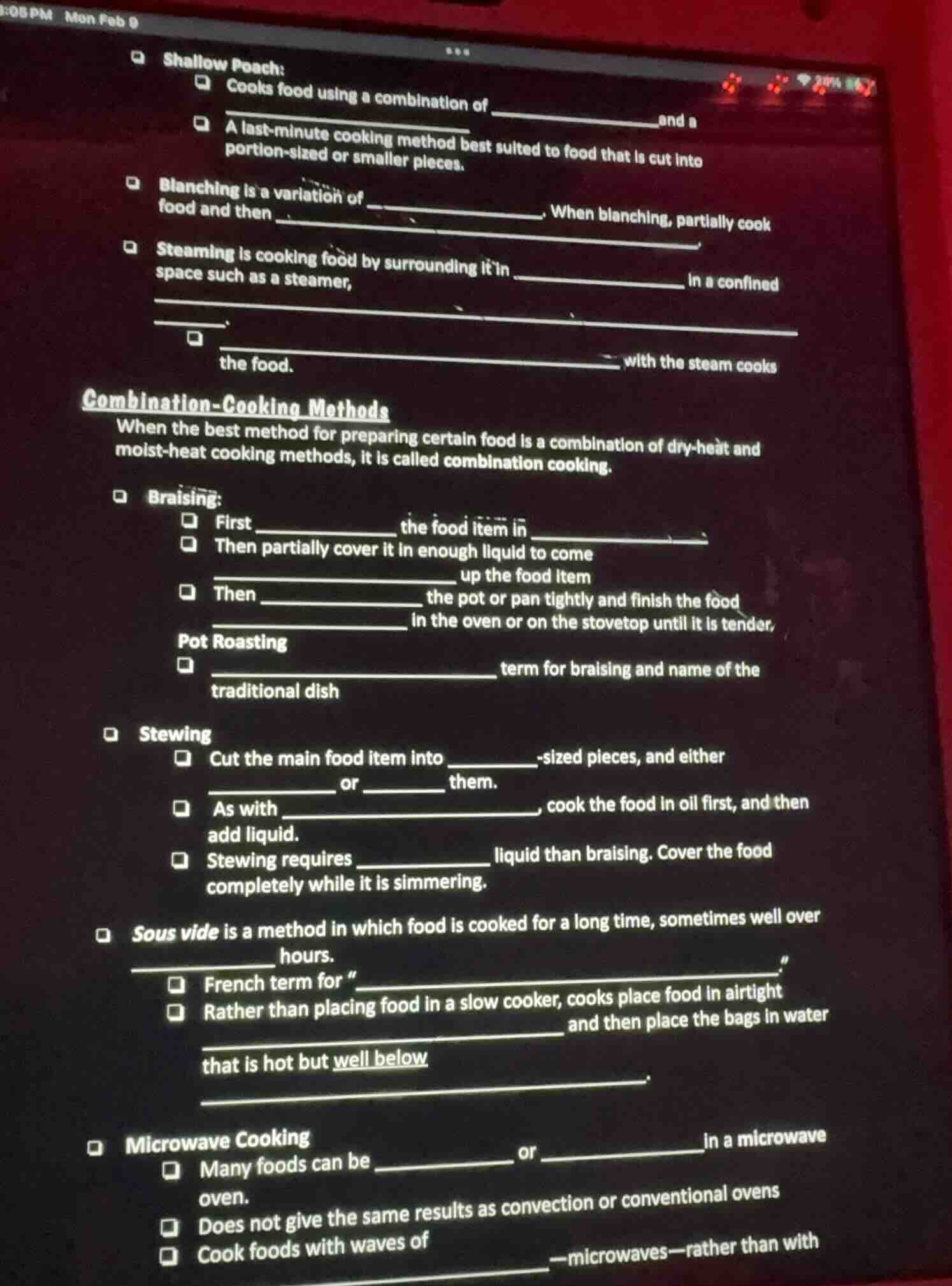
shallow poach:cooks food using a combination of _____________and aa last-minute cooking method best suited to food that is cut intoportion-sized or smaller pieces.blanching is a variation of ___________food. when blanching, partially cookfood and then ___________,steaming is cooking food by surrounding it in ___________in a confinedspace such as a steamer,___________with the steam cooksthe food.combination-cooking methodswhen the best method for preparing certain food is a combination of dry-heat andmoist-heat cooking methods, it is called combination cooking.braising:first ___________the food item in ___________,then partially cover it in enough liquid to come___________up the food itemthen ___________the pot or pan tightly and finish the food___________in the oven or on the stovetop until it is tender,pot roasting___________term for braising and name of thetraditional dishstewingcut the main food item into ___________-sized pieces, and either___________or ___________them.as with ___________, cook the food in oil first, and thenadd liquid.stewing requires ___________liquid than braising. cover the foodcompletely while it is simmering.sous vide is a method in which food is cooked for a long time, sometimes well over___________hours.french term for \_____________
ather than placing food in a slow cooker, cooks place food in airtight_____________and then place the bags in waterthat is hot but well below___________.microwave cookingmany foods can be ___________or ___________in a microwaveoven.does not give the same results as convection or conventional ovenscook foods with waves of_____________—microwaves—rather than with
These are fill-in-the-blank questions about culinary cooking methods, with answers based on standard professional cooking knowledge:
- Shallow Poach uses hot liquid and steam, and is for small portions.
- Blanching is a variation of boiling, followed by shocking in ice water.
- Steaming uses hot/boiling steam; the heat from steam cooks food.
- Braising first sears food in fat, uses liquid to cover part of the food, then covers the pot to cook until tender.
- Pot roasting is an American term for braising.
- Stewing uses bite-sized pieces, which can be browned or blanched; it follows braising's initial fat cook, and uses more liquid than braising.
- Sous vide cooks food for over 24 hours, is French for "under vacuum", uses sealed plastic bags, and cooks below boiling temperature (212°F/100°C).
- Microwaves can reheat or cook food, using electromagnetic radiation.

Snap & solve any problem in the app
Get step-by-step solutions on Sovi AI
Photo-based solutions with guided steps
Explore more problems and detailed explanations
- Shallow Poach:
- Cooks food using a combination of hot liquid and a small amount of steam
- Blanching:
- Blanching is a variation of boiling food. When blanching, partially cook food and then shock it in ice water
- Steaming:
- Steaming is cooking food by surrounding it in hot/boiling steam in a confined space such as a steamer;
- The heat with the steam cooks the food.
- Braising:
- First sear the food item in hot fat/oil
- Then partially cover it in enough liquid to come halfway up the food item
- Then cover the pot or pan tightly and finish the food slowly in the oven or on the stovetop until it is tender
- Pot Roasting:
- An American term for braising and name of the traditional dish
- Stewing:
- Cut the main food item into bite-sized pieces, and either brown or blanch them
- As with braising, cook the food in oil first, and then add liquid
- Stewing requires more liquid than braising. Cover the food completely while it is simmering
- Sous vide:
- Sous vide is a method in which food is cooked for a long time, sometimes well over 24 hours
- French term for "under vacuum"
- Rather than placing food in a slow cooker, cooks place food in airtight plastic bags and then place the bags in water that is hot but well below boiling temperature (212°F/100°C)
- Microwave Cooking:
- Many foods can be reheated or cooked in a microwave oven
- Cook foods with waves of electromagnetic radiation—microwaves—rather than with direct heat