QUESTION IMAGE
Question
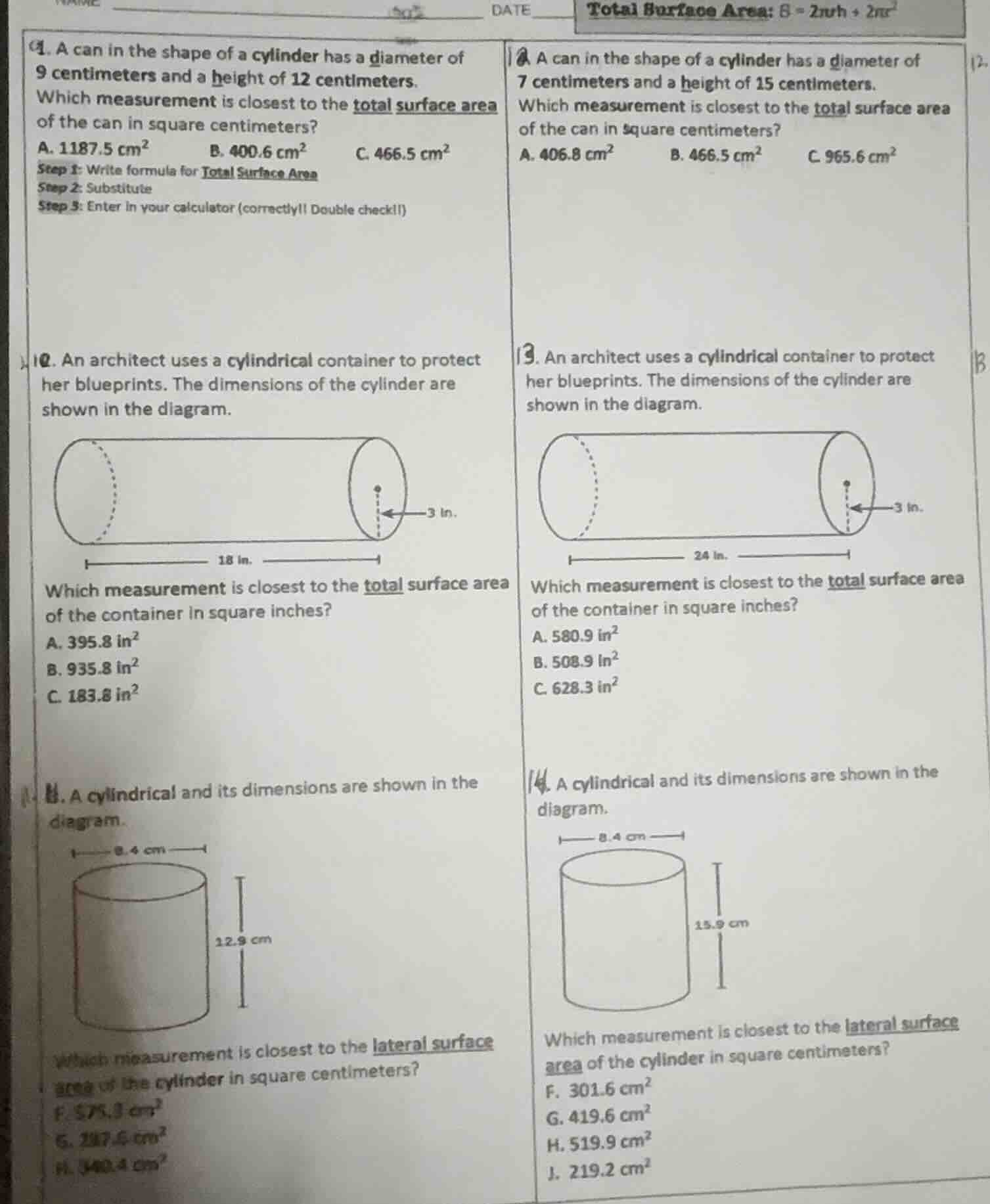
- a can in the shape of a cylinder has a diameter of 9 centimeters and a height of 12 centimeters. which measurement is closest to the total surface area of the can in square centimeters? a. 1187.5 cm² b. 400.6 cm² c. 466.5 cm² step 1: write formula for total surface area step 2: substitute step 3: enter in your calculator (correctly!! double check!!) 2. a can in the shape of a cylinder has a diameter of 7 centimeters and a height of 15 centimeters. which measurement is closest to the total surface area of the can in square centimeters? a. 406.8 cm² b. 466.5 cm² c. 965.6 cm² 10. an architect uses a cylindrical container to protect her blueprints. the dimensions of the cylinder are shown in the diagram. diagram of cylinder with radius 3 in, height 18 in which measurement is closest to the total surface area of the container in square inches? a. 395.8 in² b. 935.8 in² c. 183.8 in² 13. an architect uses a cylindrical container to protect her blueprints. the dimensions of the cylinder are shown in the diagram. diagram of cylinder with radius 3 in, height 24 in which measurement is closest to the total surface area of the container in square inches? a. 580.9 in² b. 508.9 in² c. 628.3 in² 11. a cylindrical object and its dimensions are shown in the diagram. diagram of cylinder with diameter 8.4 cm, height 12.9 cm which measurement is closest to the lateral surface area of the cylinder in square centimeters? f. 376.3 cm² g. 287.6 cm² h. 340.4 cm² 14. a cylindrical object and its dimensions are shown in the diagram. diagram of cylinder with diameter 8.4 cm, height 15.9 cm which measurement is closest to the lateral surface area of the cylinder in square centimeters? f. 301.6 cm² g. 419.6 cm² h. 519.9 cm² j. 219.2 cm²
Question 1
Step 1: Recall the formula for the total surface area of a cylinder.
The formula for the total surface area \( S \) of a cylinder is \( S = 2\pi rh + 2\pi r^2 \), where \( r \) is the radius and \( h \) is the height. Given the diameter \( d = 9 \) cm, the radius \( r=\frac{d}{2}=\frac{9}{2} = 4.5 \) cm and height \( h = 12 \) cm.
Step 2: Substitute the values into the formula.
First, calculate \( 2\pi rh \): \( 2\times\pi\times4.5\times12=108\pi \)
Then, calculate \( 2\pi r^2 \): \( 2\times\pi\times(4.5)^2=2\times\pi\times20.25 = 40.5\pi \)
Now, add these two parts together: \( S=108\pi + 40.5\pi=148.5\pi \)
Step 3: Calculate the numerical value.
Using \( \pi\approx3.14 \), we have \( 148.5\times3.14 = 148.5\times3+148.5\times0.14=445.5 + 20.79 = 466.29\approx466.5 \) \( \text{cm}^2 \)
Step 1: Recall the formula for the total surface area of a cylinder.
The formula for the total surface area \( S \) of a cylinder is \( S = 2\pi rh + 2\pi r^2 \), where \( r \) is the radius and \( h \) is the height. Given the diameter \( d = 7 \) cm, the radius \( r=\frac{d}{2}=\frac{7}{2}=3.5 \) cm and height \( h = 15 \) cm.
Step 2: Substitute the values into the formula.
First, calculate \( 2\pi rh \): \( 2\times\pi\times3.5\times15 = 105\pi \)
Then, calculate \( 2\pi r^2 \): \( 2\times\pi\times(3.5)^2=2\times\pi\times12.25 = 24.5\pi \)
Now, add these two parts together: \( S = 105\pi+24.5\pi=129.5\pi \)
Step 3: Calculate the numerical value.
Using \( \pi\approx3.14 \), we have \( 129.5\times3.14=129.5\times3 + 129.5\times0.14 = 388.5+18.13 = 406.63\approx406.8 \) \( \text{cm}^2 \)
Step 1: Recall the formula for the total surface area of a cylinder.
The formula for the total surface area \( S \) of a cylinder is \( S = 2\pi rh + 2\pi r^2 \), where \( r = 3 \) in (given) and \( h = 18 \) in.
Step 2: Substitute the values into the formula.
First, calculate \( 2\pi rh \): \( 2\times\pi\times3\times18=108\pi \)
Then, calculate \( 2\pi r^2 \): \( 2\times\pi\times(3)^2=2\times\pi\times9 = 18\pi \)
Now, add these two parts together: \( S=108\pi + 18\pi = 126\pi \)
Step 3: Calculate the numerical value.
Using \( \pi\approx3.14 \), we have \( 126\times3.14=395.64\approx395.8 \) \( \text{in}^2 \)

Snap & solve any problem in the app
Get step-by-step solutions on Sovi AI
Photo-based solutions with guided steps
Explore more problems and detailed explanations
C. \( 466.5 \text{ cm}^2 \)