QUESTION IMAGE
Question
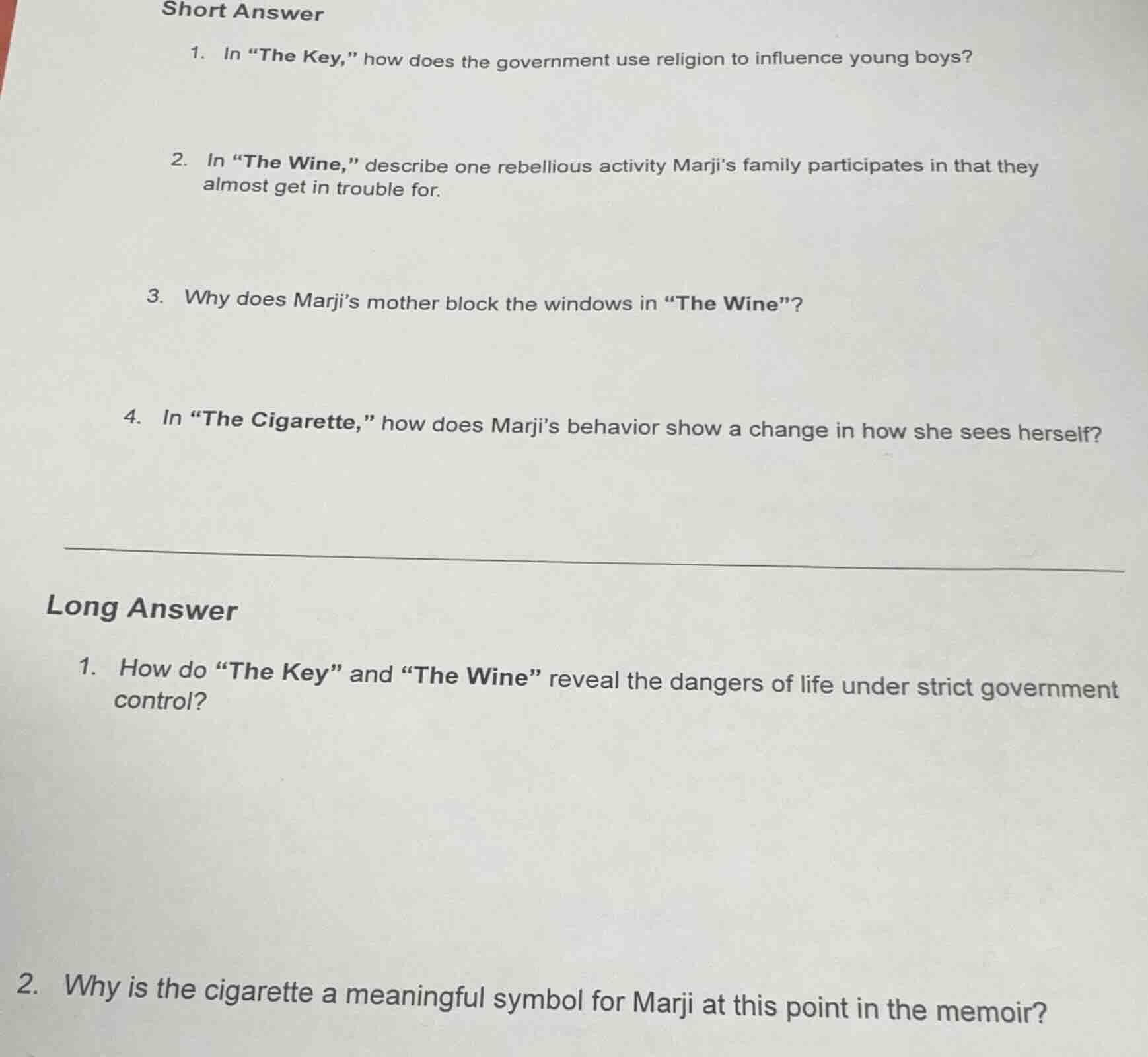
short answer
- in \the key,\ how does the government use religion to influence young boys?
- in \the wine,\ describe one rebellious activity marjis family participates in that they almost get in trouble for.
- why does marjis mother block the windows in \the wine\?
- in \the cigarette,\ how does marjis behavior show a change in how she sees herself?
long answer
- how do \the key\ and \the wine\ reveal the dangers of life under strict government control?
- why is the cigarette a meaningful symbol for marji at this point in the memoir?
Short Answer 1:
The government distributes golden keys to young boys, framing them as a "key to paradise" that the boys will receive if they die fighting in the war. They use religious rhetoric to convince the boys (and their families) that sacrificing their lives for the state will grant them eternal salvation, manipulating their faith to drive them into combat.
Short Answer 2:
Marji's father makes homemade wine, which is strictly banned under the Islamic government's rules. One night, when Islamic morality police nearly search their home, the family frantically tries to hide the wine, risking severe punishment if caught.
Short Answer 3:
Marji's mother blocks the windows to prevent the Islamic morality police from seeing the family drinking the forbidden homemade wine inside their home, avoiding arrest or harsh penalties.
Short Answer 4:
Marji buys and smokes a cigarette, deliberately defying her mother's rules and the government's strict social codes. This act is her way of asserting that she is no longer a child, but a mature, independent person who can make her own choices, even rebellious ones.
Long Answer 1:
In "The Key," the government's manipulation of religion to send children to their deaths exposes the danger of authoritarian regimes exploiting ideology to sacrifice vulnerable people—young boys are tricked into dying for a false religious promise, with no regard for their lives or their families' grief. In "The Wine," the family's need to hide a simple, personal pleasure (drinking wine) and their fear of the morality police shows how strict control erodes personal freedom and forces people to live in constant fear of punishment for minor, harmless acts. Together, the sections reveal that strict government control threatens both physical safety (through forced conscription and violence) and emotional/psychological well-being (through fear, repression, and the destruction of personal autonomy).
Long Answer 2:
The cigarette is a symbol of Marji's desperate bid to claim adulthood and independence. After feeling powerless amid the war, her family's struggles, and the strict social rules, smoking the cigarette is her deliberate act of rebellion against both her parents' authority and the oppressive regime. She sees it as a ritual that proves she is no longer a child, but someone who can make her own choices and resist the constraints placed on her. It also represents her attempt to cope with the trauma and confusion of her environment by clinging to a small, tangible act of self-determination.

Snap & solve any problem in the app
Get step-by-step solutions on Sovi AI
Photo-based solutions with guided steps
Explore more problems and detailed explanations
Short Answer:
- The government gives young boys golden keys, telling them the keys will grant them entry to paradise if they die fighting in the war, using religious promises to manipulate them into enlisting and sacrificing their lives.
- Marji's father makes homemade wine (a banned substance). When Islamic morality police come to their building, the family panics to hide the wine, nearly getting caught and facing severe punishment.
- She blocks the windows to stop the morality police from seeing the family drinking forbidden homemade wine, avoiding arrest or harsh legal consequences.
- Marji smokes a cigarette to deliberately rebel against rules, asserting she is no longer a child but an independent, mature person who can make her own choices.
Long Answer:
- "The Key" shows the physical danger of strict control: the government exploits religious faith to trick young boys into dying in the war, treating children as disposable tools for state goals and destroying families. "The Wine" exposes the constant, oppressive fear of everyday life: the family must hide a small, personal pleasure (drinking wine) to avoid brutal punishment, showing how authoritarian control erodes personal freedom and forces people to live in constant anxiety. Together, they reveal that strict government control threatens both physical safety and basic human dignity, stripping people of autonomy and forcing them to choose between compliance and risking harm.
- The cigarette is a meaningful symbol of Marji's struggle to claim adulthood and autonomy amid trauma and oppression. After feeling powerless due to the war, strict social rules, and family conflict, smoking the cigarette is her deliberate act of rebellion against both parental authority and the regime's constraints. She views it as a ritual that marks her transition from child to adult, a small but powerful way to take control of her identity and resist the forces that seek to limit her. It also symbolizes her attempt to cope with the confusion and pain of her environment by clinging to a tangible act of self-determination.