QUESTION IMAGE
Question
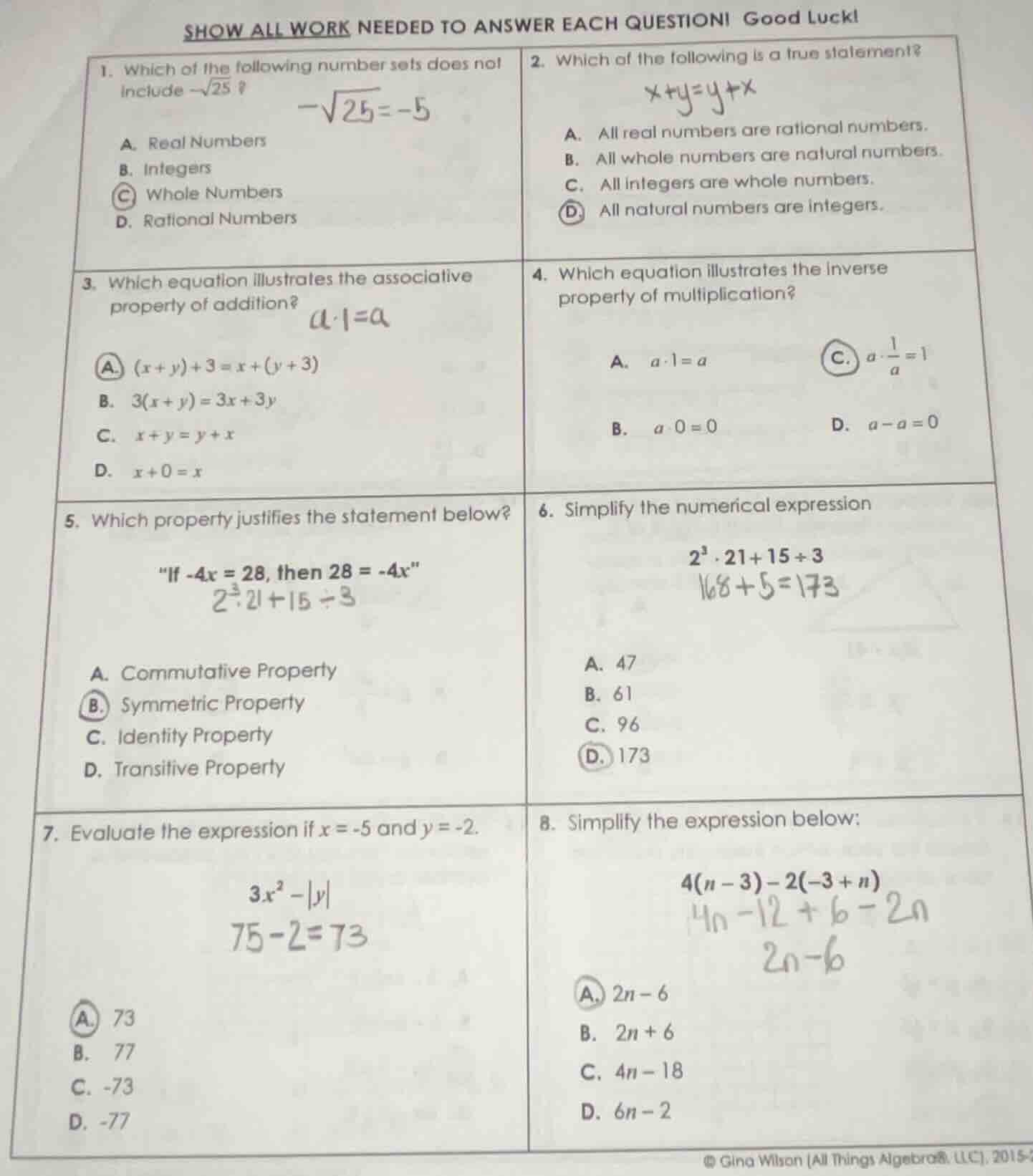
show all work needed to answer each question! good luck!
- which of the following number sets does not include $-sqrt{25}$?
a. real numbers
b. integers
c. whole numbers
d. rational numbers
- which of the following is a true statement?
a. all real numbers are rational numbers.
b. all whole numbers are natural numbers.
c. all integers are whole numbers.
d. all natural numbers are integers.
- which equation illustrates the associative property of addition?
a. $(x + y) + 3 = x + (y + 3)$
b. $3(x + y) = 3x + 3y$
c. $x + y = y + x$
d. $x + 0 = x$
- which equation illustrates the inverse property of multiplication?
a. $a cdot 1 = a$
b. $a cdot 0 = 0$
c. $a cdot \frac{1}{a} = 1$
d. $a - a = 0$
- which property justifies the statement below?
\if $-4x = 28$, then $28 = -4x$\
a. commutative property
b. symmetric property
c. identity property
d. transitive property
- simplify the numerical expression $2^3 cdot 21 + 15 div 3$
a. 47
b. 61
c. 96
d. 173
- evaluate the expression if $x = -5$ and $y = -2$.
$3x^2 - |y|$
a. 73
b. 77
c. -73
d. -77
- simplify the expression below:
$4(n - 3) - 2(-3 + n)$
a. $2n - 6$
b. $2n + 6$
c. $4n - 18$
d. $6n - 2$
Question 1
Step1: Simplify \(-\sqrt{25}\)
\(-\sqrt{25} = - 5\)
Step2: Analyze each number set
- Real Numbers: Include all rational and irrational numbers, \(-5\) is real.
- Integers: Include whole numbers and their negatives, \(-5\) is an integer.
- Whole Numbers: Start from \(0,1,2,\dots\), \(-5\) is not a whole number.
- Rational Numbers: Numbers that can be written as \(\frac{p}{q}\) (\(q
eq0\)), \(-5=\frac{-5}{1}\) is rational.
- Option A: Real numbers include irrational numbers (e.g., \(\sqrt{2}\)) which are not rational, so A is false.
- Option B: Whole numbers include \(0\), natural numbers start from \(1\), so \(0\) is a whole number but not a natural number, B is false.
- Option C: Integers include negative numbers (e.g., \(-1\)) which are not whole numbers, C is false.
- Option D: Natural numbers (\(1,2,3,\dots\)) are all integers, D is true.
- Associative property of addition: \((a + b)+c=a+(b + c)\).
- Option A: \((x + y)+3=x+(y + 3)\) follows associative property of addition.
- Option B: \(3(x + y)=3x + 3y\) is distributive property.
- Option C: \(x + y=y + x\) is commutative property of addition.
- Option D: \(x + 0=x\) is identity property of addition.

Snap & solve any problem in the app
Get step-by-step solutions on Sovi AI
Photo-based solutions with guided steps
Explore more problems and detailed explanations
C. Whole Numbers