QUESTION IMAGE
Question
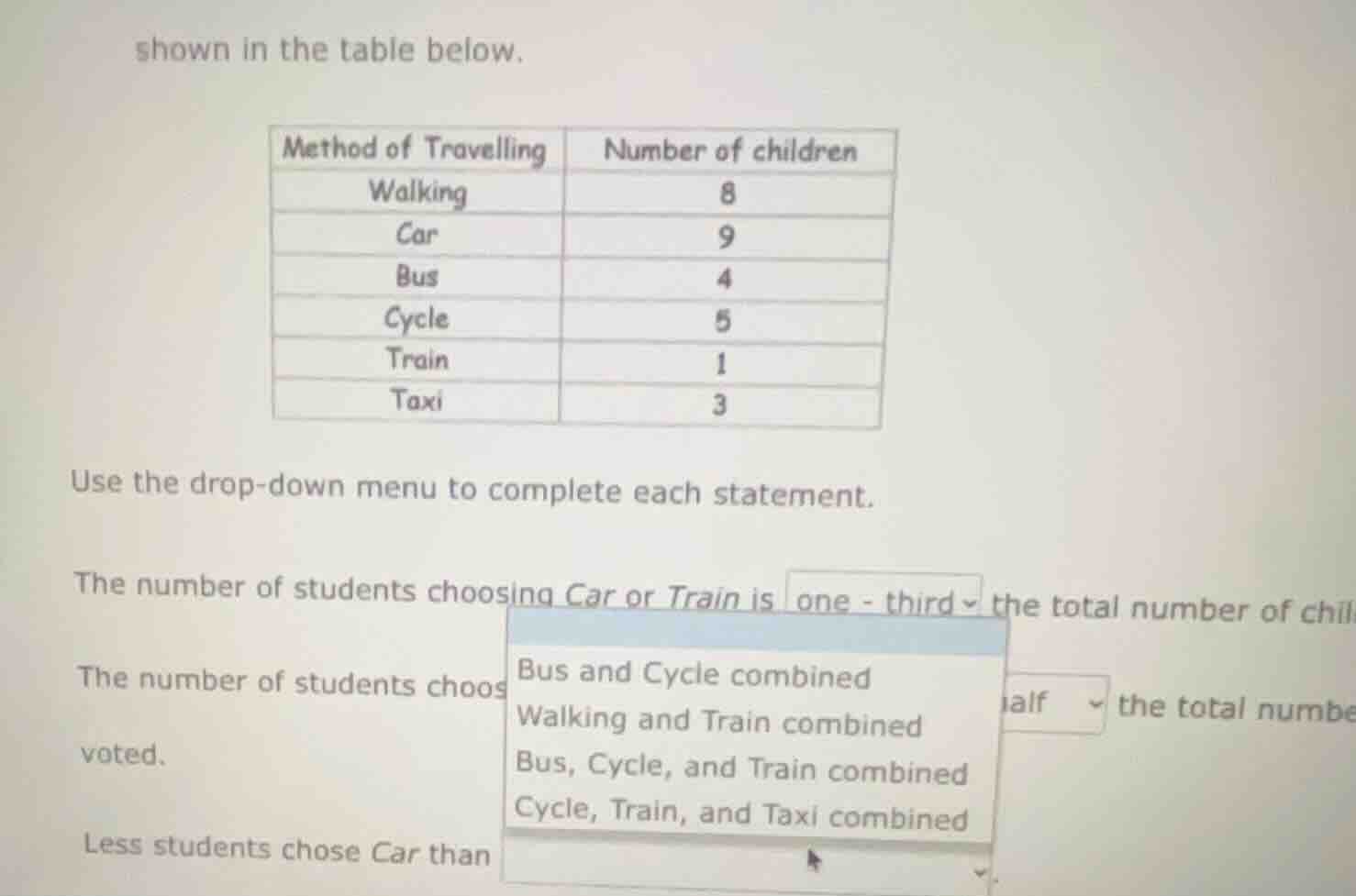
shown in the table below.
| method of travelling | number of children |
|---|---|
| car | 9 |
| bus | 4 |
| cycle | 5 |
| train | 1 |
| taxi | 3 |
use the drop - down menu to complete each statement.
the number of students choosing car or train is one - third the total number of chil
the number of students choos voted.
less students chose car than
(the drop - down menu options are: bus and cycle combined; walking and train combined; bus, cycle, and train combined; cycle, train, and taxi combined)
To solve this, we first calculate the total number of children:
- Walking: \( 8 \), Car: \( 9 \), Bus: \( 4 \), Cycle: \( 5 \), Train: \( 1 \), Taxi: \( 3 \)
- Total \( = 8 + 9 + 4 + 5 + 1 + 3 = 30 \)
First Statement:
Number of students choosing Car or Train: \( 9 + 1 = 10 \)
Check the fraction: \( \frac{10}{30} = \frac{1}{3} \) (one - third), so this part is consistent.
Second Statement (Incomplete, but let’s analyze the drop - down for “Less students chose Car than”):
Number of children who chose Car: \( 9 \)
- Bus and Cycle combined: \( 4 + 5 = 9 \) (not less, equal)
- Walking and Train combined: \( 8 + 1 = 9 \) (not less, equal)
- Bus, Cycle, and Train combined: \( 4 + 5 + 1 = 10 \) ( \( 10>9 \), so less students chose Car than this)
- Cycle, Train, and Taxi combined: \( 5 + 1 + 3 = 9 \) (not less, equal)
For the “Less students chose Car than” part, the correct option from the drop - down is “Bus, Cycle, and Train combined” because \( 9 < 10 \).
(Note: If the second statement was about a different comparison, adjust based on full context, but from the drop - down and Car’s count \( 9 \), the above is the logical choice.)
For the first statement, “one - third” is correct as \( \frac{10}{30}=\frac{1}{3} \).
Final Answers (for the visible parts):
- The number of students choosing Car or Train is \(\boldsymbol{\text{one - third}}\) the total.
- Less students chose Car than \(\boldsymbol{\text{Bus, Cycle, and Train combined}}\).

Snap & solve any problem in the app
Get step-by-step solutions on Sovi AI
Photo-based solutions with guided steps
Explore more problems and detailed explanations
To solve this, we first calculate the total number of children:
- Walking: \( 8 \), Car: \( 9 \), Bus: \( 4 \), Cycle: \( 5 \), Train: \( 1 \), Taxi: \( 3 \)
- Total \( = 8 + 9 + 4 + 5 + 1 + 3 = 30 \)
First Statement:
Number of students choosing Car or Train: \( 9 + 1 = 10 \)
Check the fraction: \( \frac{10}{30} = \frac{1}{3} \) (one - third), so this part is consistent.
Second Statement (Incomplete, but let’s analyze the drop - down for “Less students chose Car than”):
Number of children who chose Car: \( 9 \)
- Bus and Cycle combined: \( 4 + 5 = 9 \) (not less, equal)
- Walking and Train combined: \( 8 + 1 = 9 \) (not less, equal)
- Bus, Cycle, and Train combined: \( 4 + 5 + 1 = 10 \) ( \( 10>9 \), so less students chose Car than this)
- Cycle, Train, and Taxi combined: \( 5 + 1 + 3 = 9 \) (not less, equal)
For the “Less students chose Car than” part, the correct option from the drop - down is “Bus, Cycle, and Train combined” because \( 9 < 10 \).
(Note: If the second statement was about a different comparison, adjust based on full context, but from the drop - down and Car’s count \( 9 \), the above is the logical choice.)
For the first statement, “one - third” is correct as \( \frac{10}{30}=\frac{1}{3} \).
Final Answers (for the visible parts):
- The number of students choosing Car or Train is \(\boldsymbol{\text{one - third}}\) the total.
- Less students chose Car than \(\boldsymbol{\text{Bus, Cycle, and Train combined}}\).