QUESTION IMAGE
Question
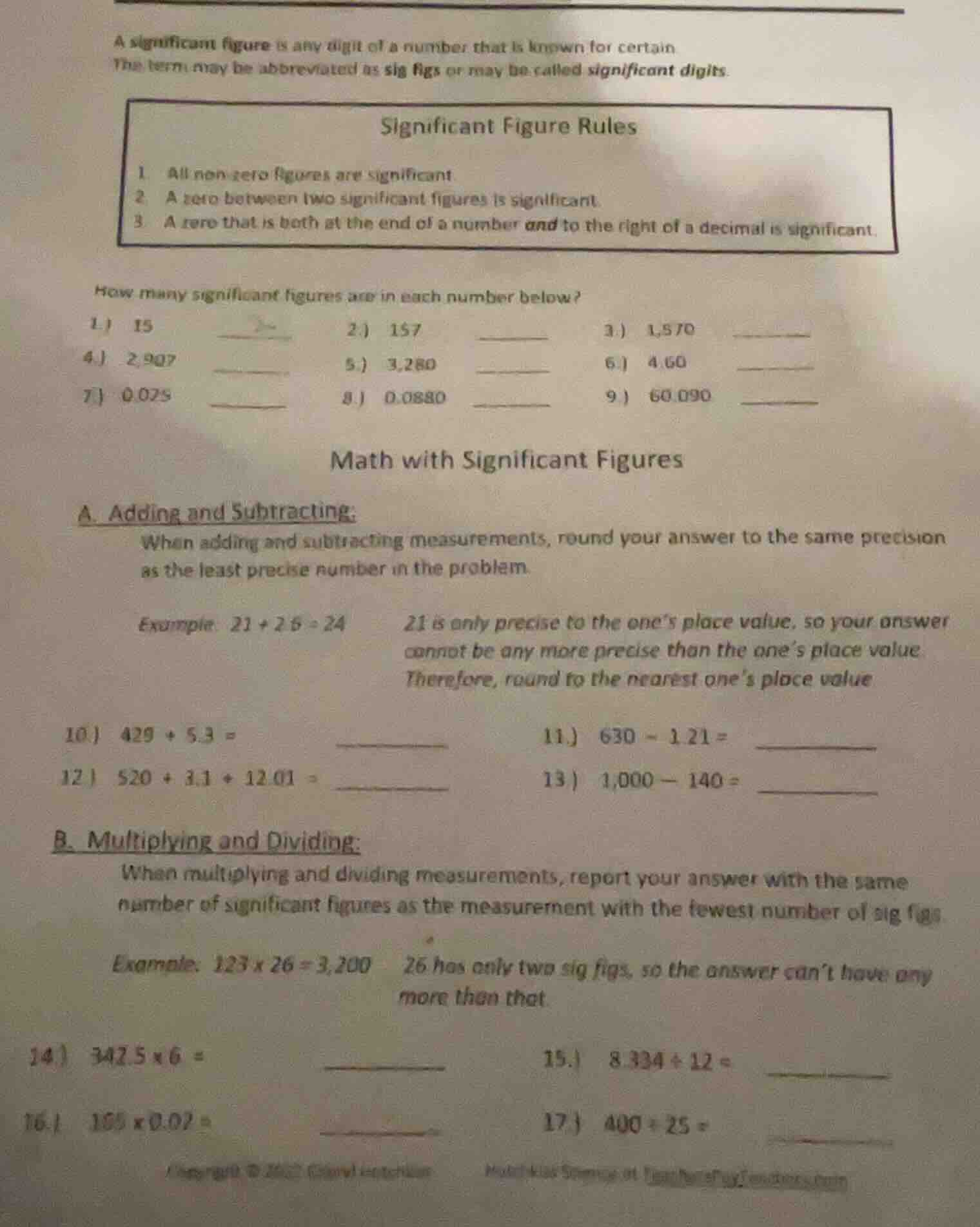
a significant figure is any digit of a number that is known for certain
the term may be abbreviated as sig figs or may be called significant digits.
significant figure rules
- all non - zero figures are significant.
- a zero between two significant figures is significant.
- a zero that is both at the end of a number and to the right of a decimal is significant.
how many significant figures are in each number below?
1.) 15
2.) 157
3.) 1,570
4.) 2,907
5.) 3,280
6.) 4.60
7.) 0.075
8.) 0.0880
9.) 60.090
math with significant figures
a. adding and subtracting:
when adding and subtracting measurements, round your answer to the same precision
as the least precise number in the problem.
example: 21 + 2.6 = 24 21 is only precise to the one’s place value, so your answer
cannot be any more precise than the one’s place value.
therefore, round to the nearest one’s place value
10.) 429 + 5.3 =
11.) 630 - 1.21 =
12.) 520 + 3.1 + 12.01 =
13.) 1,000 - 140 =
b. multiplying and dividing:
when multiplying and dividing measurements, report your answer with the same
number of significant figures as the measurement with the fewest number of sig figs.
example: 123×26 = 3,200 26 has only two sig figs, so the answer can’t have any
more than that.
14.) 342.5×6 =
15.) 8.334÷12 =
16.) 165×0.02 =
17.) 400÷25 =
Step1: Count sig figs for 15
Non-zeros are significant: $2$
Step2: Count sig figs for 157
Non-zeros are significant: $3$
Step3: Count sig figs for 1,570
Non-zeros + trailing zero (no decimal): $3$
Step4: Count sig figs for 2,907
Non-zeros + trapped zero: $4$
Step5: Count sig figs for 3,280
Non-zeros + trailing zero (no decimal): $3$
Step6: Count sig figs for 4.60
Non-zeros + trailing decimal zero: $3$
Step7: Count sig figs for 0.029
Leading zeros ignored, non-zeros count: $2$
Step8: Count sig figs for 0.0880
Leading zeros ignored, non-zeros + trailing decimal zero: $3$
Step9: Count sig figs for 60.090
Non-zeros + trapped zeros + trailing decimal zero: $5$
Step10: Add 429 + 5.3
Round to ones place (least precise): $429 + 5.3 = 434.3
ightarrow 434$
Step11: Subtract 630 - 1.21
Round to ones place (least precise): $630 - 1.21 = 628.79
ightarrow 629$
Step12: Add 520 + 3.1 + 12.01
Round to ones place (least precise): $520 + 3.1 + 12.01 = 535.11
ightarrow 535$
Step13: Subtract 1,000 - 140
Round to hundreds place (least precise): $1000 - 140 = 860
ightarrow 900$
Step14: Multiply 342.5 × 6
1 sig fig (from 6): $342.5 \times 6 = 2055
ightarrow 2000$
Step15: Divide 8.334 ÷ 12
2 sig figs (from 12): $8.334 \div 12 = 0.6945
ightarrow 0.69$
Step16: Multiply 165 × 0.02
1 sig fig (from 0.02): $165 \times 0.02 = 3.3
ightarrow 3$
Step17: Divide 400 ÷ 25
2 sig figs (from 25): $400 \div 25 = 16
ightarrow 16$

Snap & solve any problem in the app
Get step-by-step solutions on Sovi AI
Photo-based solutions with guided steps
Explore more problems and detailed explanations
1.) 2
2.) 3
3.) 3
4.) 4
5.) 3
6.) 3
7.) 2
8.) 3
9.) 5
10.) 434
11.) 629
12.) 535
13.) 900
14.) 2000
15.) 0.69
16.) 3
17.) 16