QUESTION IMAGE
Question
a similarity transformation is a composition of one or more rigid motions and a dilation. if a similarity transformation maps one figure to another, then the figures are similar.
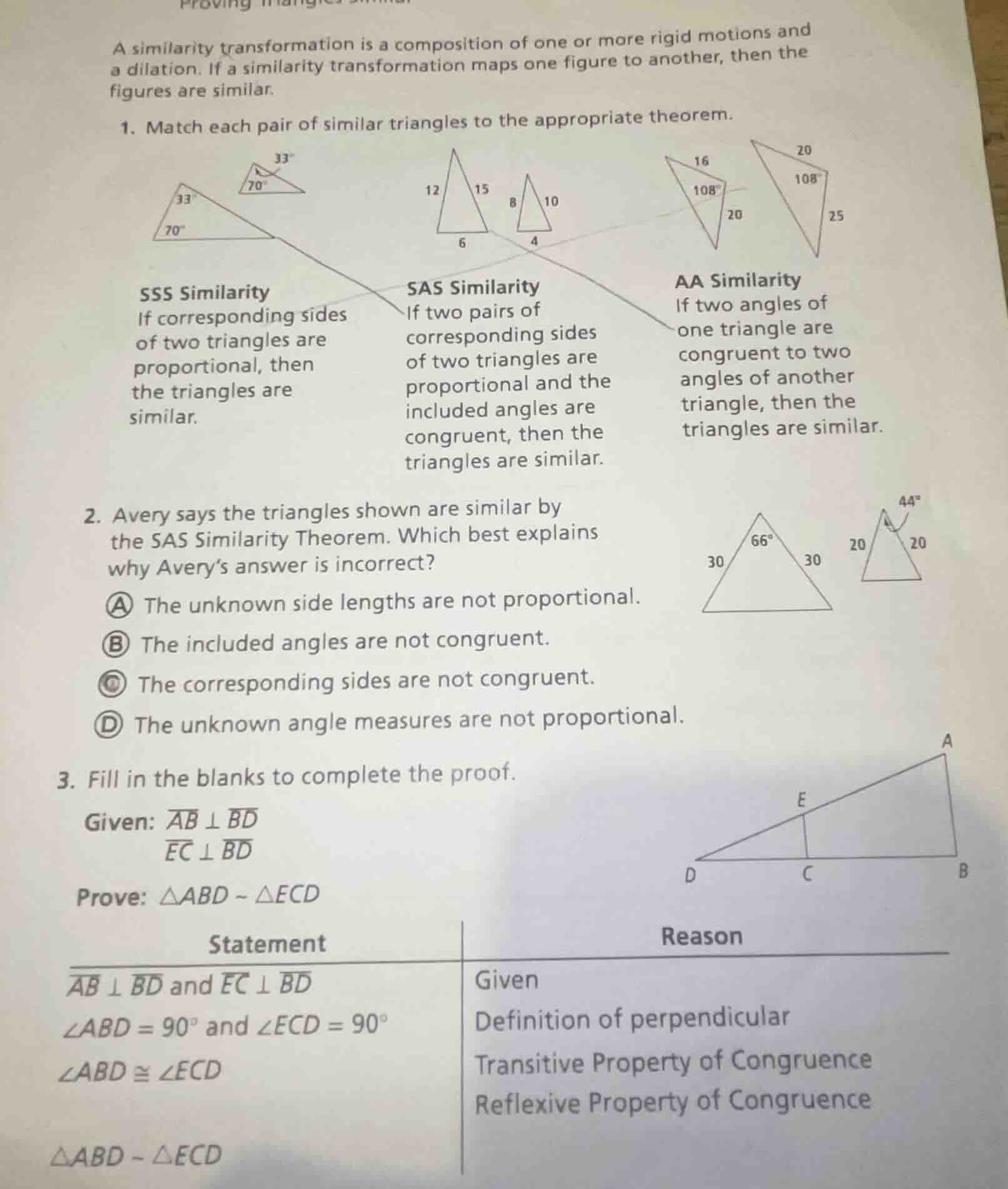
- match each pair of similar triangles to the appropriate theorem.
sss similarity
if corresponding sides of two triangles are proportional, then the triangles are similar.
sas similarity
if two pairs of corresponding sides of two triangles are proportional and the included angles are congruent, then the triangles are similar.
aa similarity
if two angles of one triangle are congruent to two angles of another triangle, then the triangles are similar.
- avery says the triangles shown are similar by the sas similarity theorem. which best explains why avery’s answer is incorrect?
a the unknown side lengths are not proportional.
b the included angles are not congruent.
c the corresponding sides are not congruent.
d the unknown angle measures are not proportional.
- fill in the blanks to complete the proof.
given: \\(\overline{ab} \perp \overline{bd}\\)
\\(\overline{ec} \perp \overline{bd}\\)
prove: \\(\triangle abd \sim \triangle ecd\\)
statement reason
\\(\overline{ab} \perp \overline{bd}\\) and \\(\overline{ec} \perp \overline{bd}\\) given
\\(\angle abd = 90^\circ\\) and \\(\angle ecd = 90^\circ\\) definition of perpendicular
\\(\angle abd \cong \angle ecd\\) transitive property of congruence
reflexive property of congruence
\\(\triangle abd \sim \triangle ecd\\)
Question 1
Step1: Match AA Similarity
First pair of triangles have two congruent angles ($33^\circ, 70^\circ$), so this matches AA Similarity.
Step2: Match SSS Similarity
Second pair: Check side proportions: $\frac{12}{8}=\frac{15}{10}=\frac{6}{4}=1.5$. All sides proportional, so this matches SSS Similarity.
Step3: Match SAS Similarity
Third pair: $\frac{16}{20}=\frac{20}{25}=0.8$, and the included angle ($108^\circ$) is congruent. So this matches SAS Similarity.
SAS Similarity requires two proportional sides and congruent included angles. First, check side proportions: $\frac{30}{20}=1.5$. Then find the included angles: For the left triangle, the included angle between the two 30-length sides is $66^\circ$. For the right triangle, the included angle between the two 20-length sides is $44^\circ$. These angles are not congruent, so SAS does not apply. Angles are not proportional (they must be congruent for similarity rules), and sides are proportional, so Avery's error is the included angles are not congruent.
Step1: Identify shared angle
$\angle D$ is common to both $\triangle ABD$ and $\triangle ECD$.
<Expression>$\angle D \cong \angle D$</Expression>
Step2: State reason for shared angle
This uses the Reflexive Property of Congruence.
Step3: Apply AA Similarity
We have two pairs of congruent angles: $\angle ABD \cong \angle ECD$ and $\angle D \cong \angle D$. By AA Similarity, the triangles are similar.
<Expression>$\triangle ABD \sim \triangle ECD$</Expression>

Snap & solve any problem in the app
Get step-by-step solutions on Sovi AI
Photo-based solutions with guided steps
Explore more problems and detailed explanations
- Triangles with $33^\circ, 70^\circ$ ↔ AA Similarity
- Triangles with sides 12,15,6 and 8,10,4 ↔ SSS Similarity
- Triangles with sides 16,20 and 20,25 (included $108^\circ$) ↔ SAS Similarity
---