QUESTION IMAGE
Question
similarity transformations
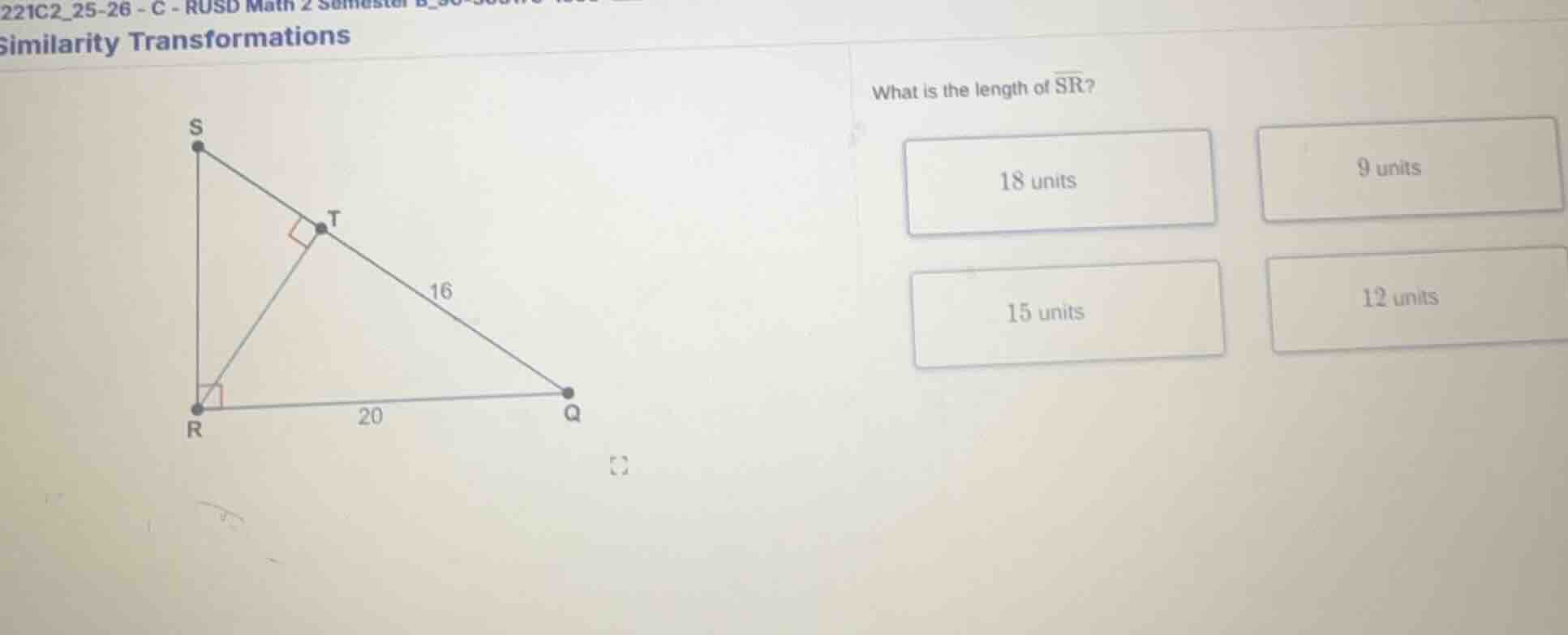
what is the length of \\(\overline{sr}\\)?
18 units
9 units
15 units
12 units
Step1: Identify similar triangles
In right triangle \( \triangle SRQ \) and right triangle \( \triangle QTR \), \( \angle R = \angle T = 90^\circ \) and \( \angle Q \) is common. So, \( \triangle SRQ \sim \triangle QTR \) by AA similarity. Also, \( \triangle SRQ \sim \triangle STR \). From the geometric mean theorem (altitude-on-hypotenuse theorem), we know that \( \frac{SR}{SQ}=\frac{ST}{SR} \) and also \( \frac{QR}{QT}=\frac{QT}{QS} \), but more directly, for right triangle with altitude, \( SR^2 + RQ^2 = SQ^2 \), but also from similar triangles, \( \frac{SR}{QR}=\frac{ST}{RT}=\frac{SQ}{SR} \)? Wait, better to use the geometric mean: in right triangle \( \triangle SRQ \), with altitude \( RT \) (wait, no, \( RT \) is not altitude, \( ST \) is? Wait, the right angles: \( \angle R = 90^\circ \), \( \angle T = 90^\circ \), so \( \triangle SRT \sim \triangle QTR \sim \triangle SRQ \). So by the geometric mean theorem, \( SR^2 = ST \times SQ \)? Wait, no, let's label the segments. Let \( ST = x \), \( TQ = 16 \), \( RQ = 20 \), \( SR = y \), \( SQ = ST + TQ = x + 16 \). In \( \triangle SRQ \), \( y^2 + 20^2 = (x + 16)^2 \). In \( \triangle QTR \), \( 20^2 = 16 \times (x + 16) \) (by geometric mean: leg \( RQ \) is geometric mean of hypotenuse segments \( TQ \) and \( SQ \)). So \( 400 = 16(x + 16) \). Solve for \( x + 16 \): \( x + 16 = \frac{400}{16} = 25 \). So \( SQ = 25 \). Then in \( \triangle SRQ \), \( y^2 + 20^2 = 25^2 \). So \( y^2 = 25^2 - 20^2 = (25 - 20)(25 + 20) = 5 \times 45 = 225 \). So \( y = \sqrt{225} = 15 \)? Wait, no, wait, maybe I mixed up the segments. Wait, \( RQ = 20 \), \( TQ = 16 \), \( SQ = ST + TQ \). Wait, the geometric mean for leg \( RQ \): \( RQ^2 = TQ \times SQ \). So \( 20^2 = 16 \times SQ \). So \( SQ = \frac{400}{16} = 25 \). Then \( SQ = 25 \), so \( ST = SQ - TQ = 25 - 16 = 9 \). Then for leg \( SR \), \( SR^2 = ST \times SQ \)? Wait, no, \( SR^2 = ST \times SQ \)? Wait, no, \( SR^2 = ST \times SQ \) is for the other leg? Wait, no, the geometric mean theorem: in a right triangle, the square of a leg is equal to the product of the hypotenuse and the adjacent segment. So \( SR^2 = ST \times SQ \)? Wait, \( ST \) is the segment of the hypotenuse adjacent to \( SR \), yes! Because \( SR \) is a leg, adjacent to \( ST \) on the hypotenuse \( SQ \). So \( SR^2 = ST \times SQ \). We found \( SQ = 25 \), \( ST = SQ - TQ = 25 - 16 = 9 \). So \( SR^2 = 9 \times 25 = 225 \), so \( SR = \sqrt{225} = 15 \)? Wait, but let's check with Pythagoras: \( SR^2 + RQ^2 = 15^2 + 20^2 = 225 + 400 = 625 = 25^2 = SQ^2 \). Yes, that works. So \( SR = 15 \)? Wait, but the options are 18,9,15,12. So 15 is an option. Wait, but let's recheck. The geometric mean: leg \( RQ \) (20) is geometric mean of \( TQ \) (16) and \( SQ \), so \( 20^2 = 16 \times SQ \implies SQ = 400 / 16 = 25 \). Then leg \( SR \) is geometric mean of \( ST \) (which is \( SQ - TQ = 25 - 16 = 9 \)) and \( SQ \) (25), so \( SR^2 = 9 \times 25 = 225 \implies SR = 15 \). Yes, that's correct.
Step2: Calculate \( SR \)
Using the geometric mean theorem (leg - geometric mean of adjacent hypotenuse segments):
- Find \( SQ \) using \( RQ^2 = TQ \times SQ \):
\( 20^2 = 16 \times SQ \)
\( 400 = 16 \times SQ \)
\( SQ = \frac{400}{16} = 25 \)
- Find \( ST = SQ - TQ = 25 - 16 = 9 \)
- Use \( SR^2 = ST \times SQ \) (geometric mean for leg \( SR \)):
\( SR^2 = 9 \times 25 = 225 \)
\( SR = \sqrt{225} = 15 \)

Snap & solve any problem in the app
Get step-by-step solutions on Sovi AI
Photo-based solutions with guided steps
Explore more problems and detailed explanations
15 units